

Dossier:
not provided by us yet
WelfareCheck:
C (2023-11-08)
Advice:
not provided by us yet
Scientific names (currently not valid)
Engraulis pulchellus, Engraulis tapirulus
English: Peruvian anchoveta
Latin names based on Eschmeyer's
Common names based on Wikipedia


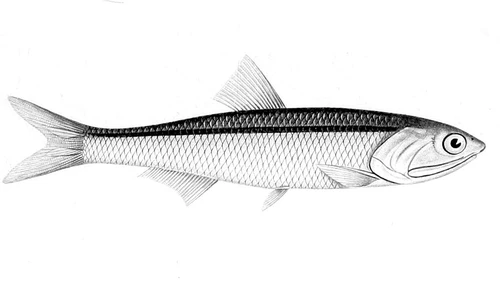
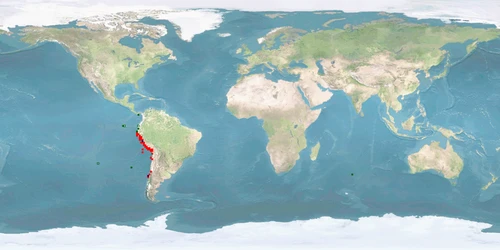
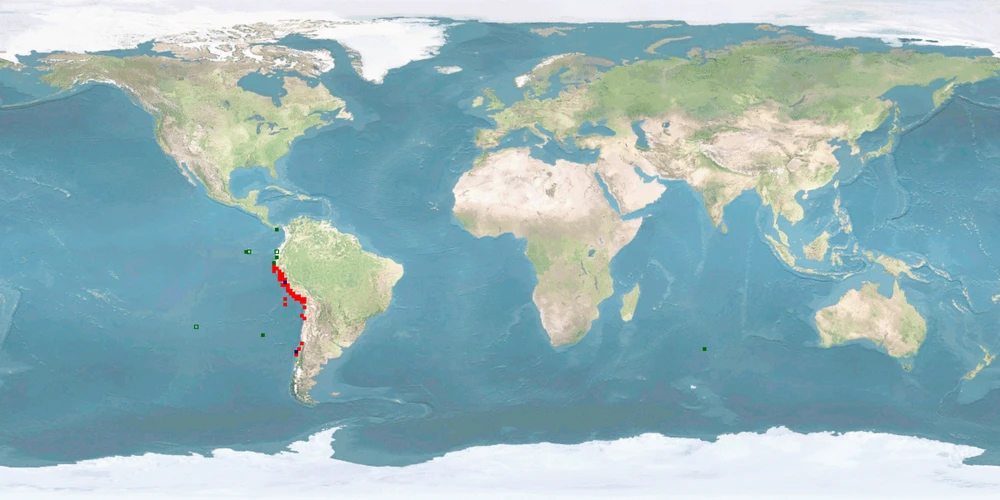
Engraulis ringens is the most heavily targeted single fish species in the oceans. It is distributed along the coasts of Peru and Chile in the immensely productive Humboldt current system, a stream carrying cold water from the Antarctic and upwelling deep and nutrient-rich water to the surface. Here, E. ringens finds the preferred cold water and the preferred prey zooplankton. In years of El Nino and in summer, when warm water spreads, E. ringens migrates closer to the coast to stay in cold water layers. Because E. ringens lives in schools, fishing folks predominantly use purse seining to catch it, which imposes the risk of catching under-sized IND. In fact, the target size entails JUVENILES as well as ADULTS. What concerns bycatch of non-target species, E. ringens is the main prey for some penguins, dolphins, boobies, birds, sea lions, and seals among others. These species are in danger of being accidentally caught by the E. ringens fishery, especially by the wooden (32.6-110 m3 holding capacity) or steel industrial fleet (90-870 m3) which catches E. ringens for fish meal production. The wooden small- (<10 m3) and medium-scale fleet (10-32.6 m3) catches E. ringens for direct human consumption and seldomly causes bycatch of larger species than jellyfish.
Besides the high density inside the purse seine during hauling and especially during crowding causing injuries and stress, E. ringens will be easy prey for adjacent predators. Transfer to the vessel mainly happens via pumps which avoids contact with air, but the arrival on deck or in the storage containers is most likely stressful and may lead to injuries. Further research is needed on welfare hazards and their consequences. E. ringens is brought to land without prior stunning or slaughter. A protocol for both, stunning and slaughter, is urgently needed.
For details see: WelfareCheck | catch (pre-release)
Series 21 of FishEthoGroup's Fish Talk podcast covering species in the fair-fish database is out! It presents a quick look into the lives of Micropterus salmoides (Largemouth bass), Dicentrarchus labrax (European seabass), and Colossoma macropomum (Tambaqui). In around 3 min each, it also covers the main welfare hazards in aquaculture, possible improvements, and the grounds for our welfare assessment.
In another podcast episode, you will learn about the catching method "purse seine" based on our Method profile of it. We combined the information of the four WelfareChecks of Clupea harengus (Atlantic herring), Engraulis ringens (Peruvian anchoveta), Scomber colias (Atlantic chub mackerel), and Scomber scombrus (Atlantic mackerel) – all caught with purse seine – and complemented the Method profile with more general bits of purse seine knowledge.
As usual, you can find these episodes in the respective profiles here in the fair-fish database or over at FishEthoGroup's. While you are there, also check out their podcast programmes "Fish Five" – interviews with renowned scientists in the field of welfare of aquatic species – and "The Fish Mind" – a look into the different capabilites of aquatic species. Tell your friends about it!
In our ongoing effort to make the database more known, we have recently published in "Fishes", a peer-reviewed journal! We are putting a lot of effort into creating WelfareChecks – and now also method profiles – in the fair-fish database. We are applying a comprehensive approach using sources from peer-reviewed papers to grey literature like YouTube videos, university theses, and governmental reports. We do have an internal review process involving experts in our team, but inviting external reviewers has failed in the past. Therefore, the purpose of publishing in scientific journals is to make the fair-fish database known in larger scientific circles and get feedback by the community through the peer-review process.
In this latest paper, we focused on the method profile of "purse seines" on four small pelagic species that are among the most frequently caught worldwide. The review is not only a look into the welfare-relevant data gathered and critically analysed in the fair-fish database; it also offers an overview of a holistic approach suggested to apply this scientific knowledge in practice by involving practitioners, technology, and economic concerns.
Please find the paper in the Fishes journal under the link provided in the beginning – it is open access! Alternatively, feel free to browse our Publications page where you will find this and previously published peer-reviewed papers from our team as well as non-peer-reviewed manuscripts and the profiles published in the fair-fish database.
FishEthoGroup produced new spots of their Fish Talk's podcast programme on species from the fair-fish database. In series 18, you will find around 2 minutes of informative knowledge on Papyrocranus afer (Reticulated knifefish), Barbonymus schwanenfeldii (Tinfoil barb), and Arapaima gigas (Arapaima). For the first time, FishEthoGroup also covered a wild-caught species of our recently launched catch branch: Engraulis ringens (Peruvian anchoveta). And if you cannot get enough, also give their new episode of The Fish Mind programme a listen. In the current season about fish abilities, you may find episodes on memory, tool use, and self recognition. The new episode 4 is all about nest building in fishes. Enjoy and recommend!
The fair-fish database team is proud to launch the catch branch of the database. With this, we effectively enter a new era since our start in 2013. After months of work, we now broadened the scope of the database from aquaculture to fisheries.
What stays the same is our concern for the welfare of aquatic species – although in fisheries, we are aware that the welfare will never be good, as the contact with humans is limited to the final chapter of the species' lifes with the eventual goal to kill the fishes. Still, there are many steps along the catching process which potentially give rise to improvements with the aim to at least reduce the suffering as much as possible. For the rationale of the catch branch, see here.
The first profile which introduces the catch branch is the WelfareCheck | catch of Engraulis ringens (Peruvian anchoveta) caught with purse seines. Our assessment of the welfare potential is quite grim which is in part also due to the little literature we found on welfare-related issues. This is just one reason why we released this WelfareCheck as a pre-release: We would like to receive your feedback on the new branch, are eager for your input on Engraulis ringens in particular, and are still ironing out some kinks. Stay tuned for more developments and new profiles of aquatic species in fisheries!


The centre of the Overview is an array of criteria covering basic features and behaviours of the species. Each of this information comes from our literature search on the species. If we researched a full Dossier on the species, probably all criteria in the Overview will be covered and thus filled. This was our way to go when we first set up the database.
Because Dossiers are time consuming to research, we switched to focusing on WelfareChecks. These are much shorter profiles covering just 10 criteria we deemed important when it comes to behaviour and welfare in aquaculture (and lately fisheries, too). Also, WelfareChecks contain the assessment of the welfare potential of a species which has become the main feature of the fair-fish database over time. Because WelfareChecks do not cover as many criteria as a Dossier, we don't have the information to fill all blanks in the Overview, as this information is "not investigated by us yet".
Our long-term goal is to go back to researching Dossiers for all species covered in the fair-fish database once we set up WelfareChecks for each of them. If you would like to support us financially with this, please get in touch at ffdb@fair-fish.net
See the question "What does "not investigated by us yet" mean?". In short, if we have not had a look in the literature - or in other words, if we have not investigated a criterion - we cannot know the data. If we have already checked the literature on a criterion and could not find anything, it is "no data found yet". You spotted a "no data found yet" where you know data exists? Get in touch with us at ffdb@fair-fish.net!
First up, you will find answers to questions for the specific page you are on. Scrolling down in the FAQ window, there are also answers to more general questions. Explore our website and the other sub pages and find there the answers to questions relevant for those pages.
In the fair-fish database, when you have chosen a species (either by searching in the search bar or in the species tree), the landing page is an Overview, introducing the most important information to know about the species that we have come across during our literatures search, including common names, images, distribution, habitat and growth characteristics, swimming aspects, reproduction, social behaviour but also handling details. To dive deeper, visit the Dossier where we collect all available ethological findings (and more) on the most important aspects during the life course, both biologically and concerning the habitat. In contrast to the Overview, we present the findings in more detail citing the scientific references.
Depending on whether the species is farmed or wild caught, you will be interested in different branches of the database.
Founded in 2013, the farm branch of the fair-fish database focuses on farmed aquatic species.
Founded in 2022, the catch branch of the fair-fish database focuses on wild-caught aquatic species.
The heart of the farm branch of the fair-fish database is the welfare assessment – or WelfareCheck | farm – resulting in the WelfareScore | farm for each species. The WelfareCheck | farm is a condensed assessment of the species' likelihood and potential for good welfare in aquaculture, based on welfare-related findings for 10 crucial criteria (home range, depth range, migration, reproduction, aggregation, aggression, substrate, stress, malformations, slaughter).
For those species with a Dossier, we conclude to-be-preferred farming conditions in the Advice | farm. They are not meant to be as detailed as a rearing manual but instead, challenge current farming standards and often take the form of what not to do.
In parallel to farm, the main element of the catch branch of the fair-fish database is the welfare assessment – or WelfareCheck | catch – with the WelfareScore | catch for each species caught with a specific catching method. The WelfareCheck | catch, too, is a condensed assessment of the species' likelihood and potential for good welfare – or better yet avoidance of decrease of good welfare – this time in fisheries. We base this on findings on welfare hazards in 10 steps along the catching process (prospection, setting, catching, emersion, release from gear, bycatch avoidance, sorting, discarding, storing, slaughter).
In contrast to the farm profiles, in the catch branch we assess the welfare separately for each method that the focus species is caught with. In the case of a species exclusively caught with one method, there will be one WelfareCheck, whereas in other species, there will be as many WelfareChecks as there are methods to catch the species with.
Summarising our findings of all WelfareChecks | catch for one species in Advice | catch, we conclude which catching method is the least welfare threatening for this species and which changes to the gear or the catching process will potentially result in improvements of welfare.
Welfare of aquatic species is at the heart of the fair-fish database. In our definition of welfare, we follow Broom (1986): “The welfare of an individual is its state as regards its attempts to cope with its environment.” Thus, welfare may be perceived as a continuum on which an individual rates “good” or “poor” or everything in between.
We pursue what could be called a combination of not only a) valuing the freedom from injuries and stress (function-based approach) but b) supporting attempts to provide rewarding experiences and cognitive challenges (feelings-based approach) as well as c) arguing for enclosures that mimic the wild habitat as best as possible and allow for natural behaviour (nature-based approach).
Try mousing over the element you are interested in - oftentimes you will find explanations this way. If not, there will be FAQ on many of the sub-pages with answers to questions that apply to the respective sub-page. If your question is not among those, contact us at ffdb@fair-fish.net.
It's right here! We decided to re-name it to fair-fish database for several reasons. The database has grown beyond dealing purely with ethology, more towards welfare in general – and so much more. Also, the partners fair-fish and FishEthoGroup decided to re-organise their partnership. While maintaining our friendship, we also desire for greater independence. So, the name "fair-fish database" establishes it as a fair-fish endeavour.


