
Stay up-to-date on the latest developments from our world! Our news section is where you will find updates and insights.


Donation
Our mission needs your support
Your generosity can help ensure that our vital work on behalf of aquatic species continues uninterrupted. Please consider donating today so we may upkeep and expand our online database!
fair-fish international association
CHF: CH68 0900 0000 8503 8259 6
EUR: CH51 0900 0000 9136 2602 9
BIC: POFICHBEXXX
Bank: PostFinance, 3030 Bern, Switzerland
2026-09-29

Update WelfareCheck | farm: Acipenser naccarii
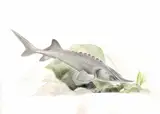
Next stop in our sturgeon year is the Adriatic sturgeon (Acipenser naccarii). Even though this sturgeon is only seldomly farmed (probably just in Italy and Spain), we needed this WelfareCheck to be up to date, because Adriatic sturgeon gets hybridised with the Siberian sturgeon (which we had dealt with earlier this year). This hybrid is the next sturgeon species on our list to update.
Despite this role in being one parent of a hybrid, there are still a lot of knowledge gaps for the Adriatic sturgeon: For the spatial needs, aggregation preferences, aggressive tendencies, and malformations, we could not properly score welfare in the farming context due to missing information.
If focusing on the resident strain, providing earthen ponds with natural substrate, taking care to avoid stressors, and choosing percussive stunning followed by bleeding, the Adriatic sturgeon can experience medium to good welfare in captivity. One large issue – as with the previous sturgeons we looked at – remains reproduction which is far removed from happening naturally.
Please let us know what you think – about the Adriatic sturgeon or other feedback on the fair-fish database.
2026-08-25
New episodes of fair-fish database podcast programme
FishEthoGroup released their series 22 of the Fish Talk podcast programme about species covered in the fair-fish database. This time, you can learn about Greater amberjack (Seriola dumerili), Yellowtail amberjack (Seriola lalandi), and Algerian barb (Luciobarbus callensis).
In about 2-3 min each, you will get the short version of our welfare assessment in the respective WelfareChecks plus some general information on the species.
As usual, you will not just find these episodes on the FishEthoGroup website but also in the Overviews of the three species here in the fair-fish database. Just visit S. dumerili, S. lalandi, or L. callensis.
Give us your feedback on the podcast or on anything that you would like us to know here.
2026-07-29
fair-fish position paper on humane stunning and slaughter
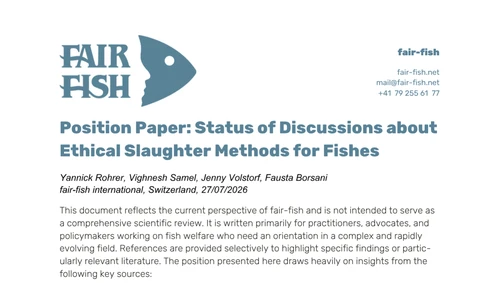
In the fair-fish database but also in our consultancy work with farmers and fishers, fair-fish needs to have a position on which stunning and slaughter methods can be considered humane.
In our position paper, we dive into how insensibility is assessed and the caveats from a welfare perspective, how electrical stunning works, and which alternatives there are. We end by concluding that electrical stunning is not the one-fits-all solution but deserves further discussion and development.
We are grateful to invaluable support by a number of experts in the field, especially Jeff Lines and Jenny Bouwsema.
Let us know what you think in the feedback form. And for further reference, you will find the link to the position paper in a new FAQ entry on each WelfareCheck page.
2026-07-18

Update WelfareCheck | farm: Acipenser gueldenstaedtii
Continuing in the sturgeon year, we present the update of another WelfareCheck – this time of the Russian sturgeon (Acipenser gueldenstaedtii). According to Wikipedia, the Russian sturgeon is named after the German-Baltic researcher Johann Anton Güldenstädt who was sent by Catherine II to explore southern Russia. The distribution of the Russian sturgeon today is the Caspian and Black Sea.
The Russian sturgeon – just as the Siberian sturgeon – is mostly reared for caviar, so everything surrounding reproduction and collection of eggs happens under highly controlled conditions and with the help of anaesthesia. There, the similarities don't stop. The spatial needs as well cannot be provided for in captivity, and too little is known about natural aggregation densities to be able to provide welfare-friendly recommendations for the farming environment.
In contrast to the Siberian sturgeon, malformations could be a problem with the Russian sturgeon. Even though substrate may be provided when kept in earthen ponds, spawners are denied this feature. Some husbandry procedures could induce stress, but we need more knowledge whether measures like anaesthesia can effectively reduce them – especially for spawners who are handled regularly during the 11-16 years they spend in captivity until mature.
Aggression is likely just an issue with the fry, and there seem to be stunning and slaughter practices that allow for immediate insensibility and unconsciousness and eventually death. Please help us fill the gaps or let us know your thoughts in the feedback form.
2026-07-06

New WelfareCheck | catch: Sardina pilchardus x purse seines
Sardina pilchardus, the European pilchard, is in the top 5 most frequently caught species worldwide. Up to 61,000,000,000 individuals end up in fisher nets each year according to the British NGO fish count. In our latest WelfareCheck | catch, we looked at the situation of S. pilchardus caught with purse seines.
During the catching process that can take around 1.5 hours from hauling to arrival on board, we identified the welfare hazards that are most pressing. A number of them can be tackled with mitigation measures that are already verified for the commercial catching process. Two major hazards remain: crowding the individuals by the side of the vessel will crush them against each other and the net, and a lack of a humane stunning and slaughter method subjects them to welfare hazards on board. Introducing a stunning and slaughter procedure would get rid of all consequences the individuals suffer from the moment of emersion on. So, pursuing a solution in this direction has the potential to alleviate a lot of suffering.
For all details, please click here. And let us know your thoughts and comments in the feedback form.
General
How to use the FAQ?
First up, you will find answers to questions for the specific page you are on. Scrolling down in the FAQ window, there are also answers to more general questions. Explore our website and the other sub pages and find there the answers to questions relevant for those pages.
How do I navigate in the fair-fish database?
In the fair-fish database, when you have chosen a species (either by searching in the search bar or in the species tree), the landing page is an Overview, introducing the most important information to know about the species that we have come across during our literatures search, including common names, images, distribution, habitat and growth characteristics, swimming aspects, reproduction, social behaviour but also handling details. To dive deeper, visit the Dossier where we collect all available ethological findings (and more) on the most important aspects during the life course, both biologically and concerning the habitat. In contrast to the Overview, we present the findings in more detail citing the scientific references.
Depending on whether the species is farmed or wild caught, you will be interested in different branches of the database.
Farm branch
Founded in 2013, the farm branch of the fair-fish database focuses on farmed aquatic species.
Catch branch
Founded in 2022, the catch branch of the fair-fish database focuses on wild-caught aquatic species.
What is the farm branch?
The heart of the farm branch of the fair-fish database is the welfare assessment – or WelfareCheck | farm – resulting in the WelfareScore | farm for each species. The WelfareCheck | farm is a condensed assessment of the species' likelihood and potential for good welfare in aquaculture, based on welfare-related findings for 10 crucial criteria (home range, depth range, migration, reproduction, aggregation, aggression, substrate, stress, malformations, slaughter).
For those species with a Dossier, we conclude to-be-preferred farming conditions in the Advice | farm. They are not meant to be as detailed as a rearing manual but instead, challenge current farming standards and often take the form of what not to do.
What is the catch branch?
In parallel to farm, the main element of the catch branch of the fair-fish database is the welfare assessment – or WelfareCheck | catch – with the WelfareScore | catch for each species caught with a specific catching method. The WelfareCheck | catch, too, is a condensed assessment of the species' likelihood and potential for good welfare – or better yet avoidance of decrease of good welfare – this time in fisheries. We base this on findings on welfare hazards in 10 steps along the catching process (prospection, setting, catching, emersion, release from gear, bycatch avoidance, sorting, discarding, storing, slaughter).
In contrast to the farm profiles, in the catch branch we assess the welfare separately for each method that the focus species is caught with. In the case of a species exclusively caught with one method, there will be one WelfareCheck, whereas in other species, there will be as many WelfareChecks as there are methods to catch the species with.
Summarising our findings of all WelfareChecks | catch for one species in Advice | catch, we conclude which catching method is the least welfare threatening for this species and which changes to the gear or the catching process will potentially result in improvements of welfare.
What do we mean by "welfare"?
Welfare of aquatic species is at the heart of the fair-fish database. In our definition of welfare, we follow Broom (1986): “The welfare of an individual is its state as regards its attempts to cope with its environment.” Thus, welfare may be perceived as a continuum on which an individual rates “good” or “poor” or everything in between.
We pursue what could be called a combination of not only a) valuing the freedom from injuries and stress (function-based approach) but b) supporting attempts to provide rewarding experiences and cognitive challenges (feelings-based approach) as well as c) arguing for enclosures that mimic the wild habitat as best as possible and allow for natural behaviour (nature-based approach).
What if I have a question?
Try mousing over the element you are interested in - oftentimes you will find explanations this way. If not, there will be FAQ on many of the sub-pages with answers to questions that apply to the respective sub-page. If your question is not among those, contact us at ffdb@fair-fish.net.
Where is the FishEthoBase?
It's right here! We decided to re-name it to fair-fish database for several reasons. The database has grown beyond dealing purely with ethology, more towards welfare in general – and so much more. Also, the partners fair-fish and FishEthoGroup decided to re-organise their partnership. While maintaining our friendship, we also desire for greater independence. So, the name "fair-fish database" establishes it as a fair-fish endeavour.
Frequently asked questions
«