

Dossier:
not provided by us yet
WelfareCheck:
C (2025-12-23)
Advice:
not provided by us yet
Scientific names (currently not valid)
Scomber pelamides, Scomber pelamis, Thynnus vagans
English: Skipjack tuna, cakalang, katsuo, arctic bonito, mushmouth, oceanic bonito, striped tuna, victor fish
Latin names based on Eschmeyer's
Common names based on Wikipedia


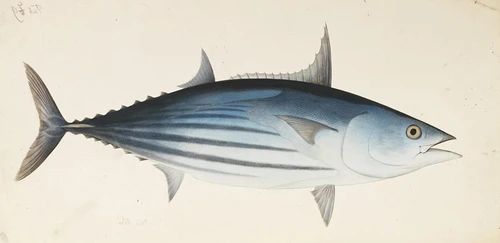
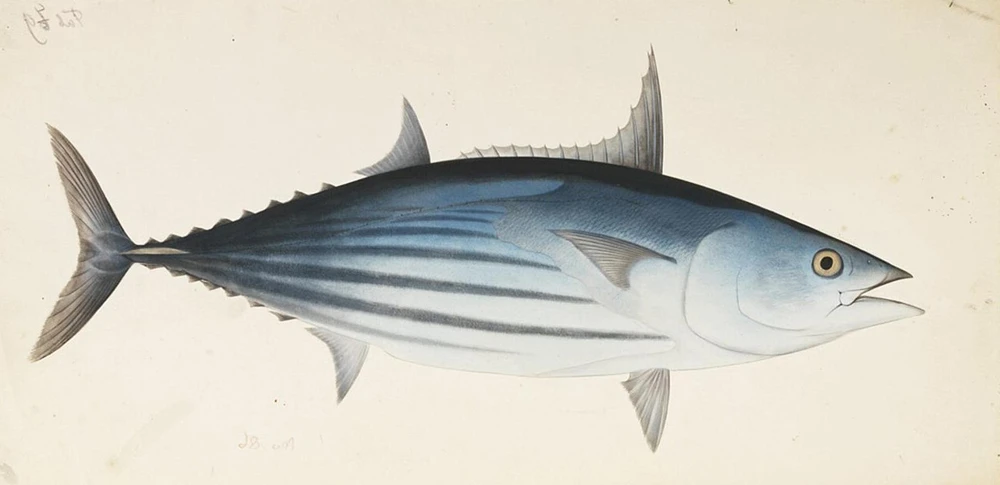
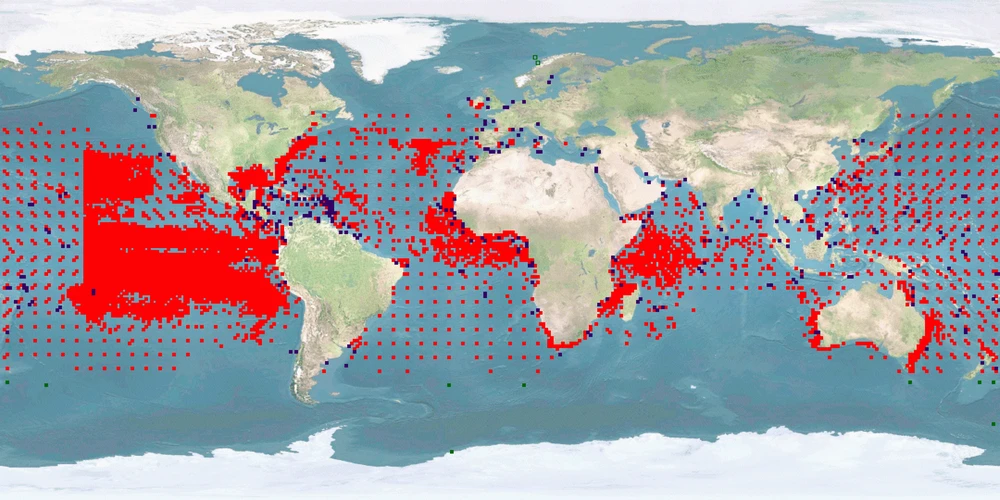
Katsuwonus pelamis is an OCEANODROMOUS PELAGIC fish species with a cosmopolitan distribution in offshore tropical waters. It tends to form large schools near the surface, often associated with floating objects, birds, sharks, and cetaceans, and is mixed with other species of tuna. Consumed globally both freshly and as a processed product (canned, dried, salted, etc.), it is one of the most heavily exploited fish species (in terms of tonnage), mainly targeted commercially by purse seining but also by other fishing methods such as longlines, troll fishing, and hand lines and pole-and-lines.
Hand lines and pole-and-lines impose a relatively short time of contact with the gear and emersion, along with a rapid and efficient release from the gear. Important welfare hazards include hooking and jerking causing mouth injuries, manual unhooking the barbless hook in the case of hand lines, hard dropping, lack of oxygen resulting in floundering on the deck, and the lack of immediate sorting, stunning, and slaughter facilities on most vessels. This results in IND suffering due to physical injuries, asphyxiation, experiencing their own weight and a stressful mortality, and getting crushed in crowded conditions on the deck and in the storage unit.
Whilst the injuries due to hooking and jerking in pole-and-lines are inevitable, the use of barbless hooks is recommended. Furthermore, measures such as cushioning the deck, keeping it moist, and having a slope, ramps, or conveyor belts leading to the opening of the catch storage chamber can be used to avoid a delay in the storage of IND. Likewise, we recommend immediate stunning of IND after sorting, followed by immediate killing when the IND are in an unconscious state. To the best of our knowledge, this has not yet been implemented in a commercial context. Future focus should be on determining optimum stunning and slaughter procedures and disincentivising fishing around FADs to reduce the rate of bycatch. Live bait FISHES are an indispensable part of pole-and-line fishing, but they suffer from poor welfare through the process of catching, transfer to the main vessel, on-board storage in live bait tanks, and throwing during the fishing process. It is, therefore, imminent to make efficient use of the live bait FISHES to minimise the quantity used or preferably, find methods to replace their use altogether.
Pole-and-lines is considered to be the most welfare-friendly fishing technique. Even though our WelfareScore is low, it is better than all for WelfareChecks assessed so far. Applying the outlined mitigation measures will potentially succeed in making pole-and-lines the least welfare deteriorating catching method for K. pelamis.
For details see: WelfareCheck | catch (latest major release: )
There are new podcast episodes available on FishEthoGroup's podcast programme about the fair-fish database! Series 20 of the farm branch of species reared in aquaculture covers Hoven's carp (Leptobarbus hoevenii), Mud carp (Cirrhinus molitorella), and Smallscale mud carp (Cirhrinus microlepis). As usual, you will get general and welfare-related information – including our welfare assessment – in around 3 to 5 minutes time.
Another episode tackles the fishery of Skipjack tuna (Katsuwonus pelamis) caught with hand lines and pole-and-lines.
You will find the episodes on the Overview page of the respective species here in the fair-fish database or over at FishEthoGroup's! Please let us know what you think about this format on our contact form.
The new addition to the fair-fish database is a WelfareCheck of the catch branch on one important tuna species: the Skipjack Katsuwonus pelamis caught with hand lines and pole-and-lines. This type of fishery has a reputation of being relatively welfare friendly, and so we were curious what we would find.
Indeed, during the process of searching for the species ("Prospection") and setting up the gear, pole-and-lines especially earned high scores, as measures are taken to not scare individuals away. From the moment of catching on, though, there were either welfare hazards that cannot be avoided (e.g., hooking leading to injuries) or for which no solution exists yet (e.g., lack of oxygen leading to asphyxia). Nevertheless, it was apparent that many more recommendations are already published in scientific papers or management reports to improve this fishery than for any of the previously covered WelfareChecks.
If fishers, governments, representatives of the supply chain, and not the least researchers collaborate to apply these recommendations, pole-and-lines can be the least welfare deteriorating fishing method that it is made out to be. A good first step is cushioning the deck to prevent hard landing, a swift transport below deck to avoid lengthy floundering and asphyxiation, immediate sorting if necessary, followed by discarding of the unwanted individuals. Ideally, the to-be-retained individuals are then stunned and slaughtered to cut any more suffering short and also improve the meat quality. Such a protocol is currently still missing.
Do you have comments, ideas, proposals? Let us know!


The centre of the Overview is an array of criteria covering basic features and behaviours of the species. Each of this information comes from our literature search on the species. If we researched a full Dossier on the species, probably all criteria in the Overview will be covered and thus filled. This was our way to go when we first set up the database.
Because Dossiers are time consuming to research, we switched to focusing on WelfareChecks. These are much shorter profiles covering just 10 criteria we deemed important when it comes to behaviour and welfare in aquaculture (and lately fisheries, too). Also, WelfareChecks contain the assessment of the welfare potential of a species which has become the main feature of the fair-fish database over time. Because WelfareChecks do not cover as many criteria as a Dossier, we don't have the information to fill all blanks in the Overview, as this information is "not investigated by us yet".
Our long-term goal is to go back to researching Dossiers for all species covered in the fair-fish database once we set up WelfareChecks for each of them. If you would like to support us financially with this, please get in touch at ffdb@fair-fish.net
See the question "What does "not investigated by us yet" mean?". In short, if we have not had a look in the literature - or in other words, if we have not investigated a criterion - we cannot know the data. If we have already checked the literature on a criterion and could not find anything, it is "no data found yet". You spotted a "no data found yet" where you know data exists? Get in touch with us at ffdb@fair-fish.net!
First up, you will find answers to questions for the specific page you are on. Scrolling down in the FAQ window, there are also answers to more general questions. Explore our website and the other sub pages and find there the answers to questions relevant for those pages.
In the fair-fish database, when you have chosen a species (either by searching in the search bar or in the species tree), the landing page is an Overview, introducing the most important information to know about the species that we have come across during our literatures search, including common names, images, distribution, habitat and growth characteristics, swimming aspects, reproduction, social behaviour but also handling details. To dive deeper, visit the Dossier where we collect all available ethological findings (and more) on the most important aspects during the life course, both biologically and concerning the habitat. In contrast to the Overview, we present the findings in more detail citing the scientific references.
Depending on whether the species is farmed or wild caught, you will be interested in different branches of the database.
Founded in 2013, the farm branch of the fair-fish database focuses on farmed aquatic species.
Founded in 2022, the catch branch of the fair-fish database focuses on wild-caught aquatic species.
The heart of the farm branch of the fair-fish database is the welfare assessment – or WelfareCheck | farm – resulting in the WelfareScore | farm for each species. The WelfareCheck | farm is a condensed assessment of the species' likelihood and potential for good welfare in aquaculture, based on welfare-related findings for 10 crucial criteria (home range, depth range, migration, reproduction, aggregation, aggression, substrate, stress, malformations, slaughter).
For those species with a Dossier, we conclude to-be-preferred farming conditions in the Advice | farm. They are not meant to be as detailed as a rearing manual but instead, challenge current farming standards and often take the form of what not to do.
In parallel to farm, the main element of the catch branch of the fair-fish database is the welfare assessment – or WelfareCheck | catch – with the WelfareScore | catch for each species caught with a specific catching method. The WelfareCheck | catch, too, is a condensed assessment of the species' likelihood and potential for good welfare – or better yet avoidance of decrease of good welfare – this time in fisheries. We base this on findings on welfare hazards in 10 steps along the catching process (prospection, setting, catching, emersion, release from gear, bycatch avoidance, sorting, discarding, storing, slaughter).
In contrast to the farm profiles, in the catch branch we assess the welfare separately for each method that the focus species is caught with. In the case of a species exclusively caught with one method, there will be one WelfareCheck, whereas in other species, there will be as many WelfareChecks as there are methods to catch the species with.
Summarising our findings of all WelfareChecks | catch for one species in Advice | catch, we conclude which catching method is the least welfare threatening for this species and which changes to the gear or the catching process will potentially result in improvements of welfare.
Welfare of aquatic species is at the heart of the fair-fish database. In our definition of welfare, we follow Broom (1986): “The welfare of an individual is its state as regards its attempts to cope with its environment.” Thus, welfare may be perceived as a continuum on which an individual rates “good” or “poor” or everything in between.
We pursue what could be called a combination of not only a) valuing the freedom from injuries and stress (function-based approach) but b) supporting attempts to provide rewarding experiences and cognitive challenges (feelings-based approach) as well as c) arguing for enclosures that mimic the wild habitat as best as possible and allow for natural behaviour (nature-based approach).
Try mousing over the element you are interested in - oftentimes you will find explanations this way. If not, there will be FAQ on many of the sub-pages with answers to questions that apply to the respective sub-page. If your question is not among those, contact us at ffdb@fair-fish.net.
It's right here! We decided to re-name it to fair-fish database for several reasons. The database has grown beyond dealing purely with ethology, more towards welfare in general – and so much more. Also, the partners fair-fish and FishEthoGroup decided to re-organise their partnership. While maintaining our friendship, we also desire for greater independence. So, the name "fair-fish database" establishes it as a fair-fish endeavour.

