Information
Authors: Jenny Volstorf, Vighnesh Samel
Version: A | 1.0Published: 2025-12-23
WelfareScore | catch
The score card gives our welfare assessments for aquatic species in 10 criteria.
For each criterion, we score the probability to experience good welfare under minimal catching conditions ("Likelihood") and under high-standard catching conditions ("Potential") representing the worst and best case scenario. The third dimension scores how certain we are of our assessments based on the number and quality of sources we found ("Certainty").
The WelfareScore sums just the "High" scores in each dimension. Although good welfare ("High") seems not possible in some criteria, there could be at least a potential improvement from low to medium welfare (indicated by ➚ and the number of criteria).
- Li = Likelihood that the individuals of the species experience good welfare under minimal catching conditions
- Po = Potential of the individuals of the species to experience good welfare under high-standard catching conditions
➚ = potential improvements not reaching "High" - Ce = Certainty of our findings in Likelihood and Potential
WelfareScore = Sum of criteria scoring "High" (max. 10 per dimension)
General remarks
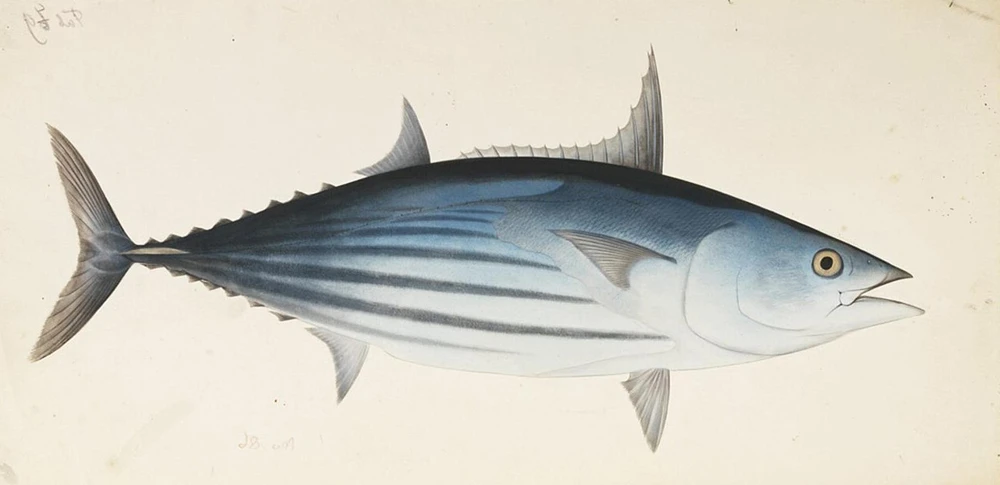
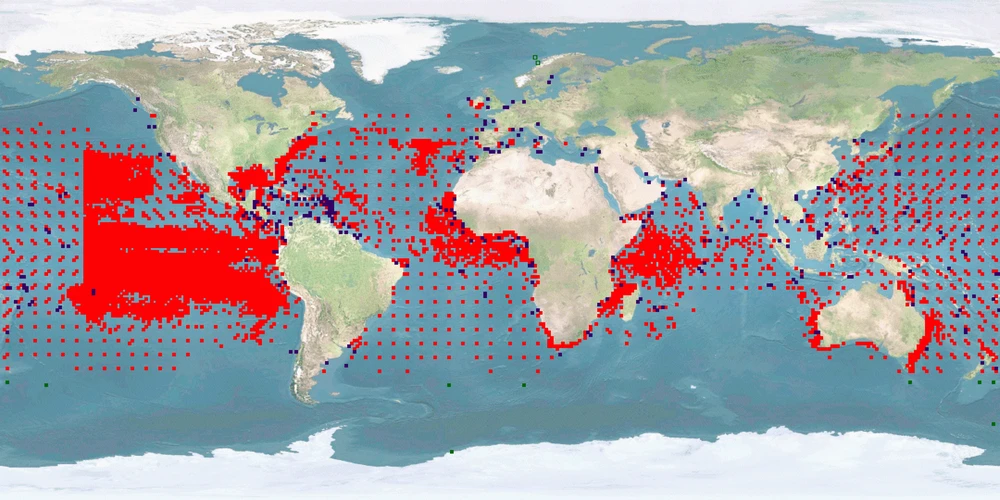
Katsuwonus pelamis is an OCEANODROMOUS PELAGIC fish species with a cosmopolitan distribution in offshore tropical waters. It tends to form large schools near the surface, often associated with floating objects, birds, sharks, and cetaceans, and is mixed with other species of tuna. Consumed globally both freshly and as a processed product (canned, dried, salted, etc.), it is one of the most heavily exploited fish species (in terms of tonnage), mainly targeted commercially by purse seining but also by other fishing methods such as longlines, troll fishing, and hand lines and pole-and-lines.
Hand lines and pole-and-lines impose a relatively short time of contact with the gear and emersion, along with a rapid and efficient release from the gear. Important welfare hazards include hooking and jerking causing mouth injuries, manual unhooking the barbless hook in the case of hand lines, hard dropping, lack of oxygen resulting in floundering on the deck, and the lack of immediate sorting, stunning, and slaughter facilities on most vessels. This results in IND suffering due to physical injuries, asphyxiation, experiencing their own weight and a stressful mortality, and getting crushed in crowded conditions on the deck and in the storage unit.
Whilst the injuries due to hooking and jerking in pole-and-lines are inevitable, the use of barbless hooks is recommended. Furthermore, measures such as cushioning the deck, keeping it moist, and having a slope, ramps, or conveyor belts leading to the opening of the catch storage chamber can be used to avoid a delay in the storage of IND. Likewise, we recommend immediate stunning of IND after sorting, followed by immediate killing when the IND are in an unconscious state. To the best of our knowledge, this has not yet been implemented in a commercial context. Future focus should be on determining optimum stunning and slaughter procedures and disincentivising fishing around FADs to reduce the rate of bycatch. Live bait FISHES are an indispensable part of pole-and-line fishing, but they suffer from poor welfare through the process of catching, transfer to the main vessel, on-board storage in live bait tanks, and throwing during the fishing process. It is, therefore, imminent to make efficient use of the live bait FISHES to minimise the quantity used or preferably, find methods to replace their use altogether.
Pole-and-lines is considered to be the most welfare-friendly fishing technique. Even though our WelfareScore is low, it is better than all for WelfareChecks assessed so far. Applying the outlined mitigation measures will potentially succeed in making pole-and-lines the least welfare deteriorating catching method for K. pelamis.
1 Prospection
To find the fishes in their habitat, there are different techniques to localise them (e.g., echosound/sonar, chasing).
What is the probability of avoiding a decrease in welfare during the process of searching for the species?
It is low for minimal catching conditions, a) as vessel noises and certain sound frequencies possibly affect the IND, b) given running the vessel into the school (which scares the IND), and c) given collision with or entanglement in FADs. It is high for high-standard catching conditions, given fishers a) use remote sensing for detecting potential fishing zones (NOAA meteorological satellite image receiver), b) approach the school from left or right, and c) prefer to catch free-swimming schools instead of using FADs or – if not possible – use non-entangling FADs. Our conclusion is based on a medium amount of evidence, as further research is needed.2 Setting
Catching methods differ in the way they are set up and consequently in the time it takes for setting them.
What is the probability of avoiding a decrease in welfare during the process of setting the catching method?
It is high for minimal and high-catching conditions given measures to distract IND from (water spraying, covering hook) and attract them to the vessel and the hook (shiny lead weight, jerking movements with the line) that are not welfare deteriorating. Our conclusion is based on a medium amount of evidence, as feeding frenzies might lead to collisions and injuries but require further research.3 Catching
Given the principle of the catching method, the gear (with the fishes caught) may be hauled vertically or horizontally in the water for a certain amount of time and distance.
What is the probability of avoiding a decrease in welfare during catching?
It is low for minimal catching conditions given hooking injuries and - for hand lines - in case of temperature shock and barotrauma at certain catching depth and hauling speed/duration. It is medium for high-standard catching conditions for pole-and-lines, as hooking injuries cannot be avoided and given shallow catching depth; for hand lines, as hooking injuries cannot be avoided and given slow hauling speed when catching at larger depth (see bycatch avoidance) or given shallow catching depth. Our conclusion is based on a medium amount of evidence, as further research is needed on safe catching depths and hauling speed and on the injuries/damages incurred through barbed versus barbless hooks.4 Bycatch avoidance
Not all specimens of the target species are equally sought after, e.g., when they are undersized, of wrong sex, wrong age, damaged, over quota, or mixed with a high proportion of undersized or unwanted non-target fishes. Measures to prevent this bycatch still in the water may include slipping in purse seine, window in net, opening in trap, etc.
What is the probability of avoiding a decrease in welfare with the help of bycatch-avoiding measures?
It is low for minimal catching conditions, as avoiding bycatch in the water is impossible in hand lines and pole-and-lines given the catching depth overlaps with the depth range of JUVENILES and in case the hook sizes are small enough for them to be lured by. It is high for high-standard catching methods, given fishers a) prefer larger hook sizes, b) catch at larger catching depth (hand lines), c) prefer free-swimming schools over FAD-associated IND, d) stop the catching process when catching JUVENILES. Our conclusion is based on a low amount of evidence, as further research is needed.5 Emersion
The process of bringing the fishes out of the water also depends on the catching method and may, thus, differ in duration and impact (e.g., netting, brailing, pumping, lifting).
What is the probability of avoiding a decrease in welfare during emersion?
It is low for minimal and high-standard catching conditions given inevitable lack of oxygen and hooking in the mouth or elsewhere and no indications of how to avoid this (although the time of emersion is restricted to a few seconds). Our conclusion is based on a high amount of evidence.6 Release from gear
There are different ways to remove the fishes from the gear (e.g., unhooking, disentangling, dropping).
What is the probability of avoiding a decrease in welfare during release from the gear?
It is low for minimal catching conditions given lack of oxygen, drop height, unhooking injuries, and experiencing their own weight in air. It is medium for high-standard catching conditions, given fishers a) keep the landing deck smooth, b) cover it with suitable cushioning (e.g., tarpaulin), and c) keep the surface moist or – if not available or possible – swing IND at acute angle or catch under the arm to gently unhook and reduce drop height, d) prefer barbless hooks over barbed hooks (further research needed) and gently over forced unhooking. Our conclusion is based on a medium amount of evidence, as further species-specific research is needed (especially on unhooking injuries).7 Sorting
Given the species specificity of the method, sorting might be necessary once the catch arrives on deck.
What is the probability of avoiding a decrease in welfare during sorting?
It is low for minimal catching conditions given lack of oxygen before and during sorting, floundering on deck, manual handling, crowding, and a lack of care for good welfare (e.g., kicking IND). It is medium for high-standard catching conditions, given fishers a) keep the landing deck smooth, b) cover it with suitable cushioning (e.g., tarpaulin), c) keep the surface moist, d) avoid crowding, e) prefer non-manual handling (e.g., conveyor belt), f) establish a below-deck system of sloped chutes to carry IND to the storage units – if not possible or available, find alternatives to cushion the fall from deck to storage (further research needed), and then g) stun followed by slaughter while still unconscious – the latter needs to be verified for the catching context. Our conclusion is based on a medium amount of evidence, as further research is needed.8 Discarding
If bycatch of the target species could not be prevented, the individuals could still be returned from the gear/deck to the water.
What is the probability of avoiding a decrease in welfare during discarding?
It is low for minimal catching conditions given lack of oxygen right after emersion, hard landing on deck, manual handling during sorting, and predation pressure once IND have been returned to sea. It is medium for high-standard catching conditions, given fishers a) keep the landing deck smooth, b) cover it with suitable cushioning (e.g., tarpaulin), c) keep the surface moist, d) avoid crowding, e) prefer non-manual handling (e.g., conveyor belt), and f) avoid accidental discards to not scare IND away (that are still in the water), but discard JUVENILES as soon as possible. Our conclusion is based on a medium amount of evidence, as further research is needed on how to discard JUVENILES efficiently.9 Storing
Given how long it takes the vessel to return to the harbour, the caught fishes have to be stored for a certain amount of time. This storing happens most frequently with the fishes still being alive, but differing in the type of storage containers and medium (ice, brine, air, etc.).
What is the probability of avoiding a decrease in welfare during storing?
It is low for minimal catching conditions given lack of a proper stunning and slaughter procedure – resulting in IND experiencing lack of oxygen and their own weight in air, crowding in the storage unit, and contact with the storing medium. It is medium for high-standard catching conditions, given fishers prefer immediate stunning followed by slaughter while still unconscious which needs to be verified for the catching context. Our conclusion is based on a medium amount of evidence.10 Slaughter
Ideally, slaughter a) immediately follows stunning (i.e., while the individual is unconscious), b) happens according to a clear and reproducible set of instructions verified under catching conditions, and c) avoids pain, suffering, and distress.
What is the probability of avoiding a decrease in welfare during stunning/slaughter?
It is low for minimal catching conditions given asphyxia and hypothermia. It is medium for high-standard catching conditions given immediate stunning followed by slaughter while still unconscious (through percussion of the head followed by gutting or percussion of the brain followed by deep freeze or spiking of the brain followed by deep freeze), which needs to be verified for the catching context. Our conclusion is based on a low amount of evidence.Side note: Uncategorised catching step
Sometimes the literature does not specify the welfare hazards and the catching step that lead to hazard consequences.
What are consequences that decrease welfare during uncategorised steps of the catching process?
No data found yet.Side note: General improvements of the method
The focus of this WelfareCheck | catch is the welfare of the target species. There could be improvements to the catching method that are not covered by the criteria and could include prevention of overexploitation, prevention of bycatch of non-target species, e.g., pingers to deter cetaceans, and avoiding damage to the environment, though.
What are these improvements?
To decrease suffering, the best is to avoid catching IND – that would be discarded – in the first place which could mean for the target species to close spawning and nursing grounds for fishing as well as to establish seasonal fishing bans. For non-target species, it could mean to prefer free-swimming schools over FAD-associated IND. Especially for ETP species, it could mean to use non-entangling FADs, raise awareness to avoid the catch of ETP species, and – if caught – to train the crew how to handle and release ETP species. For live bait FISHES, it could mean to use the vessel as FAD instead of throwing live bait FISHES (further research needed); if not possible, a) explore the possibility and efficacy of using hatchery-reared live bait (e.g., Chanos chanos) or maintain wild populations through stock enhancement programmes, b) raise awareness with fishers on sustainability, c) monitor live bait FISHES populations, d) improve utilisation ratio (catch:live bait), e) reduce waste by retaining excess live bait FISHES at the end of the day, f) during transfer, take care to treat live bait FISHES quickly and gently using wet scooping and hold them in well-oxygenated and circulating bait wells or low temperature live bait tanks. In terms of avoiding ghost fishing, it could mean to retain old gear on board and use biodegradable material for FADs. Impact on benthos from hand lines and pole-and-lines is most likely no issue, as catching takes place at the surface, but it is probable in case of live bait fishery of BENTHIC species. To prevent it, avoid sticks and anchoring in reefs as well as fishing gear that damages corals, prefer mooring buoys.- target species: hand lines in South Sulawesi, Indonesia, with a bigger average catch size than pole-and-lines (60 versus 45 cm) and shorter catch time (5 versus 7 months) 28 and thus probably lower risk for overexploitation 0.
With pole-and-lines, off Maumere, Indonesia, of IND 25-69 cm FORK LENGTH caught, 53% immature – not so different from size range caught in purse seine and challenging the future of the population 12. Recommended to replace purse seine with pole-and-lines in spawning areas (where K. pelamis is bycatch in purse seines) 12.
Hand line bycatch-avoidance management: recommended to regulate fishing times to reduce the proportion of undersized IND 17.
Pole-and-lines bycatch-avoidance management: closure of spawning and nursing grounds during spawning season in October 49↶6. With pole-and-lines, off Lakshadweep, India, fishing ban in the Indian Exclusive Economic Zone prior to or during the onset of the South West monsoon for the conservation and management of fishing resources and for sea safety reasons 50.- How to improve: closure of spawning and nursing grounds, seasonal fishing bans
- non-target species: usable bycatch: given that K. pelamis schools with Thunnus albacares (Yellowfin tuna) when these are JUVENILES 51 32 and with pole-and-lines, T. albacares JUVENILES get attracted to FADs, they may potentially get caught, causing concerns 51. With pole-and-lines, off Brazil, 5.8% bycatch: mainly T. albacares, followed by Coryphaena hippurus (Mahi-mahi), rarely Thunnus atlanticus (Blackfin tuna), Thunnus obesus (Bigeye tuna), Auxis thazard (Frigate tuna), Acanthocybium solandri (Wahoo), Euthynnus alletteratus (Little tunny), Seriola lalandi (Yellowtail amberjack) 27; in Lakshadweep, India, 74.2% of catch contained K. pelamis, another 22.6% commercially relevant T. albacares and neritic tunas - especially when catching took place near anchored FADs 11; in Seram and Halmahera Sea, Indonesia, bycatch included T. albacares and Auxis rochei (Bullet tuna) 32; off Maumere, Eastern Indonesia, accidental catch of T. albacares when mistaken for school of K. pelamis 6; (also targeting T. albacares), off Bitung City, Indonesia, caught C. hippurus and Elagatis bipinnulata (Rainbow runner) retained by the fishers 33; off Japan, main target K. pelamis, also targeted: T. albacares, Thunnus alalunga (Albacore), T. obesus, other commercially relevant species: Euthynnus affinis (Mackerel tuna), A. thazard, S. lalandi, and E. bipinnulata 20. Alternatively to FADs, fishers caught free-swimming schools with a similar catch rate as using FADs but with lower rates of T. albacares bycatch 12.
Hand lines in South Sulawesi, Indonesia, more selective than pole-and-lines (catch one instead of <3 species with relative uniform size) 28 and thus probably lower risk for non-target bycatch 0. Hand lines, off Karakelang Island, Indonesia, included 29.8% E. affinis, 15.8% C. hippurus 13.
With pole-and-lines, in Lakshadweep, India, 2.9% usable bycatch - especially when catching took place near flotsams: E. bipinnulata, C. hippurus, sharks (mainly Carcharhinus falciformis [Silky shark], followed by Carcharhinus amblyrhynchos [Grey reef shark], Galeocerdo cuvier [Tiger shark], Alopias pelagicus [Pelagic thresher], Negaprion acutidens [Sicklefin lemon shark], and Sphyrna lewini [Scalloped hammerhead]), A. solandri, bill fishes 11. Please note, G. cuvier is near threatened (decreasing) 52, C. falciformis is vulnerable (decreasing) 53, and A. pelagicus 54, C. amblyrhynchos 55, N. acutidens 56, and S. lewini 57 are endangered (decreasing) according to IUCN.
With pole-and-lines, off Sri Lanka, ca 4% bycatch of neritic tuna species, A. rochei, A. thazard, and E. affinis 29.
With hand lines and pole-and-lines, in the Maldives, 2 small trevallies (unspecified species 0) and 3 E. affinis were caught and consumed locally 58.
Troll lines, off Palabuhanratu, Indonesia, included T. albacares and T. obesus in category of target catch 59, 18% bycatch included mainly Kajikia audax (Striped marlin), to much smaller degree C. hippurus and Loligo sp, rarely Scomberomorus commerson (Narrow-barred Spanish mackerel), Istiophorus platypterus (Indio-Pacific sailfish), E. bipinnulata 59.- How to improve: prefer free-swimming schools over FAD-associated IND to reduce bycatch of Thunnus albacares
- non-target species: for pole-and-lines, fishers throw live bait FISHES 27 23 using small scoop nets to attract IND to the bow 18 2 6 9, bow and the port side 3 19 20, or to the stern of the vessel and start a feeding frenzy 7 4 25 26. Then, catching with pole-and-lines starts 6. With troll lines, off Palabuhanratu, Indonesia, fishers threw live bait FISHES to test appetite of target IND, caught them over FADs 59. Given catch of live bait FISHES, hazard consequences to those FISHES are probable:
usable bycatch: with pole-and-lines, off Brazil, open-circulation water tanks for live bait FISHES (usually Sardinella brasiliensis [Brazilian sardinella]) 27.
With hand lines and pole-and-lines, in the Maldives, live bait FISHES were mostly Spratelloides gracilis (Silver-stripe round herring), but also Spratelloides delicatulus (Blue sprat), Encrasicholina heteroloba (Shorthead anchovy), Caesionidae (Fusiliers), juvenile Apogonidae (Cardinalfishes), Chromis viridis (Blue-green damselfish), Lepidozygous tapeinosoma (Fusilier damselfish), Atherinidae (Silversides) 60 58. S. gracilis, S. delicatulus, E. heteroloba, C. viridis, Selar crumenophthalmus (Bigeye scad), Decapterus macarellus (Mackerel scad), Odonus niger (Redtoothed triggerfish), Herklotsichthys quadrimaculatus (Bluestripe herring), Atherinomorus lacunosus (Hardyhead silverside), and species from family Apogonidae and Caesionidae 61.
PELAGIC FISHES like sprats and anchovies were caught with rectangular lift nets 60 58, e.g., the net is attached to two long poles and dipped into the water and then lifted, trapping the caught FISHES 61. Catching takes place during the day 61 within the atolls 60 58 8 or – most frequently – at night 62 58 7 61 (with or without SCUBA) using artificial lights to attract the FISHES 61. This procedure causes significant mortality of the live bait FISHES due to poor handling techniques 62.
For DEMERSAL species like cardinalfishes and fusiliers, weighted nets are lowered close to the sea floor, and opened with the help of divers 61. The FISHES are attracted towards the net using chum or various other techniques such as chasing with coconut frond, plastic pipes, or making a sound with chains attached to the end of a rope 61. The FISHES are quickly transferred to the live bait tank using dry scooping or wet scooping 61 with big (50 cm) and small (ca 35 cm) ∅ scoop nets 58. Recommended to use 35 cm instead of 50 cm scoop nets, as the latter scoop large quantities of FISHES at once and cause higher mortality 58. Alternatively, prefer buckets with sea water over dry scooping to transfer live bait FISHES to the vessels 62. Live bait FISHES were kept in tanks ("bait wells") 60 7 in water 60 on vessel 60 7. During catching, transferring, and storing, live bait FISHES are subjected to hauling from large depths (45-60 m), crowding, contact with the gear, lack of oxygen, dry scooping at high densities, and hypoxic conditions in the storage tanks 61. This will lead to barotrauma, scale and mucous loss, other injuries, hypoxia 61. Most resilient species: for pole-and-lines, Apogonids followed by E. heteroloba and Caesionids; for hand lines, A. lacunosus, followed by Caesionids and H. quadrimaculatus 61. H. quadrimaculatus is chosen by most fishers as the second-best bait to keep, followed by A. lacunosus and Caesionids 61. The excess live bait FISHES at the end of the fishing day are a) retained in the live bait tank for the following day, b) discarded into the sea, reef/inner atoll (pole-and-lines), c) sold (hand lines), d) consumed 61. Rather than releasing excess live bait FISHES back to the atoll, recommended to keep for later use 62.
With pole-and-lines, in Lakshadweep, India, live bait FISHES: mostly S. gracilis, S. delicatulus, to a lesser degree Ceasio spp., Ptero ceasio spp., C. viridis, L. tapeinosoma, fusiliers, cardinalfishes 11.
With pole-and-lines, off Sri Lanka, fishers look for bait FISHES Dipterygonotus balteatus (Mottled fusilier) by diving, catch with lift net at 20-100 m 29.
For pole-and-lines, off Bitung City, Indonesia, used live bait FISHES: scads, Selaroides leptolepis (Yellowstripe trevally), anchovies, fusiliers, Dussumieria acuta (Rainbow sardine) 33; off Maumere, Eastern Indonesia, live bait FISHES mostly anchovies 12, Stolephorus zollingeri (Japanese anchovy), but also E. heteroloba, 5.7-7.2 cm 6. In Seram and Halmahera Sea, Indonesia, fishers bought live bait FISHES from specialised bait fishers who caught them with lift nets or similar means 32. Live bait FISHES were caught at midnight, swiftly transferred from lift nets to 5-8 buckets of 50 L each which are washed to get rid of debris and equipped with water circulation 6.
With hand lines and pole-and-lines, off Bitung, North Sulawesi, Indonesia, the live bait FISHES are first crowded using a small-meshed lift net 63 and then dry scooped from the tank into small buckets on the port and the starboard side of the vessel using large scoop nets 18 63. The live bait tank is present in the centre of the deck 18 63. Excess live bait FISHES may be discarded - instead of throwing live bait FISHES into the open sea, recommended to throw them overboard when the vessel returns back to the atoll to ensure higher survival of the FISHES 60.
For pole-and-lines, off Japan, live bait FISHES were collected from aquaculture facilities using surrounding nets: FISHES were gradually crowded and first transferred into buckets using wet scoop nets and then into the baitfish tank from the starboard side of the vessel 19. Live bait FISHES (anchovies, sardines 5 2, small scads, silversides) were kept alive in live bait tanks with seawater circulation 2. With pole-and-line, in distant-water areas in the Western Central Pacific, low temperature live bait tanks with cooling, filtering, purifying, bubbling system yielding >85% survival after 30 days 5.
With hand lines and pole-and-lines, in Indonesia, recommendations: training courses for fishers on best practices in handling, storage 16.
With pole-and-lines, recommended to divide big bait schools to decrease crowding density and lack of oxygen and avoid mortality 4. Recommended to release predators accidentally caught in the same net as live bait FISHES to avoid stress and mortality 4. Recommended to use low wattage light before transfer of live bait to vessel and allow for the FISHES to settle down (ideally until daylight) to avoid stress and abrasions 4. Recommended to transfer from net to bait wells quickly but gently using buckets with sea water and avoiding high densities 4. Recommended to keep live bait FISHES in tanks with smooth surfaces, low lights, and circulation 62. Circulating sea water in holding tank for live bait FISHES through openings in the hull of the vessel allows for water renewal but requires the vessel to move 4. Alternatively, oxygen can be supplied through a) bamboo poles inserted through hull openings, b) pumping through air stones, c) mechanical pumps 4. For more recommendations on holding live bait, see 4.- How to improve: take care to treat live bait FISHES quickly and gently using wet scooping and hold them in well-oxygenated and circulating bait wells or low temperature live bait tanks (see entry for details)
- non-target species: with hand lines, fishers use live bait FISHES on hooks 13, so hazard consequences are probable:
usable bycatch: with hand lines, off Karakelang Island, Indonesia, using live bait FISHES did not yield higher catch of K. pelamis than silk cloth or chicken feathers 13 - given the low sample size, further research is needed 0.
With pole-and-lines, in the Maldives, no live bait is used on barbless hooks 7; in Indonesia, no live bait is used but barbless hook covered in raffia rope and chicken feathers (lure) 6.- How to improve: with hand lines, replace live bait FISHES on the hook with raffia rope or chicken feathers (further research needed)
- non-target species: given quantities of live bait FISHES used, overexploitation is possible:
usable bycatch: with hand lines and pole-and-lines, in the Maldives, annual live bait FISHES catch of ca 12,100 tonnes between 2017 and 2022 (IPNLF data) 61. Catches fluctuated from 34 kg/trip targeting S. gracilis during the day to 296 kg/trip targeting cardinalfishes at night using artificial light 60, average catch ranging at 20-515 kg/trip 58. The catch per haul is highly variable, ranging at 7.2-78.6 kg 61. Live bait FISHES catch: 208 kg/trip (standard deviation = 322 kg) for pole-and-lines and 347 kg/trip (standard deviation = 526 kg) for hand lines 61. Utilisation ratio: 11.8 kg tuna per kg live bait FISHES 58. Ca 325 kg/d/trip live bait FISHES used, utilisation ratio: 7.3-13 kg of tuna per kg of live bait FISHES which is inefficient compared to other pole-and-lines fisheries because the fishers throw generous quantities of live bait FISHES and also due to the large scale mortality of commonly used species like sprats 61. Recommended to employ master fishers from the Pacific to improve bait holding conditions and catching efficiency 60. The excess live bait FISHES at the end of the fishing day are a) retained in the live bait tank for the following day 61, b) discarded into the open sea 60 61 causing inevitable mortality by predation 60, reef/inner atoll (pole-and-lines), c) sold (hand lines), d) consumed 61. Rather than releasing excess live bait FISHES back to the atoll, recommended to keep for later use 62. Excess live bait FISHES may be discarded – instead of throwing live bait FISHES into the open sea, recommended to throw them overboard when the vessel returns back to the atoll to ensure higher survival of the FISHES 60 or to the place where they were caught 4. As larger vessels require larger quantities of bait FISHES and fishing takes place on the same fishing grounds, this can cause local depletions 60. With hand lines and pole-and-lines, in the Maldives, anchovies and sprats were the most commonly used live bait species because they get easily attracted to light, but they have low resilience, implying early and large-scale mortality and a high frequency of bait fishing 60. Catching live bait FISHES in these huge numbers using artificial lights to attract as many FISHES as possible may make the fishery unsustainable in the future 61. If bait fish populations decline, recommendations: larger closure zone, limitation in attracting lights and net sizes 62. For more details, see 62. With pole-and-lines, in the Maldives, occasional complaints about the shortage of live bait FISHES, especially in the southern atolls, indicating potential overexploitation and leading to a ban on live bait export 62. To avoid overexploitation of live bait populations, recommendations: raise awareness and educate fishers on sustainability 60 62 4 and welfare 60 to ensure compliance with regulations which include: monitoring live bait populations 62 4, ban on SCUBA gear, ban to export live bait FISHES or sell for human consumption 62. Recommended to employ boat-associated fishing, a method in which the boat itself is used as an FAD to eliminate the need for live bait FISHES 60.
With pole-and-lines, in Seram and Halmahera Sea, Indonesia, fishers used 3,504-8,844 kg live bait of Stolephorus spp. during 3-5 trips to catch 27,317-97,345 kg target species, giving 5.8-10.7 kg catch per kg bait 32. Fluctuations in catch:live bait ratio due to ocean conditions and expertise of fishers 32. With pole-and-lines, off Maumere, Eastern Indonesia, ratio of 16.7-181.3 kg catch per kg live bait FISHES (mostly anchovies) 12. With hand lines and pole-and-lines, in Indonesia, recommendations: training courses for fishers on utilisation of bait FISHES to optimise the bait to catch ratios 16. Where applicable, support initiatives like artificial bait or live bait FISHES procured from aquaculture facilities 16, although this is arguable 64. Self reporting by the fishers and automated data reporting system (community based fisheries monitoring). If live bait FISHES are procured from third parties, the third parties should be legal operators 16.
With pole-and-lines, off Japan, live bait FISHES were collected from aquaculture facilities 19. For pole-and-lines, off Japan, 10 kg tuna per kg of live bait FISHES (anchovies, sardines 5 2, small scads, silversides) 2.
With pole-and-lines, live bait management recommended to impose rules or regulations as well as a code of conduct (to avoid waste) 4. This should include collaboration with fishers (reports on species, amount used, mortality) 4 64. Recommended to use live bait FISHES at low ratio to target species by stopping to throw live bait FISHES if schools do not react properly 4. Live bait FISHES reared in aquaculture can relieve pressure on wild-caught FISHES 4: Chanos chanos (Milkfish) 11 4 could be ideal bait fish for its attractiveness to tuna, easy reproduction in captivity, omnivorous diet 4.
Recommended to identify the location and the time of spawning for the live bait fishery and demarcate spawning grounds for protection 64. For live bait, recommended to prohibit the use of spawners by appropriate spatial and temporal closures 64. Stock enhancement programmes recommended to maintain most popular live bait populations 64.- How to improve: use the vessel as FAD instead of throwing live bait FISHES (further research needed); if not possible, explore the possibility and efficacy of using hatchery-reared live bait (e.g., Chanos chanos) or maintain wild populations through stock enhancement programmes; raise awareness with fishers on sustainability, monitor live bait FISHES populations, improve utilisation ratio (catch:live bait), reduce waste by retaining excess live bait FISHES at the end of the day (for more details, see entry)
- non-target species: given that pole-and-lines can catch K. pelamis at FADs which attract other species, there is the risk to also catch co-existing, preyed-on, and predating species 0; given extensive live bait fishery, there is the risk to also catch co-existing, preyed-on, and predating species of the live bait FISHES 0:
non-usable bycatch: with pole-and-lines, off the Azores, Portugal, encounters with cetaceans in 9.9% of fishing events, mostly Delphinus delphis (Common dolphin), more rarely Stenella frontalis (Atlantic spotted dolphin) and Tursiops truncatus (Common bottlenose dolphin), seldomly Balaenoptera physalus (Fin whale), Balaenoptera borealis (Sei whale), Balaenoptera acutorostrata (Common minke whale), Stenella coeruleoalba (Striped dolphin), Grampus griseus (Risso's dolphin), Pseudorca crassidens (False killer whale), Physeter macrocephalus (Sperm whale), which for the most part arrived after fishing started. Of the 9.9%, in 44%, tuna schools dived down in reaction to cetaceans being present, in 41%, cetaceans (mostly D. delphis, to a lesser degree S. frontalis, T. truncatus) fed on live bait FISHES 65.
With pole-and-lines, in the Maldives, occasional bycatch of small species and fish larvae with a high mortality during bait fishing 60.
With pole-and-lines, in Lakshadweep, India, 0.3% non-usable bycatch - especially when catching took place near flotsams - discarded alive: triggerfishes, miscellaneous 11. FADs tend to attract smaller-sized IND and FISHES towards them - thus, fishing around FADs increases bycatch, causing a negative impact on the pelagic fish community 66. With live bait fishery for pole-and-lines, in Lakshadweep, India: 5-6% bycatch independent of catch in outer reefs or lagoons, which are mostly discarded alive (triggerfishes, Anthias spp., Atherinids) or consumed by the crew (wrasses, half beaks) 11.- How to improve: prefer free-swimming schools over FAD-associated IND
- non-target species: given that pole-and-lines can catch K. pelamis at FADs and by throwing live bait FISHES which both attract ETP species, there is the risk to also catch co-existing, preyed-on, and predating species 0. Even though ETP species should be released ("non-usable"; listed here), in some regions, they are consumed ("usable") – see above:
with pole-and-lines, of 87 fishing trips in the Maldives, accidental bycatch of ETP species: 7 sharks alive and non injured or slightly injured (C. falciformis; representing 4.6% fishing trips), 2 sharks dead (2.3% of fishing trips), 3 birds alive and non injured or slightly injured (Anous tenuirostris [Lesser noddy], Anous stolidus [Brown noddy]; one bird affected during trolling; 2.3% fishing trips) 7. Given the size and the strength, accidental catch of adult C. falciformis, Carcharhinus longimanus (Oceanic whitetip), etc. is unlikely 7. Given the short lines used, turtles are unlikely to be caught, but can get entangled in FADs 7.
With live bait fishery for pole-and-lines, in the Maldives, anecdotal mentions of interactions between live bait fishing and ETP species 62. Recommended to raise awareness to also avoid the catch of ETP species during bait fishing 62.
With live bait fishery for hand lines and pole-and-lines, in the Maldives, occasional bycatch of sharks and rays, which get caught in the lift nets and can suffer from injuries 58. 1 Carcharhinus melanopterus (Blacktip reef shark) returned dead 58.
With pole-and-lines, in Lakshadweep, India, 0.001% ETP species caught and safely released: Onychoprion fuscatus (Sooty tern) when feeding on live bait FISHES 11.
With live bait fishery for pole-and-lines, in Lakshadweep, India: in 35% of fishing trips, turtles (Eretmochelys imbricata [Hawksbill sea turtle] and Chelonia mydas [Green sea turtle]) entered the net (dip nets and encircling boat seines), in 7% sharks - all were released unharmed 11. Sightings of dolphins, sting rays, birds nearby 11.
With hand lines and pole-and-lines, in Indonesia, code of conduct includes several rules: binding to minimise catching marine megafauna and ETP species, all the retained sharks should be landed with their fins still attached to the carcass, it is prohibited to remove the shark fins on board vessels, prohibited to land, retain, or trans ship shark fins, train the captain and the crew members on best practices of handling and releasing marine megafauna and ETP species 16. Given ETP species could collide with or get entangled in FADs, hazard consequences are probable 0. With hand lines and pole-and-lines, in Indonesia, FADs are required to use non-entangling and easily biodegradable material, ensuring that the main parts of the FAD are non-trapping and they do not unravel to prevent ghost fishing 16.- How to improve: use non-entangling FADs; raise awareness to avoid the catch of ETP species; if caught, train crew how to handle and release ETP species
- non-target species: given the principle of hand lines and pole-and-lines to catch at or close to the surface 7 28 e.g., 23 18 2 25 up to 10 m 29 (=avoid the bottom), seabed damage or impact on benthos respectively is unlikely 7. Hand lines and pole-and-lines in South Sulawesi, Indonesia, assessed to be more environmentally friendly fishing gear than seine nets 28.
Given that for hand lines and pole-and-lines, in the Maldives, live bait fishing for the DEMERSAL FISHES takes place in the atolls and that the vessels might need to anchor 60 62 61 – to use sticks to scare the live bait FISHES out of the corals 62 – potential damage to the corals are probable 60 62. Damage to the coral reef structures whilst trying to drive out reef-associated live bait FISHES out of the crevices 64. Usually no anchoring to catch PELAGIC live bait FISHES 61.
With live bait fishery for pole-and-lines, in Lakshadweep, India, in 2.8% of 25 fishing trips: damages to corals by nets, fishers (swimming to support fishing), anchoring in lagoons and outer reefs 11.
Globally, estimated 23% of hand lines and 65% of pole-and-lines get abandoned, lost, or discarded 67 as well as 9.9% drifting FADs in the Indian and Atlantic Ocean 68 and ca 88.7% anchored FADs off Samoa 69↶70 or ca 80.7% off the Maldives 71. Given the small sample size, further research is needed as well as whether this applies to K. pelamis and hand lines or pole-and-lines 0. With hand lines and pole-and-lines, in Indonesia, FADs are required to use non-entangling and easily biodegradable material, ensuring that the main parts of the FAD are non-trapping and they do not unravel to prevent ghost fishing 16. Recommended to record and report the loss and/or recovery of fishing gear and retain old fishing gear on board 16.
With live bait fishery for pole-and-lines, recommended to a) avoid contact of gear with coral reefs, b) instead of anchoring in reefs, use moored buoys 4. Recommended ban on fishing practices that can disrupt coral reefs 62 64. Continuous monitoring of live bait FISHES habitats for physical, chemical, and biological changes 64.- How to improve: impact on benthos from hand lines and pole-and-lines unlikely, but probable in case of live bait fishery of BENTHIC species – avoid sticks and anchoring in reefs as well as fishing gear that damages corals, prefer mooring buoys, prevent ghost fishing by retaining old gear on board and using biodegradable material for FADs
Side note: Commercial relevance
How much is this species targeted annually?
2,712,667 t/year 2003-2022 (across all fishing methods) amounting to estimated 300,000,000-1,500,000,000 IND/year 2003-2022 72.Glossary
DEMERSAL = living and feeding on or near the bottom of a body of water, mostly benthopelagic, some benthic
ETP = endangered, threatened, protected
FAD = fish-aggregating device. Artificial or natural floating or anchored device meant to attract small fishes to take shelter and large fishes to prey on them so that fishers have them conveniently aggregated for fishing
FISHES = using "fishes" instead of "fish" for more than one individual - whether of the same species or not - is inspired by Jonathan Balcombe who proposed this usage in his book "What a fish knows". By referring to a group as "fishes", we acknowledge the individuals with their personalities and needs instead of an anonymous mass of "fish".
FORK LENGTH = from snout to fork of caudal fin as compared to total length (from snout to tip of caudal fin) 31 or standard length (from head to base of tail fin) or body length (from the base of the eye notch to the posterior end of the telson)
IND = individuals
JUVENILES = fully developed but immature individuals
LAB = setting in laboratory environment
OCEANODROMOUS = living and migrating in the sea
PELAGIC = living independent of bottom and shore of a body of water
TOTAL LENGTH = from snout to tip of caudal fin as compared to fork length (from snout to fork of caudal fin) 31 or standard length (from head to base of tail fin) or body length (from the base of the eye notch to the posterior end of the telson)
Bibliography
1 Sarà, G, Jm Dean, D D’Amato, G Buscaino, A Oliveri, S Genovese, S Ferro, G Buffa, Ml Martire, and S Mazzola. 2007. Effect of boat noise on the behaviour of bluefin tuna Thunnus thynnus in the Mediterranean Sea. Marine Ecology Progress Series 331: 243–253. https://doi.org/10.3354/meps331243.
2 Discover with us. 2021. Pole and Line tuna fishing in the Japan (YouTube).
3 Jafar Shodiq. 2012. Japan`s pole and line fishing large (YouTube).
4 International Seafood Sustainability Foundation (ISSF), and International Pole & Line Foundation (IPNLF). 2019. Skippers’ guidebook to pole and line fishing best practices. Version 1.0. International Seafood Sustainability Foundation (ISSF) and International Pole and Line Foundation (IPNLF).
5 Shono, Hiroshi, and Miki Ogura. 2000. The Standardized Skipjack CPUE, Including the Effect of Searching Devices, of the Japanese Distant Water Pole and Line Fishery In the Western Central Pacific Ocean. 51(1). Col.Vol.Sci.Pap. ICCAT.
6 Khikmawati, Liya Tri, Demetrio Lopes Dethan, Arwan Renanda, and Aditya Bramana. 2022. Teknik pengoperasian alat tangkap pole and line di KMN.KCBS 15 di Maumere, Nusa Tenggara Timur (Operation techniques of pole and line fishing gears in KMN.KCBS 15 in Maumere, East Nusa Tenggara) [Originally in Bahasa Indonesia, translated into English with DeepSeek-V3.1]. Aurelia Journal 4: 265–278. https://doi.org/10.15578/aj.v4i2.11625.
7 Miller, Kelsey I., A. Riyaz Jauharee, Ibrahim Nadheeh, and M. Shiham Adam. 2016. Interactions with Endangered, Threatened, and Protected (ETP) Species in the Maldivian Pole-and-Line Tuna Fishery. IPNLF Technical Report 7.
8 International Pole & Line Foundation. 2023. Inside the Most Sustainable Fishing Method (Maldives Tour) (YouTube).
9 International Pole & Line Foundation. 2024. A Day in the Life of Indonesia’s Pole-and-Line Fishermen (YouTube).
10 Widiastuti, Indah, and dan Sumpeno Putro. 2010. Analisis mutu Ikan Tuna selama lepas tangkap [Originally in Bahasa Indonesia, translated into English with DeepSeek-V3.1]. Maspari Journal 01: 22–29.
11 Koya, M, A.P. Azeez, P Rohit, E.M. Abdussamad, K.G. Mini, and K.M. Rajesh. 2019. Ecological impacts of tuna fisheries of Lakshadweep, the archipelagic territory of India situated in the central Indian Ocean. Indian Ocean Tuna Commission (IOTC): Working Party on Ecosystems and Bycatch (WPEB); Meeting Session: 15.
12 Setiyawan, Agus, Michael A. Rice, Fayakun Satria, and Agustinus Anung Widodo. 2021. Estimates of length-based population parameters of skipjack tuna (Katsuwonus pelamis, Linnaeus 1798) from a pole & line fishery in Maumere-Sikka, Indonesia. Indonesian Fisheries Research Journal 27: 37–49.
13 Larengka, Falenscya, Lefrand Manoppo, Lusia Manu, Effendi P. Sitanggang, Alfred Luasunaung, and Mariana E. Kayadoe. 2022. Pengaruh Jenis Umpan Terhadap Jumlah Hasil Tangkapan Ikan Cakalang (Katsuwonus pelamis) Dengan Menggunakan Pancing Ulur (The Effect of Bait Type on Total Catch of Skipjack Tuna (Katsuwonus Pelamis) by Using Hand Line) [Originally in Bahasa Indonesia, translated into English with DeepSeek-V3.1]. Jurnal Ilmiah PLATAX 10: 315. https://doi.org/10.35800/jip.v10i2.41949.
14 Katiandagho, Bernhard, Alfonsina Meokbun, and Olivia L. Y. Rumkorem. 2024. Kelayakan Usaha Penangkapan Ikan Pelagis Dengan Pancing Ulur (Multipel Hand Line) Di Perairan Kampung Pasi Distrik Aimando Padaido Kabupaten Biak Numfor (The Feasibility of Pelagic Fish Capture Using Handline Fishing in the Waters of Pasi Village, Aimando Padaido District, Biak Numfor Regency) [Originally in Bahasa Indonesia, translated into English with DeepSeek-V3.1]. Jurnal Akademi Perikanan Kamasan 4: 71–80.
15 Yusfiandayani, Roza. 2013. Fish aggregating devices in Indonesia: Past and present status on sustainable capture fisheries. Galaxea, Journal of Coral Reef Studies 15: 260–268. https://doi.org/10.3755/galaxea.15.260.
16 Code of Conduct: Asosiasi Perikanan Pole and Line dan Handline (AP2HI) (Indonesian Pole and Line and Handline Fisheries Association). 2024. Indonesia: Asosiasi Perikanan Pole and Line dan Handline (AP2HI).
17 Rumpa, Arham, Yaser Krisnafi, Muhidin Syamsuddin, and Muh Kasim. 2025. Strategi Penangkapan Tuna (Thunnus spp.) dan Cakalang (Katsuwonus pelamis) pada areal rumpon untok menadapatkan ukuran layak tangkap menggunakan pancing ulur (Fishing strategy for Tuna (Thunnus spp.) and Skipjack tuna (Katsuwonus pelamis) in Fish Aggregating Devices areas to obtain catcheable sizes using handline [Originally in Bahasa Indonesia, translated into English with DeepSeek-V3.2]. BAWAL WIDYA RISET PERIKANAN TANGKAP 17: 22–35.
18 Yeremia Apridianto. 2020. Skipjack Tuna Feasts! Pole and Line Fishing from Bitung, North Sulawesi (KM. Jaya Bitung 89) (YouTube).
19 Siwar Planet. 2020. Wonderful Skipjack TUNA Big Catch Old Fashioned Way | Rod & Line Fishing For | Tuna Fishing Japan (YouTube).
20 Specified Skills Educational Textbook for the Fishing Industry Skills Proficiency Test (Fishing) (Line Fishing). 2019. Japan: Japan Fisheries Association.
21 THE LIFE OF A FISHERMAN. 2022. FISHING | MALDIVES | POLE AND LINE (YouTube).
22 THE LIFE OF A FISHERMAN. 2023. Maldives Pole-and-line Tuna Fishing (YouTube).
23 Popa Observer. 2019. Franklin Tavares chamando bonitos com isca viva (YouTube).
24 Popa Observer. 2019. Franklin Tavares Pesca de bonito com cana (YouTube).
25 Zainu Annar. 2024. boat#ANNAR#pole and line fishing#lakshadweep#minicoy#maliku#india (YouTube).
26 Manu... manasir...... 2025. Boat Dihamathi Skipjack Pole and Line Fishing Video Minicoy Island Lakshadweep (YouTube).
27 Ávila da Silva, Antônio Olinto, and André Martins Vaz-dos-Santos. 2000. Análise das capturas de atuns e afins pelos métodos de vara e isca viva e corrico realizadas pelo N/Pq Malacostraca de 1980 a 1991 (Catch analysis of tunas and related species based on the pole and line and trolling fishing of the RV Malacostraca from 1980 to 1991) [Originally in Portuguese, translated into English with DeepSeek-V3.2]. Bol. Inst. Pesca (Impr.) 26: 211–221.
28 Najamuddin, Aris Baso, Musbir, Akmaluddin, Alfa Nelwan, Sudirman, Ibnu Hajar, Mahfud Palo, and Mukti Zainuddin. 2017. Performance of fishing gear on skipjack tuna Katsuwonus pelamis in south Sulawesi, Indonesia. Aquaculture, Aquarium, Conservation & Legislation - International Journal of the Bioflux Society 10: 164–171.
29 Bandaranayake, K. H. K., S. S. Gunasekera, R. P. Prabath K. Jayasinghe, and Rekha Maldeniya. 2023. Present Status and Future Developmental Perspectives of Pole and Line Fishery in Sri Lanka. Sri Lanka Journal of Aquatic Sciences 28: 55–64. https://doi.org/10.4038/sljas.v28i2.7607.
30 Kantun, Wayan, Lukman Darris, and Wayan Suma Arsana. 2018. Komposisi jenis dan ukuran ikan yang pada rumpon dengan pancing ulur di SELAT MAKASSAR (Species Composition and Size of Fish Caught in FADs using Hand-line in Makassar Strait) [Originally in Bahasa Indonesia, translated into English with DeepSeek-V3.2]. Marine Fisheries : Journal of Marine Fisheries Technology and Management 9: 157–167. https://doi.org/10.29244/jmf.9.2.157-167.
31 Pawson, M.G., and G.D. Pickett. 1996. The Annual Pattern of Condition and Maturity in Bass, Dicentrarchus Labrax, in Waters Around England and Wales. Journal of the Marine Biological Association of the United Kingdom 76: 107. https://doi.org/10.1017/S0025315400029040.
32 Nainggolan, Chandra, Djodjo Suwardjo, Jerry Hutajulu, Suharyanto, Syarif Syamsuddin, Arief Effendy, Abdul Basith, et al. 2017. Analyses of pole and line fishery: catch composition and use of live bait for catching skipjack tuna Katsuwonus pelamis and yellowfin tuna Thunnus albacares in Fisheries Management Area 715, Indonesia. Aquaculture, Aquarium, Conservation & Legislation - International Journal of the Bioflux Society 10: 1627–1637.
33 Gandaria, David Y., Frangky E. Kaparang, Mariana E. Kayadoe, Kawilarang W.A. Masengi, Lusia Manu, and Dan Fransisco P.T. Pangalila. 2023. Studi teknis dan kelayakan usaha kapal pole and line [Originally in Bahasa Indonesia, translated into English with DeepSeek-V3.1]. JURNAL ILMU DAN TEKNOLOGI PERIKANAN TANGKAP 8: 84–91. https://doi.org/10.35800/jitpt.8.2.2023.48955.
34 Akroyd, Jo, Kevin Stokes, and Nagano Kohei. 2016. MSC Sustainability Fisheries Certification: Japanese Pole and Line Skipjack and Albacore Fishery- Public Certification Report. Edinburgh, Scotland: Acoura Marine.
35 NANDEMO Channel. 2023. A surprise attack in the afternoon of 18 tons in just 25 minutes. the fish were scattered skipjack (YouTube).
36 Amir, N, A Farhum, S Baso, and Y Novita. 2024. Quality of skipjack tuna (Katsuwonus pelamis) caught using pole and line redesign vessel. In IOP Conference Series: Earth and Environmental Science, 1410:012052. Makassar, Indonesia: IOP Publishing. https://doi.org/10.1088/1755-1315/1410/1/012052.
37 Indonesian Tuna. 2022. Pole & Line Fishing on KM Raja Mas – Observer On-board (YouTube).
38 Sareng, Rolandsius, Dedi H Sutisna, and Deni A Soeboer. 2020. Inventing Damage Fishing Results on Pole and Line Ship. International Research Journal of Management, IT & Social Services 7: 103–108.
39 Jeje Jamaru. 2022. Fishing For Albacore Fish Full Load (SkipJack) Pole and Line Japan!!!
40 Bourke, R. E., J. Brock, and R. M. Nakamura. 1987. A study of delayed capture mortality syndrome in skipjack tuna, Katsuwonus pelamis (1). Journal of Fish Diseases 10: 275–287. https://doi.org/10.1111/j.1365-2761.1987.tb01072.x.
41 Alós, Josep, Miquel Palmer, Antoni Maria Grau, and Salud Deudero. 2008. Effects of hook size and barbless hooks on hooking injury, catch per unit effort, and fish size in a mixed-species recreational fishery in the western Mediterranean Sea. ICES Journal of Marine Science 65: 899–905. https://doi.org/10.1093/icesjms/fsn067.
42 Cooke, Steven J., Benjamin W. C. Cooke, Joshua T. H. Cooke, Cameron J. A. Cooke, Luc LaRochelle, Andy J. Danylchuk, Sascha Clark Danylchuk, and Robert J. Lennox. 2022. Evaluating different hook removal gear for in-water dehooking of jaw-hooked fish captured with barbed or barbless hooks. Fisheries Research 248: 106201. https://doi.org/10.1016/j.fishres.2021.106201.
43 Reeves, Keith A., and David F. Staples. 2011. Relative Hooking Mortality among Walleyes Caught on Barbed and Barbless Octopus Hooks and Barbed Jigs. North American Journal of Fisheries Management 31: 32–40. https://doi.org/10.1080/02755947.2011.557944.
44 Breen, Mike, Neil Anders, Odd-Børre Humborstad, Jonatan Nilsson, Maria Tenningen, and Aud Vold. 2020. Catch Welfare in Commercial Fisheries. In The Welfare of Fish, ed. Tore S. Kristiansen, Anders Fernö, Michail A. Pavlidis, and Hans van de Vis, 401–437. Animal Welfare. Cham: Springer International Publishing. https://doi.org/10.1007/978-3-030-41675-1_17.
45 Zainu Annar. 2023. sustainble pole and line fishing#skipjacktuna#godhaymas Maliku#Lakshadweep (Lakshadweep).
46 Litaay, Christina, Sugeng Hari Wisudo, and Hairati Arfah. 2020. Penanganan Ikan Cakalang oleh Nelayan Pole and Line (Handling System of Skipjack Tuna by Pole and Line Fishermen. Jurnal Pengolahan Hasil Perikanan Indonesia 23: 112–121. https://doi.org/10.17844/jphpi.v23i1.30924.
47 Rossarie, D., Y.S. Darmanto, and F. Swastawati. 2017. Quality Identification of Skipjact Tuna (Katsuwonus Pelamis) Caught Using Pole-and-Line Vessels in Sorong City. Russian Journal of Agricultural and Socio-Economic Sciences 12: 288–293. https://doi.org/10.18551/rjoas.2017-12.40.
48 Terayama, Makoto, and Hideaki Yamanaka. 2000. Effects of Bleeding on the Quality of Skipjack [Originally in Japanese, translated into English with DeepSeek-V3.2]. Nihon-suisan-gakkai-shi 66: 852–858. https://doi.org/10.2331/suisan.66.852.
49 Jamal, Muhammad, Fedi A Sondita, Budi Wiryawan, and John Haluan. Konsep Pengelolaan Perikanan Tangkap Cakalang (Katsuwonus pelamis)Di Kawasan Teluk Bone Dlam Perspektif Keberlanjutan (Management Concept of Skipjack Tuna (Katsuwonus pelamis) Fisheries Within Bone Bay Zone in The Perspective of Sustainability). Jurnal IPTEKS 1.
50 Rajesh, K.M. 2013. Fisheries legislation in India. Mangalore, India: Central Marine Fisheries Research Institute.
51 Stone, Robert, Lagi Toribau, and Tolvanen. 2009. Developing Sustainable and Equitable Pole and Line Fisheries for Skipjack. Greenpeace International.
52 Ferreira, Luciana, and Colin Simpfendorfer. 2018. IUCN Red List of Threatened Species: Galeocerdo cuvier. IUCN Red List of Threatened Species. https://doi.org/https://dx.doi.org/10.2305/IUCN.UK.2019-1.RLTS.T39378A2913541.en.
53 Rigby, Cassandra L., Samantha Sherman, Andrew Chin, and Colin Simpfendorfer. 2021. IUCN Red List of Threatened Species: Carcharhinus falciformis (amended version of 2017 assessment). IUCN Red List of Threatened Species. https://doi.org/https://dx.doi.org/10.2305/IUCN.UK.2021-3.RLTS.T39370A205782570.en.
54 Rigby, Cassandra L., Rodrigo Barreto, John Carlson, Daniel Fernando, Sonja Fordham, Malcolm P. Francis, Katelyn Herman, et al. 2019. IUCN Red List of Threatened Species: Alopias pelagicus. IUCN Red List of Threatened Species. https://doi.org/https://dx.doi.org/10.2305/IUCN.UK.2019-3.RLTS.T161597A68607857.en.
55 Simpfendorfer, Colin, Ahmad Bin Ali Fahmi, Jean A. T. Utzurrum, Ly Seyha, Antt Maung, K. K. Bineesh, R. R. Yuneni, et al. 2020. IUCN Red List of Threatened Species: Carcharhinus amblyrhynchos. IUCN Red List of Threatened Species. https://doi.org/https://dx.doi.org/10.2305/IUCN.UK.2020-3.RLTS.T39365A173433550.en.
56 Simpfendorfer, Colin, Danielle Derrick, R. R. Yuneni, Antt Maung, Jean A. T. Utzurrum, Ly Seyha, Alifa B. Haque, et al. 2021. IUCN Red List of Threatened Species: Negaprion acutidens. IUCN Red List of Threatened Species. https://doi.org/https://dx.doi.org/10.2305/IUCN.UK.2021-2.RLTS.T41836A173435545.en.
57 Rigby, Cassandra L., Nicholas K. Dulvy, Rodrigo Barreto, John Carlson, Daniel Fernando, Sonja Fordham, Malcolm P. Francis, et al. 2019. IUCN Red List of Threatened Species: Sphyrna lewini. IUCN Red List of Threatened Species.
58 Jauharee, A Riyaz, Ken Neal, and Kelsey Miller. 2015. Maldives tuna Pole-and-line Tuna Fishery: Livebait Fishery Review. MRC, IPNLF, and MSPEA.
59 Apriliani, Izza Mahdiana, Shafira Bilqis Annida, and Faqih Baihaqi. 2021. Description of troll line unit at Palabuhanratu fishing port, Sukabumi, Indonesia. International Journal of All Research Writings 3: 85–89.
60 Anderson, Charles R. 2009. Technical Assistance to Bait Fisheries Monitoring - Final Report. The Maldives: Maldives Environmental Management Project (IDA Credit: 44270-MAL).
61 Nashath, M., M.S. Adam, M. Shimal, A.R. Jauharee, I Nadheeh, and I Saneeh. 2023. Livebait Fishery of the Maldives- Fishing Grounds in the Central and Southern Atolls, Fisher Perception and Current Trends in Fishery. Maldives National University.
62 Gillett, Robert, A Riyaz Jauharee, and M Shiham Adam. 2013. Maldives Livebait Fishery Management Plan. The Maldives: Marine Research Centre, Ministry of Fisheries and Agriculture, Maldives.
63 Yeremia Apridianto. 2020. Feeding Frenzy! Skipjack Tuna Fishing (Pole and Line) - Bitung, North Sulawesi, Indonesia (YouTube).
64 Koya, M., P Abdul Azeez, P Rohit, K.R. Sreenath, K.M. Rajesh, and E.M. Abdussamad. 2019. Lakshadweep Livebait Fisheries Management Plan. 12. ICAR-CMFRI Mar. Fish. Policy Series. Kochi, India: Central Marine Fisheries Research Institute.
65 Silva, Mónica A., R. Feio, R. Prieto, J. M. Gonçalves, and R. S. Santos. 2002. Interactions Between Cetaceans and the Tuna Fishery in the Azores. Marine Mammal Science 18: 893–901. https://doi.org/10.1111/j.1748-7692.2002.tb01080.x.
66 Jaini, Mahima, and Jafer Hisham. 2013. Sustainable Pole and Line Tuna Fisheries in the Indian Ocean: Does Lakshadweep hold up to Maldives’ MSC standards? In . Centre for Economic and Social Studies, Hyderabad, India.
67 Richardson, Kelsey, Britta Denise Hardesty, and Chris Wilcox. 2019. Estimates of fishing gear loss rates at a global scale: A literature review and meta-analysis. Fish and Fisheries 20: 1218–1231. https://doi.org/10.1111/faf.12407.
68 Maufroy, Alexandra, Emmanuel Chassot, Rocío Joo, and David Michael Kaplan. 2015. Large-Scale Examination of Spatio-Temporal Patterns of Drifting Fish Aggregating Devices (dFADs) from Tropical Tuna Fisheries of the Indian and Atlantic Oceans. PLOS ONE 10. Public Library of Science: e0128023. https://doi.org/10.1371/journal.pone.0128023.
69 South Pacific Commission. Unpublished report.
70 Macfadyen, Graeme, Tim Huntington, and Rod Cappell. 2009. Abandoned, lost or otherwise discarded fishing gear. FAO Fisheries and Aquaculture Technical Paper 523. UNEP Regional Seas Reports and Studies. Rome, Italy: FAO, UNEP.
71 Shainee, M., and B. J. Leira. 2011. On the cause of premature FAD loss in the Maldives. Fisheries Research 109: 42–53. https://doi.org/10.1016/j.fishres.2011.01.015.
72 Mood, A., and P. Brooke. 2025. Fishcount.org.uk.
Information
Authors: Jenny Volstorf, Vighnesh Samel
Version: A | 1.0Published: 2025-12-23
Please note: This view of the WelfareCheck was generated automatically from the default view.
1 Physical damage
As a consequence of welfare hazards, fishes may suffer from physical damage (e.g., barotrauma, abrasions/lacerations/wounds, ecchymosis, desiccation).
Where in the catching process does physical damage occur and how to avoid it?
Physical damage may occur most frequently through contact with the gear, handling, decreasing distance to neighbours during storage, and exposure to the storing medium. To avoid or decrease it during prospection, prefer free-swimming schools over FAD-associated IND; if not possible, use non-entangling FADs. To avoid it during catching/hauling, prefer shallow catching depth or – if catching at larger depths – prefer slow hauling speed. Further research needed on hooking injuries. To avoid it for JUVENILES that might be released, prefer free-schwimming schools over FAD-associated IND, prefer large hook sizes (=smaller number), stop catching process when catching JUVENILES, avoid accidental discards to not scare IND away (that are still in the water), but discard JUVENILES as soon as possible – further research needed on the way to do that efficiently; with hand lines, prefer catching in deeper waters (>200 m). To avoid it during release from gear and sorting, keep the landing deck smooth, cover it with suitable cushioning (e.g., tarpaulin), keep the surface moist, avoid crowding, and prefer non-manual handling (e.g., conveyor belt), prefer barbless hooks over barbed hooks (further research needed) and gently over forced unhooking. To avoid it during sorting, prefer below-deck system of sloped chutes to carry IND to the storage units; if not possible or available, find alternatives to cushion the fall from deck to storage. Post sorting, prefer immediate stunning followed by slaughter while still unconscious, continue with cleaning IND before putting them in storage. Further research needed.
1.1 Barotrauma
Extruded eyes/guts: no data found yet.
Ruptured swim bladder: no data found yet.
Bleeding: no data found yet.
Unspecified- Given catching depth with hand lines at 10-100 m 17, 100 m 28 and unknown speed of hauling, barotrauma is possible 0.
Given catching depth with pole-and-lines at the surface 7 28 (e.g., 23 18 2 25) up to 10 m 29, barotrauma is unlikely 0.
1.2 Damages/abrasions/lacerations/wounds
Eye damage: no data found yet.
Skin damage- With pole-and-lines, no sorting while catching is ongoing: fishers let IND flounder on deck 23 18 37 21 35 45 22 26 often in crowded conditions – resulting in cuts and bruises – and only sort IND manually after the whole catch has been taken in 46 36 45, which in the Maldives can take 5 min to >4 h 7 and thus might already be after death 46 36. Given that IND are crowded on the deck 38 during the sorting process 37 and get kicked on or stood upon by the fishers 37, hazard consequences are probable 0. Some fishers do not sort out IND with injuries and bruises or sort large from small IND 46, but wait until they are immobile 45 to put all IND into storage by grabbing them with hands 46 45 (large-sized IND: 2-5 with one grab, small-sized IND: 8+ with one grab) 46.
Given that IND – that were dropped on the sloping flying deck 18 6 9 or a sloped ramp on the main deck 2 and released from hook – slide down onto the main deck 18 6 9 or directly to the storage unit 20 22 or on to a crowded conveyor belt leading to the storage unit 3 19 2, physical injuries are probable 0. Further research needed on types of hazard consequences and on how to avoid them. Recommended to keep landing deck smooth and free of obstructions to avoid bruises and damages 4. Recommended to cover landing deck with tarpaulin or another sheet and keep those wet to avoid scratches, skin abrasions, bruises 4 (see here for unidentified tunas caught with pole-and-lines 39). - With pole-and-lines, after catching, rinsing with sea water 47 46 6 35 to remove blood when the IND are on deck 46 or to get rid of bacteria when the IND are in the storage area 6. Spraying IND with seawater and not properly cleaning them will result in fish blood collecting in the storage 46.
Some fishers do not sort out IND with injuries and bruises or sort large from small IND 46, but wait until they are immobile 45 to put all IND into storage by grabbing them with hands 46 45 (large-sized IND: 2-5 with one grab, small-sized IND: 8+ with one grab) 46. IND with injuries will spoil quicker and transmit bacteria to intact IND 46. Other fishers sort out IND with scratches, wounds, burst bellies, other damages and sort large from small IND 6. Manually handling IND by grabbing them and assuming IND are not already dead, hazard consequences are probable 0. Further research needed on types of consequences and on how to avoid them. Putting in ice-water mix immediately after arriving on deck improved quality over keeping in air 36.
LAB: immediately killing the IND after arriving on board (percussive stunning followed by gutting) and then storing in ice at ice:IND ratio 1:1 is recommended for better quality 10. - With pole-and-lines, given storing on board with ice 7 47 46 36 or without ice 36, in ice-water mix (vessels 20-200 gross tonnage) 5 3 2 6 9, mixture of sea and cold fresh water 20, in refrigerated seawater 8, or in deep freeze (vessels >200 gross tonnage) 5 and given that in some cases, the IND are not already dead 45 22, hazard consequences are probable 0. Further research needed on types of hazard consequences. Layering IND and ice in storage kept organoleptic quality, microbial count, and histamine levels below safety threshold 47 if stacked evenly 47 46 and not too high 47. Putting in ice-water mix immediately after arriving on deck improved quality over keeping in air 36. Mixing ice with sea water reduced pressure from ice to skin and avoids skin damage 6.
LAB: immediately killing the IND after arriving on board (percussive stunning followed by gutting) and then storing in ice at ice:IND ratio 1:1 is recommended for better quality 10.
- With hand lines, fishers lower line down to the FAD and pull up and backwards when they feel an IND bite 14 leading to injuries to the mouth 14.
With pole-and-lines, as soon as IND bite the hook, fishers pull up and backwards. Given that fishers in Japan use barbed hooks with live bait if the IND are not biting actively 20, injuries to the mouth, gills, oesophagus, and gut are probable 0. Most frequently, fishers use barbless hooks 7 20 2 12 6 which will probably cause injuries to the mouth 0. Further research needed on types of hazard consequences.
Opercular/gill damage: no data found yet.
Scale loss: no data found yet.
Broken spine: no data found yet.
Unspecified- Fishers fish around FADs to locate IND 10 7 11 12 13 14 2. They either install FADs 10 6 or use existing FADs 7 13 14, called "rumpon" 10 14 to specify a traditional type of FAD in Indonesia 15, anchored at 500-1,000 m depth consisting of 3-4 layers of 6 m long bamboo poles, building a raft from which fishers hang coconut leaves as attractor for small FISHES to take shelter and for larger FISHES to find prey 6. FADs can also float and consist of naturally occurring logs 7 or flotsams 11. Given the risk of colliding with or entangling in the FADs during prey pursuit, hazard consequences are probable 0. Further research needed on types of hazard consequences.
With hand lines and pole-and-lines, in Indonesia, FADs are required to use non-entangling and easily biodegradable material, ensuring that the main parts of the FAD are non-trapping 16. Alternatively to FADs, fishers catch free-schwimming schools 12 11 with a similar catch rate as using FADs 12 but with higher percentage of catchable size than in non-FAD associated schools (90% versus 48.4% IND) 17 and with lower rates of Yellowfin tuna Thunnus albacares bycatch 12. Recommended to target free swimming schools as opposed to FAD-associated fishing 12 17. - With hand lines, fishers lower line down to the FAD and pull up and backwards when they feel an IND bite 14 leading to injuries to the mouth 14.
With pole-and-lines, as soon as IND bite the hook, fishers pull up and backwards. Given that fishers in Japan use barbed hooks with live bait if the IND are not biting actively 20, injuries to the mouth, gills, oesophagus, and gut are probable 0. Most frequently, fishers use barbless hooks 7 20 2 12 6 which will probably cause injuries to the mouth 0. Further research needed on types of hazard consequences. - With hand lines and pole-and-lines, fishers immediately pull when IND bite 23 2 6 14.
Given catching at the surface with pole-and-lines 7 28 (e.g., 23 18 2 25) up to 10 m 29 compared to depth of 10-100 m with hand lines 28 17, catch duration and therefore time hooked – resulting in hazard consequences – will probably be shorter with pole-and-lines 0. - With hand lines, IND of 23-42 cm FORK LENGTH caught around shallow water FADs (<200 m deep) versus 29-52 cm around deep-water FADs (>200 m deep) 30, indicating larger catch size at larger depth 0. Recommended to regulate fishing gear depth to reduce the proportion of undersized IND 17.
- With hand lines, 48.4% IND of catchable size (dominating size class 31-40 cm) when operated around FADs versus 90% IND of catchable size in non-FAD associated schools. Recommended to avoid FADs to reduce the proportion of undersized IND 17.
- With hand lines, hook sizes 5 and 7 caught IND 23-52 cm FORK LENGTH 30, hook size 9 14. Recommended to regulate hook sizes to reduce the proportion of undersized IND 17.
With pole-and-lines, hook sizes 2.5-2.8 (probably measured in cm 0) caught IND of <10-60+ cm TOTAL LENGTH 6, hook size 2.5-4 (probably measured in cm 0) caught IND of average 45 cm 28, catch size 21-72 cm 32, hook sizes 2.8-4.8 (probably measured in cm 0) 33, hook sizes 5-7 caught IND of range 25-69 cm FORK LENGTH (mean 40.5 cm FORK LENGTH) 12, hooks 13-15 caught IND of 39-87 cm FORK LENGTH (mean 55.8 cm FORK LENGTH) 27, hook size 16 caught IND of 38-61 cm FORK LENGTH 29.
With pole-and-lines, of IND 25-69 cm FORK LENGTH caught, 53% immature – not so different from size range caught in purse seine and challenging the future of the population 12. Recommended to use larger hooks (=smaller number) than 5-7 to decrease the number of JUVENILES 12. - With pole-and-lines, recommended to stop the catching process when catching JUVENILES (<1.5 kg) 34.
- With pole-and-lines, given that IND are brought on deck with a swinging action at an obtuse angle 3 18 2 37 35 25 26 and drop heavily on the flying deck 20 18 6, the front deck 3 2 37 19, or the back deck 7 23 24 21 35 22 25 26, hazard consequences are probable 0. With pole-and-lines in general, dropping from considerable height onto hard deck surface led to physical damage (e.g., broken skull and stomach) in 25.5-28.6% of IND caught 38. Further research needed to determine whether this applies to K. pelamis as well.
Fishers can manually unhook IND by gently catching them under the left arm and removing the hook from the mouth using their right hand before placing them on the deck of the fishing vessel 24 or when the IND are less active 6 or caught with baited barbed hooks 20. Dropping from under the arm or swinging the IND at a relatively acute angle results in a reduced drop height 23.
With pole-and-lines, recommended to keep landing deck smooth and free of obstructions to avoid bruises and damages 4. Recommended to cover landing deck with tarpaulin or another sheet and keep those wet to avoid scratches, skin abrasions, bruises 4 (see here for unidentified tunas caught with pole-and-lines 39). - With hand lines, IND have to be unhooked manually 14.
With pole-and-lines, given that fishers in Japan use barbed hooks with live bait if the IND are not biting actively 20, during release from these hooks, injuries to the mouth, gills, oesophagus, and gut are probable 0. Most frequently, fishers use barbless hooks 7 2 12 6 20 which will cause injuries to the mouth during unhooking – at times tearing or dislocating bones in the upper jaw 40 – but generally of small extent 40. Given forced manual unhooking in case the IND was hooked deeply 35, mouth injuries are probable 0. Further research needed on types of hazard consequences.
With pole-and-lines, IND have to be unhooked either by a jerk mid-air or after the IND land on the deck 3 23 18 2 35 or manually after being brought on to the vessel 23 24 6. In the case of manual unhooking, the fishers pull up the IND into one arm and gently unhook them using the other hand before dropping them on the deck of the fishing vessel 24 20.
In recreational angling of some species ≤35 cm, longer mean unhooking time for barbed than barbless hooks, especially in larger FISHES 41 42, but no difference in other species of mean 34.6 cm TOTAL LENGTH 43. No difference in rate of deep hooking (=oesophagus or stomach, sometimes also gills) between barbed and barbless hooks 41 43. Higher incidence of moderate to severe injuries in barbed than barbless hooks in some species 42, but no difference between mild, moderate, and severe injuries in other species, probably due to appropriate hook size:fish size ratio 43. Further research needed to determine which of these results apply to hand lines or pole-and-lines and K. pelamis as well. - With hand lines and pole-and-lines, given that fishers lift IND out of the water onto the deck (e.g., 7 23 20 2 6 35 22 9 36), given that water is a relatively denser medium, and given no evolutionary adaptation to experiencing own weight in air 44, hazard consequences are probable 0. Further research needed on types of hazard consequences and on how to avoid them.
- With pole-and-lines, after catching, rinsing with sea water 47 46 6 35 to remove blood when the IND are on deck 46 or to get rid of bacteria when the IND are in the storage area 6. Spraying IND with seawater and not properly cleaning them will result in fish blood collecting in the storage 46.
Some fishers do not sort out IND with injuries and bruises or sort large from small IND 46, but wait until they are immobile 45 to put all IND into storage by grabbing them with hands 46 45 (large-sized IND: 2-5 with one grab, small-sized IND: 8+ with one grab) 46. IND with injuries will spoil quicker and transmit bacteria to intact IND 46. Other fishers sort out IND with scratches, wounds, burst bellies, other damages and sort large from small IND 6. Manually handling IND by grabbing them and assuming IND are not already dead, hazard consequences are probable 0. Further research needed on types of consequences and on how to avoid them. Putting in ice-water mix immediately after arriving on deck improved quality over keeping in air 36.
LAB: immediately killing the IND after arriving on board (percussive stunning followed by gutting) and then storing in ice at ice:IND ratio 1:1 is recommended for better quality 10. - With pole-and-lines, given that after sorting, fishers throw IND into storage 46 6 and given IND are not already dead 45, hazard consequences are probable 0. Further research needed on types of hazard consequences and how to avoid them. Alternatively, fishers use conveyor belts on deck leading to the entry of the underdeck 3 19 2 which reduces drop height by a number of sloped chutes that carry IND to available storage units 3.
- With pole-and-lines, IND occasionally get unhooked before or right after being landed too close to the edge of the vessel, resulting in them getting inadvertently released back into the sea 26. As long as catching takes place, fishers take care not to accidentally throw caught IND back into the water, as this can scare others away 6.
With pole-and-lines, of IND 25-69 cm FORK LENGTH caught, 53% immature – not so different from size range caught in purse seine and challenging the future of the population 12. Recommended to use larger hooks (=smaller number) than 5-7, release immature IND immediately after boarding 12. - With pole-and-lines, given that after sorting, fishers place IND in a way to maximise storage capacity 6 45 22, piling IND and ice in multiple layers 47 46 and given IND are not already dead, crowding stress is probable 0. If storing a large quantity of IND, use horizontal bulkheads to hold the second and the third layers so that the IND at the bottom layer/level are not crushed 47.
LAB: immediately killing the IND after arriving on board (percussive stunning followed by gutting) and then storing in ice at ice:IND ratio 1:1 is recommended for better quality 10. - With pole-and-lines, given storing on board with ice 7 47 46 36 or without ice 36, in ice-water mix (vessels 20-200 gross tonnage) 5 3 2 6 9, mixture of sea and cold fresh water 20, in refrigerated seawater 8, or in deep freeze (vessels >200 gross tonnage) 5 and given that in some cases, the IND are not already dead 45 22, hazard consequences are probable 0. Further research needed on types of hazard consequences. Layering IND and ice in storage kept organoleptic quality, microbial count, and histamine levels below safety threshold 47 if stacked evenly 47 46 and not too high 47. Putting in ice-water mix immediately after arriving on deck improved quality over keeping in air 36. Mixing ice with sea water reduced pressure from ice to skin and avoids skin damage 6.
LAB: immediately killing the IND after arriving on board (percussive stunning followed by gutting) and then storing in ice at ice:IND ratio 1:1 is recommended for better quality 10.
1.3 Ecchymosis
Bruising and discoloration of the skin due to squeezing- With pole-and-lines, no sorting while catching is ongoing: fishers let IND flounder on deck 23 18 37 21 35 45 22 26 often in crowded conditions – resulting in cuts and bruises – and only sort IND manually after the whole catch has been taken in 46 36 45, which in the Maldives can take 5 min to >4 h 7 and thus might already be after death 46 36. Given that IND are crowded on the deck 38 during the sorting process 37 and get kicked on or stood upon by the fishers 37, hazard consequences are probable 0. Some fishers do not sort out IND with injuries and bruises or sort large from small IND 46, but wait until they are immobile 45 to put all IND into storage by grabbing them with hands 46 45 (large-sized IND: 2-5 with one grab, small-sized IND: 8+ with one grab) 46.
Given that IND – that were dropped on the sloping flying deck 18 6 9 or a sloped ramp on the main deck 2 and released from hook – slide down onto the main deck 18 6 9 or directly to the storage unit 20 22 or on to a crowded conveyor belt leading to the storage unit 3 19 2, physical injuries are probable 0. Further research needed on types of hazard consequences and on how to avoid them. Recommended to keep landing deck smooth and free of obstructions to avoid bruises and damages 4. Recommended to cover landing deck with tarpaulin or another sheet and keep those wet to avoid scratches, skin abrasions, bruises 4 (see here for unidentified tunas caught with pole-and-lines 39). - With pole-and-lines, given storing on board with ice 7 47 46 36 or without ice 36, in ice-water mix (vessels 20-200 gross tonnage) 5 3 2 6 9, mixture of sea and cold fresh water 20, in refrigerated seawater 8, or in deep freeze (vessels >200 gross tonnage) 5 and given that in some cases, the IND are not already dead 45 22, hazard consequences are probable 0. Further research needed on types of hazard consequences. Layering IND and ice in storage kept organoleptic quality, microbial count, and histamine levels below safety threshold 47 if stacked evenly 47 46 and not too high 47. Putting in ice-water mix immediately after arriving on deck improved quality over keeping in air 36. Mixing ice with sea water reduced pressure from ice to skin and avoids skin damage 6.
LAB: immediately killing the IND after arriving on board (percussive stunning followed by gutting) and then storing in ice at ice:IND ratio 1:1 is recommended for better quality 10. - With pole-and-lines, given that after sorting, fishers place IND in a way to maximise storage capacity 6 45 22, piling IND and ice in multiple layers 47 46 and given IND are not already dead, crowding stress is probable 0. If storing a large quantity of IND, use horizontal bulkheads to hold the second and the third layers so that the IND at the bottom layer/level are not crushed 47.
LAB: immediately killing the IND after arriving on board (percussive stunning followed by gutting) and then storing in ice at ice:IND ratio 1:1 is recommended for better quality 10.
1.4 Desiccation (surface issue)
Unspecified- With pole-and-lines, no sorting while catching is ongoing: fishers let IND flounder on deck 23 18 37 21 35 45 22 26 often in crowded conditions – resulting in cuts and bruises – and only sort IND manually after the whole catch has been taken in 46 36 45, which in the Maldives can take 5 min to >4 h 7 and thus might already be after death 46 36. Given that IND are crowded on the deck 38 during the sorting process 37 and get kicked on or stood upon by the fishers 37, hazard consequences are probable 0. Some fishers do not sort out IND with injuries and bruises or sort large from small IND 46, but wait until they are immobile 45 to put all IND into storage by grabbing them with hands 46 45 (large-sized IND: 2-5 with one grab, small-sized IND: 8+ with one grab) 46.
Given that IND – that were dropped on the sloping flying deck 18 6 9 or a sloped ramp on the main deck 2 and released from hook – slide down onto the main deck 18 6 9 or directly to the storage unit 20 22 or on to a crowded conveyor belt leading to the storage unit 3 19 2, physical injuries are probable 0. Further research needed on types of hazard consequences and on how to avoid them. Recommended to keep landing deck smooth and free of obstructions to avoid bruises and damages 4. Recommended to cover landing deck with tarpaulin or another sheet and keep those wet to avoid scratches, skin abrasions, bruises 4 (see here for unidentified tunas caught with pole-and-lines 39). - With pole-and-lines, given storing on board with ice 7 47 46 36 or without ice 36, in ice-water mix (vessels 20-200 gross tonnage) 5 3 2 6 9, mixture of sea and cold fresh water 20, in refrigerated seawater 8, or in deep freeze (vessels >200 gross tonnage) 5 and given that in some cases, the IND are not already dead 45 22, hazard consequences are probable 0. Further research needed on types of hazard consequences. Layering IND and ice in storage kept organoleptic quality, microbial count, and histamine levels below safety threshold 47 if stacked evenly 47 46 and not too high 47. Putting in ice-water mix immediately after arriving on deck improved quality over keeping in air 36. Mixing ice with sea water reduced pressure from ice to skin and avoids skin damage 6.
LAB: immediately killing the IND after arriving on board (percussive stunning followed by gutting) and then storing in ice at ice:IND ratio 1:1 is recommended for better quality 10.
2 Stress
Stress is a likely consequence of various welfare hazards. It may be measured via physiological parameters (cortisol, glucose, lactate, etc.) or behavioural observations (e.g., opercular movement).
Where in the catching process does stress occur and how to avoid it?
Stress may occur most frequently through contact with the gear, lack of oxygen, and handling/dropping. To avoid it during prospection, use remote sensing for detecting potential fishing zones (NOAA meteorological satellite image receiver) and approach school from left or right instead of from behind and prevent running into the school to avoid scaring IND away. To avoid it for JUVENILES that might be released, prefer free-schwimming schools over FAD-associated IND, prefer large hook sizes (=smaller number), stop catching process when catching JUVENILES, avoid accidental discards to not scare IND away (that are still in the water), but discard JUVENILES as soon as possible – further research needed on the way to do that efficiently; with hand lines, prefer catching in deeper waters (>200 m). To avoid it during release from gear and sorting, keep the landing deck smooth, cover it with suitable cushioning (e.g., tarpaulin), keep the surface moist, avoid crowding, and prefer non-manual handling (e.g., conveyor belt). To avoid it during sorting, prefer below-deck system of sloped chutes to carry IND to the storage units; if not possible or available, find alternatives to cushion the fall from deck to storage. Post sorting, prefer immediate stunning followed by slaughter while still unconscious, continue with cleaning IND before putting them in storage. Further research needed. Stress is probably not an issue during setting, as fishers use water spraying to not invoke fear of the boat and as fishers cover the hook with raffia rope and chicken feathers, add shiny lead weight, and perform jerking movements with the line to not invoke fear of the hook.
Cortisol, glucose, lactate, other physiological stress parameters: no data found yet.
Opercular movement: no data found yet.
Unspecified- With pole-and-lines, fishers use echosound/sonar devices to locate IND 2 3 4. Fishers use low frequency sonar with a range of 1,500 m with low resolution and 500m with high resolution to locate schools of IND and observe their behaviour 5. They also use high frequency and tilt-scanning sonars 5. Further research needed on types of hazard consequences. Fishers use NOAA meteorological satellite image receiver (NOAA receiver) to locate fishing grounds near the Japanese shore 5.
- With pole-and-lines, fishers spot fishing grounds by observing the sea surface (ripples/splashes, jumping IND) 4 6, flying 7 4 2 or diving birds 6, or dolphins 8 9. Approaching school from left or right instead of from behind does not scare IND away 6. Recommended to avoid directing vessel directly into the school, as IND will dive away and resurface at a distance 4. When fishing starts and the boat is stopped, fishers keep engines on to be able to chase school should it move away 6.
- With pole-and-lines, once boat is adjacent to school, water spraying with pump system from bow 18 12 2 6 9, the bow and the port side 3 19 20 the bow, the port, and the starboard sides 21 22, the stern 7 23 24 25 26, or the stern and starboard sides 27 of the vessel to hide sight of boat 4 6 and to simulate a school of prey 4. Fishers throw live bait 27 23 to attract IND to the bow 18 2 6 9, bow and the port side 3 19 20, or to the stern and start a feeding frenzy 7 4 25 26. When fishing starts and the boat is stopped, fishers keep engines on to be able to chase school should it move away 6. Fishers throw line with barbless hook 7 20 2 12 6 covered by raffia rope 6 or chicken feathers 12 6 in spraying water – both measures to hide sight of hook 6.
- With hand lines, upon reaching the fishing ground, the line was deployed near the FAD 14. Dependent on the type of bait, fishers used trolling with artificial baits like chicken feathers and silk cloth and threw live bait FISHES in the water 13.
With pole-and-lines, fishers throw live bait 27 23 to attract IND 3 18 19 2 6 9 and start a feeding frenzy 7 4 25 26. Hook has lead weight covered in shiny nickel to attract IND 6. Fishers jerk the line to simulate live bait 6. - With hand lines, fishers lower line down to the FAD and pull up and backwards when they feel an IND bite 14 leading to injuries to the mouth 14.
With pole-and-lines, as soon as IND bite the hook, fishers pull up and backwards. Given that fishers in Japan use barbed hooks with live bait if the IND are not biting actively 20, injuries to the mouth, gills, oesophagus, and gut are probable 0. Most frequently, fishers use barbless hooks 7 20 2 12 6 which will probably cause injuries to the mouth 0. Further research needed on types of hazard consequences. - With hand lines and pole-and-lines, fishers immediately pull when IND bite 23 2 6 14.
Given catching at the surface with pole-and-lines 7 28 (e.g., 23 18 2 25) up to 10 m 29 compared to depth of 10-100 m with hand lines 28 17, catch duration and therefore time hooked – resulting in hazard consequences – will probably be shorter with pole-and-lines 0. - With hand lines, IND of 23-42 cm FORK LENGTH caught around shallow water FADs (<200 m deep) versus 29-52 cm around deep-water FADs (>200 m deep) 30, indicating larger catch size at larger depth 0. Recommended to regulate fishing gear depth to reduce the proportion of undersized IND 17.
- With hand lines, 48.4% IND of catchable size (dominating size class 31-40 cm) when operated around FADs versus 90% IND of catchable size in non-FAD associated schools. Recommended to avoid FADs to reduce the proportion of undersized IND 17.
- With hand lines, hook sizes 5 and 7 caught IND 23-52 cm FORK LENGTH 30, hook size 9 14. Recommended to regulate hook sizes to reduce the proportion of undersized IND 17.
With pole-and-lines, hook sizes 2.5-2.8 (probably measured in cm 0) caught IND of <10-60+ cm TOTAL LENGTH 6, hook size 2.5-4 (probably measured in cm 0) caught IND of average 45 cm 28, catch size 21-72 cm 32, hook sizes 2.8-4.8 (probably measured in cm 0) 33, hook sizes 5-7 caught IND of range 25-69 cm FORK LENGTH (mean 40.5 cm FORK LENGTH) 12, hooks 13-15 caught IND of 39-87 cm FORK LENGTH (mean 55.8 cm FORK LENGTH) 27, hook size 16 caught IND of 38-61 cm FORK LENGTH 29.
With pole-and-lines, of IND 25-69 cm FORK LENGTH caught, 53% immature – not so different from size range caught in purse seine and challenging the future of the population 12. Recommended to use larger hooks (=smaller number) than 5-7 to decrease the number of JUVENILES 12. - With pole-and-lines, recommended to stop the catching process when catching JUVENILES (<1.5 kg) 34.
- With hand lines and pole-and-lines, given that fishers lift IND out of the water onto the deck (e.g., 7 23 20 2 6 35 22 9 36) and given that IND emerge out of water with a high metabolic rate, hazard consequences are probable 0. Further research needed on types of hazard consequences and on how to avoid them.
- With hand lines and pole-and-lines, given that fishers lift IND out of the water onto the deck (e.g., 7 23 20 2 6 35 22 9 36), given that water is a relatively denser medium, and given no evolutionary adaptation to experiencing own weight in air 44, hazard consequences are probable 0. Further research needed on types of hazard consequences and on how to avoid them.
- With pole-and-lines, no sorting while catching is ongoing: fishers let IND flounder on deck 23 18 37 21 35 45 22 26 often in crowded conditions – resulting in cuts and bruises – and only sort IND manually after the whole catch has been taken in 46 36 45, which in the Maldives can take 5 min to >4 h 7 and thus might already be after death 46 36. Given that IND are crowded on the deck 38 during the sorting process 37 and get kicked on or stood upon by the fishers 37, hazard consequences are probable 0. Some fishers do not sort out IND with injuries and bruises or sort large from small IND 46, but wait until they are immobile 45 to put all IND into storage by grabbing them with hands 46 45 (large-sized IND: 2-5 with one grab, small-sized IND: 8+ with one grab) 46.
Given that IND – that were dropped on the sloping flying deck 18 6 9 or a sloped ramp on the main deck 2 and released from hook – slide down onto the main deck 18 6 9 or directly to the storage unit 20 22 or on to a crowded conveyor belt leading to the storage unit 3 19 2, physical injuries are probable 0. Further research needed on types of hazard consequences and on how to avoid them. Recommended to keep landing deck smooth and free of obstructions to avoid bruises and damages 4. Recommended to cover landing deck with tarpaulin or another sheet and keep those wet to avoid scratches, skin abrasions, bruises 4 (see here for unidentified tunas caught with pole-and-lines 39). - With pole-and-lines, after catching, rinsing with sea water 47 46 6 35 to remove blood when the IND are on deck 46 or to get rid of bacteria when the IND are in the storage area 6. Spraying IND with seawater and not properly cleaning them will result in fish blood collecting in the storage 46.
Some fishers do not sort out IND with injuries and bruises or sort large from small IND 46, but wait until they are immobile 45 to put all IND into storage by grabbing them with hands 46 45 (large-sized IND: 2-5 with one grab, small-sized IND: 8+ with one grab) 46. IND with injuries will spoil quicker and transmit bacteria to intact IND 46. Other fishers sort out IND with scratches, wounds, burst bellies, other damages and sort large from small IND 6. Manually handling IND by grabbing them and assuming IND are not already dead, hazard consequences are probable 0. Further research needed on types of consequences and on how to avoid them. Putting in ice-water mix immediately after arriving on deck improved quality over keeping in air 36.
LAB: immediately killing the IND after arriving on board (percussive stunning followed by gutting) and then storing in ice at ice:IND ratio 1:1 is recommended for better quality 10. - With pole-and-lines, given that after sorting, fishers throw IND into storage 46 6 and given IND are not already dead 45, hazard consequences are probable 0. Further research needed on types of hazard consequences and how to avoid them. Alternatively, fishers use conveyor belts on deck leading to the entry of the underdeck 3 19 2 which reduces drop height by a number of sloped chutes that carry IND to available storage units 3.
- With pole-and-lines, sharks that follow the fishing vessel specifically target IND that have fallen off the hook 7. Given that IND are probably stressed by hooking and potential emersion, there is a higher probability of falling prey to sharks 0.
- With pole-and-lines, IND occasionally get unhooked before or right after being landed too close to the edge of the vessel, resulting in them getting inadvertently released back into the sea 26. As long as catching takes place, fishers take care not to accidentally throw caught IND back into the water, as this can scare others away 6.
With pole-and-lines, of IND 25-69 cm FORK LENGTH caught, 53% immature – not so different from size range caught in purse seine and challenging the future of the population 12. Recommended to use larger hooks (=smaller number) than 5-7, release immature IND immediately after boarding 12. - With pole-and-lines, given storing on board with ice 7 47 46 36 or without ice 36, in ice-water mix (vessels 20-200 gross tonnage) 5 3 2 6 9, mixture of sea and cold fresh water 20, in refrigerated seawater 8, or in deep freeze (vessels >200 gross tonnage) 5 and given that in some cases, the IND are not already dead 45 22, hazard consequences are probable 0. Further research needed on types of hazard consequences. Layering IND and ice in storage kept organoleptic quality, microbial count, and histamine levels below safety threshold 47 if stacked evenly 47 46 and not too high 47. Putting in ice-water mix immediately after arriving on deck improved quality over keeping in air 36. Mixing ice with sea water reduced pressure from ice to skin and avoids skin damage 6.
LAB: immediately killing the IND after arriving on board (percussive stunning followed by gutting) and then storing in ice at ice:IND ratio 1:1 is recommended for better quality 10. - With pole-and-lines, given that after sorting, fishers place IND in a way to maximise storage capacity 6 45 22, piling IND and ice in multiple layers 47 46 and given IND are not already dead, crowding stress is probable 0. If storing a large quantity of IND, use horizontal bulkheads to hold the second and the third layers so that the IND at the bottom layer/level are not crushed 47.
LAB: immediately killing the IND after arriving on board (percussive stunning followed by gutting) and then storing in ice at ice:IND ratio 1:1 is recommended for better quality 10. - With pole-and-lines, after catching, rinsing with sea water 47 46 6 35 to remove blood when the IND are on deck 46 or to get rid of bacteria when the IND are in the storage area 6. Spraying IND with seawater and not properly cleaning them will result in fish blood collecting in the storage 46. Assuming that IND are not already dead, hazard consequences are probable 0.
LAB: immediately killing the IND after arriving on board (percussive stunning followed by gutting) and then storing in ice at ice:IND ratio 1:1 is recommended for better quality 10. - LAB: spiking in two places (hind brain and before tail) led to immediate loss of motion (except a short time of trembling) and higher bleeding rate than individually spiking heart, behind pectoral fin, or before tail, and combining spiking hind brain and behind pectoral fin 48. Higher scores in preference survey for meat colour and taste in IND spiking (hind brain + 1 min) and placed in ice water than just placed in ice water 48.
3 Temperature shock
The difference between temperature in water and air may induce a thermal shock.
Where in the catching process does temperature shock occur and how to avoid it?
Temperature shock may occur during exposure to (ice) water. To avoid it during storing, prefer immediate stunning followed by slaughter while still unconscious. Temperature shock during catching is probably not an issue in pole-and-lines, as catching takes place at the surface. To avoid it in hand lines, prefer shallow catching depth. Further research needed.
Unspecified- Given catching depth with hand lines at 10-100 m 17, 100 m 28, temperature shock is possible 0.
Given catching depth with pole-and-lines at the surface 7 28 (e.g., 23 18 2 25) up to 10 m 29, temperature shock is unlikely 0. - With pole-and-lines, given storing on board with ice 7 47 46 36 or without ice 36, in ice-water mix (vessels 20-200 gross tonnage) 5 3 2 6 9, mixture of sea and cold fresh water 20, in refrigerated seawater 8, or in deep freeze (vessels >200 gross tonnage) 5 and given that in some cases, the IND are not already dead 45 22, hazard consequences are probable 0. Further research needed on types of hazard consequences. Layering IND and ice in storage kept organoleptic quality, microbial count, and histamine levels below safety threshold 47 if stacked evenly 47 46 and not too high 47. Putting in ice-water mix immediately after arriving on deck improved quality over keeping in air 36. Mixing ice with sea water reduced pressure from ice to skin and avoids skin damage 6.
LAB: immediately killing the IND after arriving on board (percussive stunning followed by gutting) and then storing in ice at ice:IND ratio 1:1 is recommended for better quality 10.
4 Osmoregulatory distress
The quick transition from one salinity level to another may lead to osmoregulatory distress.
Where in the catching process does osmoregulatory distress occur and how to avoid it?
There is no conclusion yet.
Unspecified5 Disorientation
Removing an individual from its home ground and social group and subjecting it to a potentially stressful catching event may result in disorientation.
Where in the catching process does disorientation occur and how to avoid it?
There is no conclusion yet.
Unspecified: no data found yet.
6 Asphyxia
Lack of oxygen is a likely consequence for aquatic species facing removal from the water.
Where in the catching process does asphyxia occur and how to avoid it?
Asphyxia may occur from emersion on. To avoid it, prefer immediate stunning followed by slaughter while still unconscious. Further research needed.
Behaviour indicating lack of oxygen (gulping, tail beating, etc.)- With pole-and-lines, no sorting while catching is ongoing: fishers let IND flounder on deck 23 18 37 21 35 45 22 26 often in crowded conditions – resulting in cuts and bruises – and only sort IND manually after the whole catch has been taken in 46 36 45, which in the Maldives can take 5 min to >4 h 7 and thus might already be after death 46 36. Given that IND are crowded on the deck 38 during the sorting process 37 and get kicked on or stood upon by the fishers 37, hazard consequences are probable 0. Some fishers do not sort out IND with injuries and bruises or sort large from small IND 46, but wait until they are immobile 45 to put all IND into storage by grabbing them with hands 46 45 (large-sized IND: 2-5 with one grab, small-sized IND: 8+ with one grab) 46.
Given that IND – that were dropped on the sloping flying deck 18 6 9 or a sloped ramp on the main deck 2 and released from hook – slide down onto the main deck 18 6 9 or directly to the storage unit 20 22 or on to a crowded conveyor belt leading to the storage unit 3 19 2, physical injuries are probable 0. Further research needed on types of hazard consequences and on how to avoid them. Recommended to keep landing deck smooth and free of obstructions to avoid bruises and damages 4. Recommended to cover landing deck with tarpaulin or another sheet and keep those wet to avoid scratches, skin abrasions, bruises 4 (see here for unidentified tunas caught with pole-and-lines 39).
- With hand lines and pole-and-lines, given that fishers lift IND out of the water onto the deck (e.g., 7 23 20 2 6 35 22 9 36) and given that IND emerge out of water with a high metabolic rate, hazard consequences are probable 0. Further research needed on types of hazard consequences and on how to avoid them.
- With hand lines and pole-and-lines, given that fishers lift IND out of the water onto the deck (e.g., 7 23 20 2 6 35 22 9 36), given that water is a relatively denser medium, and given no evolutionary adaptation to experiencing own weight in air 44, hazard consequences are probable 0. Further research needed on types of hazard consequences and on how to avoid them.
- With pole-and-lines, given storing on board with ice 7 47 46 36 or without ice 36, in ice-water mix (vessels 20-200 gross tonnage) 5 3 2 6 9, mixture of sea and cold fresh water 20, in refrigerated seawater 8, or in deep freeze (vessels >200 gross tonnage) 5 and given that in some cases, the IND are not already dead 45 22, hazard consequences are probable 0. Further research needed on types of hazard consequences. Layering IND and ice in storage kept organoleptic quality, microbial count, and histamine levels below safety threshold 47 if stacked evenly 47 46 and not too high 47. Putting in ice-water mix immediately after arriving on deck improved quality over keeping in air 36. Mixing ice with sea water reduced pressure from ice to skin and avoids skin damage 6.
LAB: immediately killing the IND after arriving on board (percussive stunning followed by gutting) and then storing in ice at ice:IND ratio 1:1 is recommended for better quality 10. - With pole-and-lines, given that after sorting, fishers place IND in ice-water mix and seal storage to avoid exposure to air 6, given that storage holds are sealed with insulating agents 10, and assuming IND are not already dead, hazard consequences are probable 0. Further research needed on types of hazard consequences.
LAB: immediately killing the IND after arriving on board (percussive stunning followed by gutting) and then storing in ice at ice:IND ratio 1:1 is recommended for better quality 10. - With pole-and-lines, fishers leave IND to flounder on deck 23 18 37 21 35 45 22 26 until whole catch has been taken in resulting in asphyxia in air 46 36.
With pole-and-lines, given storing on board with ice 7 47 46 36 or without ice 36, in ice-water mix (vessels 20-200 gross tonnage) 5 3 2 6 9, mixture of sea and cold fresh water 20, in refrigerated seawater 8, or in deep freeze (vessels >200 gross tonnage) 5 and given that in some cases, the IND are not already dead 45 22, probably no stunning and slaughter but asphyxia or hypothermia or both 0.
With pole-and-lines, given that after sorting, fishers place IND on ice and dilute with sea water, then seal storage to avoid exposure to air 6 and given that storage holds are sealed with insulating agents 10, probably no stunning and slaughter but hypoxia or hypothermia or both 0.
LAB: immediately killing the IND after arriving on board (percussive stunning followed by gutting) and then storing in ice at ice:IND ratio 1:1 is recommended for better quality 10.
LAB: percussive stunning or piercing hind brain both followed by deep freezing at -60 °C resulted in higher pH, lower metmyoglobin ratio, and higher organoleptic value than IND percussively stunned and placed in ice water 48.
Unspecified: no data found yet.
7 Dehydration (internal issue)
Loss of water is another likely consequence of exposing aquatic species to air.
Where in the catching process does dehydration occur and how to avoid it?
There is no conclusion yet.
Unspecified: no data found yet.
8 Fatigue/exhaustion
In an attempt to escape the situation of being caught, many individuals struggle and resist until they are exhausted.
Where in the catching process does fatigue/exhaustion occur and how to avoid it?
There is no conclusion yet.
Inactivity/low vitality: no data found yet.
Oxidative stress: no data found yet.
Unspecified: no data found yet.
9 Emotion-like states
The process of being caught probably induces states not unlike emotions.
Where in the catching process do emotion-like states occur and how to avoid them?
IND may be scared during prospection and setting. To avoid it, approach school from left or right instead of from behind and prevent running into the school, distract IND with water spraying and cover hook with raffia rope and chicken feathers to not invoke fear of boat and hook, attract IND with shiny lead weight and jerking movements with the line to not invoke fear of hook. IND that are still in the water may be scared during discarding. Try to avoid accidental discards.
9.1 Fear (continuum up to panic)
Freeze: no data found yet.
Avoidance behaviour- LAB: for the Bluefin tuna Thunnus thynnus, exposure to boat engine sound caused a potential avoidance behaviour in FISHES, where they swam vertically to the water surface and occasionally to the bottom of a semi-enclosed area 1. Further research needed to determine whether this applies to K. pelamis as well.
- With pole-and-lines, IND occasionally get unhooked before or right after being landed too close to the edge of the vessel, resulting in them getting inadvertently released back into the sea 26. As long as catching takes place, fishers take care not to accidentally throw caught IND back into the water, as this can scare others away 6.
With pole-and-lines, of IND 25-69 cm FORK LENGTH caught, 53% immature – not so different from size range caught in purse seine and challenging the future of the population 12. Recommended to use larger hooks (=smaller number) than 5-7, release immature IND immediately after boarding 12.
- With pole-and-lines, fishers spot fishing grounds by observing the sea surface (ripples/splashes, jumping IND) 4 6, flying 7 4 2 or diving birds 6, or dolphins 8 9. Approaching school from left or right instead of from behind does not scare IND away 6. Recommended to avoid directing vessel directly into the school, as IND will dive away and resurface at a distance 4. When fishing starts and the boat is stopped, fishers keep engines on to be able to chase school should it move away 6.
- With pole-and-lines, once boat is adjacent to school, water spraying with pump system from bow 18 12 2 6 9, the bow and the port side 3 19 20 the bow, the port, and the starboard sides 21 22, the stern 7 23 24 25 26, or the stern and starboard sides 27 of the vessel to hide sight of boat 4 6 and to simulate a school of prey 4. Fishers throw live bait 27 23 to attract IND to the bow 18 2 6 9, bow and the port side 3 19 20, or to the stern and start a feeding frenzy 7 4 25 26. When fishing starts and the boat is stopped, fishers keep engines on to be able to chase school should it move away 6. Fishers throw line with barbless hook 7 20 2 12 6 covered by raffia rope 6 or chicken feathers 12 6 in spraying water – both measures to hide sight of hook 6.
- With hand lines, upon reaching the fishing ground, the line was deployed near the FAD 14. Dependent on the type of bait, fishers used trolling with artificial baits like chicken feathers and silk cloth and threw live bait FISHES in the water 13.
With pole-and-lines, fishers throw live bait 27 23 to attract IND 3 18 19 2 6 9 and start a feeding frenzy 7 4 25 26. Hook has lead weight covered in shiny nickel to attract IND 6. Fishers jerk the line to simulate live bait 6.
Startling behaviour: no data found yet.
Unspecified: no data found yet.
9.2 Other
Unspecified: no data found yet.
10 Mortality
Although killing is the ultimate goal of fisheries, many mortalities happen unwanted - even resulting in discards - and unregulated, without avoiding prolonged suffering.
Where in the catching process does mortality occur and how to avoid it?
Mortality may occur most frequently through lack of oxygen and handling/dropping. To avoid it for JUVENILES that might be released, prefer free-schwimming schools over FAD-associated IND, prefer large hook sizes (=smaller number), stop catching process when catching JUVENILES; with hand lines, prefer catching in deeper waters (>200 m). To avoid it during release from gear and sorting, keep the landing deck smooth, cover it with suitable cushioning (e.g., tarpaulin), keep the surface moist, avoid crowding, and prefer non-manual handling (e.g., conveyor belt). To avoid it during storing, prefer immediate stunning followed by slaughter while still unconscious. Further research needed.
Unspecified- With hand lines, IND of 23-42 cm FORK LENGTH caught around shallow water FADs (<200 m deep) versus 29-52 cm around deep-water FADs (>200 m deep) 30, indicating larger catch size at larger depth 0. Recommended to regulate fishing gear depth to reduce the proportion of undersized IND 17.
- With hand lines, 48.4% IND of catchable size (dominating size class 31-40 cm) when operated around FADs versus 90% IND of catchable size in non-FAD associated schools. Recommended to avoid FADs to reduce the proportion of undersized IND 17.
- With hand lines, hook sizes 5 and 7 caught IND 23-52 cm FORK LENGTH 30, hook size 9 14. Recommended to regulate hook sizes to reduce the proportion of undersized IND 17.
With pole-and-lines, hook sizes 2.5-2.8 (probably measured in cm 0) caught IND of <10-60+ cm TOTAL LENGTH 6, hook size 2.5-4 (probably measured in cm 0) caught IND of average 45 cm 28, catch size 21-72 cm 32, hook sizes 2.8-4.8 (probably measured in cm 0) 33, hook sizes 5-7 caught IND of range 25-69 cm FORK LENGTH (mean 40.5 cm FORK LENGTH) 12, hooks 13-15 caught IND of 39-87 cm FORK LENGTH (mean 55.8 cm FORK LENGTH) 27, hook size 16 caught IND of 38-61 cm FORK LENGTH 29.
With pole-and-lines, of IND 25-69 cm FORK LENGTH caught, 53% immature – not so different from size range caught in purse seine and challenging the future of the population 12. Recommended to use larger hooks (=smaller number) than 5-7 to decrease the number of JUVENILES 12. - With pole-and-lines, recommended to stop the catching process when catching JUVENILES (<1.5 kg) 34.
- With pole-and-lines, given that IND are brought on deck with a swinging action at an obtuse angle 3 18 2 37 35 25 26 and drop heavily on the flying deck 20 18 6, the front deck 3 2 37 19, or the back deck 7 23 24 21 35 22 25 26, hazard consequences are probable 0. With pole-and-lines in general, dropping from considerable height onto hard deck surface led to physical damage (e.g., broken skull and stomach) in 25.5-28.6% of IND caught 38. Further research needed to determine whether this applies to K. pelamis as well.
Fishers can manually unhook IND by gently catching them under the left arm and removing the hook from the mouth using their right hand before placing them on the deck of the fishing vessel 24 or when the IND are less active 6 or caught with baited barbed hooks 20. Dropping from under the arm or swinging the IND at a relatively acute angle results in a reduced drop height 23.
With pole-and-lines, recommended to keep landing deck smooth and free of obstructions to avoid bruises and damages 4. Recommended to cover landing deck with tarpaulin or another sheet and keep those wet to avoid scratches, skin abrasions, bruises 4 (see here for unidentified tunas caught with pole-and-lines 39). - With pole-and-lines, no sorting while catching is ongoing: fishers let IND flounder on deck 23 18 37 21 35 45 22 26 often in crowded conditions – resulting in cuts and bruises – and only sort IND manually after the whole catch has been taken in 46 36 45, which in the Maldives can take 5 min to >4 h 7 and thus might already be after death 46 36. Given that IND are crowded on the deck 38 during the sorting process 37 and get kicked on or stood upon by the fishers 37, hazard consequences are probable 0. Some fishers do not sort out IND with injuries and bruises or sort large from small IND 46, but wait until they are immobile 45 to put all IND into storage by grabbing them with hands 46 45 (large-sized IND: 2-5 with one grab, small-sized IND: 8+ with one grab) 46.
Given that IND – that were dropped on the sloping flying deck 18 6 9 or a sloped ramp on the main deck 2 and released from hook – slide down onto the main deck 18 6 9 or directly to the storage unit 20 22 or on to a crowded conveyor belt leading to the storage unit 3 19 2, physical injuries are probable 0. Further research needed on types of hazard consequences and on how to avoid them. Recommended to keep landing deck smooth and free of obstructions to avoid bruises and damages 4. Recommended to cover landing deck with tarpaulin or another sheet and keep those wet to avoid scratches, skin abrasions, bruises 4 (see here for unidentified tunas caught with pole-and-lines 39). - With pole-and-lines, sharks that follow the fishing vessel specifically target IND that have fallen off the hook 7. Given that IND are probably stressed by hooking and potential emersion, there is a higher probability of falling prey to sharks 0.
- With pole-and-lines, given storing on board with ice 7 47 46 36 or without ice 36, in ice-water mix (vessels 20-200 gross tonnage) 5 3 2 6 9, mixture of sea and cold fresh water 20, in refrigerated seawater 8, or in deep freeze (vessels >200 gross tonnage) 5 and given that in some cases, the IND are not already dead 45 22, hazard consequences are probable 0. Further research needed on types of hazard consequences. Layering IND and ice in storage kept organoleptic quality, microbial count, and histamine levels below safety threshold 47 if stacked evenly 47 46 and not too high 47. Putting in ice-water mix immediately after arriving on deck improved quality over keeping in air 36. Mixing ice with sea water reduced pressure from ice to skin and avoids skin damage 6.
LAB: immediately killing the IND after arriving on board (percussive stunning followed by gutting) and then storing in ice at ice:IND ratio 1:1 is recommended for better quality 10.
11 Uncategorised behavioural changes
When it is difficult to assign an observed behaviour to one of the above categories, we report it here.
Where in the catching process do uncategorised behavioural changes occur and how to avoid them?
There is no conclusion yet.
Unspecified: no data found yet.
Glossary
DEMERSAL = living and feeding on or near the bottom of a body of water, mostly benthopelagic, some benthic
ETP = endangered, threatened, protected
FAD = fish-aggregating device. Artificial or natural floating or anchored device meant to attract small fishes to take shelter and large fishes to prey on them so that fishers have them conveniently aggregated for fishing
FISHES = using "fishes" instead of "fish" for more than one individual - whether of the same species or not - is inspired by Jonathan Balcombe who proposed this usage in his book "What a fish knows". By referring to a group as "fishes", we acknowledge the individuals with their personalities and needs instead of an anonymous mass of "fish".
FORK LENGTH = from snout to fork of caudal fin as compared to total length (from snout to tip of caudal fin) 31 or standard length (from head to base of tail fin) or body length (from the base of the eye notch to the posterior end of the telson)
IND = individuals
JUVENILES = fully developed but immature individuals
LAB = setting in laboratory environment
OCEANODROMOUS = living and migrating in the sea
PELAGIC = living independent of bottom and shore of a body of water
TOTAL LENGTH = from snout to tip of caudal fin as compared to fork length (from snout to fork of caudal fin) 31 or standard length (from head to base of tail fin) or body length (from the base of the eye notch to the posterior end of the telson)
Bibliography
1 Sarà, G, Jm Dean, D D’Amato, G Buscaino, A Oliveri, S Genovese, S Ferro, G Buffa, Ml Martire, and S Mazzola. 2007. Effect of boat noise on the behaviour of bluefin tuna Thunnus thynnus in the Mediterranean Sea. Marine Ecology Progress Series 331: 243–253. https://doi.org/10.3354/meps331243.
2 Discover with us. 2021. Pole and Line tuna fishing in the Japan (YouTube).
3 Jafar Shodiq. 2012. Japan`s pole and line fishing large (YouTube).
4 International Seafood Sustainability Foundation (ISSF), and International Pole & Line Foundation (IPNLF). 2019. Skippers’ guidebook to pole and line fishing best practices. Version 1.0. International Seafood Sustainability Foundation (ISSF) and International Pole and Line Foundation (IPNLF).
5 Shono, Hiroshi, and Miki Ogura. 2000. The Standardized Skipjack CPUE, Including the Effect of Searching Devices, of the Japanese Distant Water Pole and Line Fishery In the Western Central Pacific Ocean. 51(1). Col.Vol.Sci.Pap. ICCAT.
6 Khikmawati, Liya Tri, Demetrio Lopes Dethan, Arwan Renanda, and Aditya Bramana. 2022. Teknik pengoperasian alat tangkap pole and line di KMN.KCBS 15 di Maumere, Nusa Tenggara Timur (Operation techniques of pole and line fishing gears in KMN.KCBS 15 in Maumere, East Nusa Tenggara) [Originally in Bahasa Indonesia, translated into English with DeepSeek-V3.1]. Aurelia Journal 4: 265–278. https://doi.org/10.15578/aj.v4i2.11625.
7 Miller, Kelsey I., A. Riyaz Jauharee, Ibrahim Nadheeh, and M. Shiham Adam. 2016. Interactions with Endangered, Threatened, and Protected (ETP) Species in the Maldivian Pole-and-Line Tuna Fishery. IPNLF Technical Report 7.
8 International Pole & Line Foundation. 2023. Inside the Most Sustainable Fishing Method (Maldives Tour) (YouTube).
9 International Pole & Line Foundation. 2024. A Day in the Life of Indonesia’s Pole-and-Line Fishermen (YouTube).
10 Widiastuti, Indah, and dan Sumpeno Putro. 2010. Analisis mutu Ikan Tuna selama lepas tangkap [Originally in Bahasa Indonesia, translated into English with DeepSeek-V3.1]. Maspari Journal 01: 22–29.
11 Koya, M, A.P. Azeez, P Rohit, E.M. Abdussamad, K.G. Mini, and K.M. Rajesh. 2019. Ecological impacts of tuna fisheries of Lakshadweep, the archipelagic territory of India situated in the central Indian Ocean. Indian Ocean Tuna Commission (IOTC): Working Party on Ecosystems and Bycatch (WPEB); Meeting Session: 15.
12 Setiyawan, Agus, Michael A. Rice, Fayakun Satria, and Agustinus Anung Widodo. 2021. Estimates of length-based population parameters of skipjack tuna (Katsuwonus pelamis, Linnaeus 1798) from a pole & line fishery in Maumere-Sikka, Indonesia. Indonesian Fisheries Research Journal 27: 37–49.
13 Larengka, Falenscya, Lefrand Manoppo, Lusia Manu, Effendi P. Sitanggang, Alfred Luasunaung, and Mariana E. Kayadoe. 2022. Pengaruh Jenis Umpan Terhadap Jumlah Hasil Tangkapan Ikan Cakalang (Katsuwonus pelamis) Dengan Menggunakan Pancing Ulur (The Effect of Bait Type on Total Catch of Skipjack Tuna (Katsuwonus Pelamis) by Using Hand Line) [Originally in Bahasa Indonesia, translated into English with DeepSeek-V3.1]. Jurnal Ilmiah PLATAX 10: 315. https://doi.org/10.35800/jip.v10i2.41949.
14 Katiandagho, Bernhard, Alfonsina Meokbun, and Olivia L. Y. Rumkorem. 2024. Kelayakan Usaha Penangkapan Ikan Pelagis Dengan Pancing Ulur (Multipel Hand Line) Di Perairan Kampung Pasi Distrik Aimando Padaido Kabupaten Biak Numfor (The Feasibility of Pelagic Fish Capture Using Handline Fishing in the Waters of Pasi Village, Aimando Padaido District, Biak Numfor Regency) [Originally in Bahasa Indonesia, translated into English with DeepSeek-V3.1]. Jurnal Akademi Perikanan Kamasan 4: 71–80.
15 Yusfiandayani, Roza. 2013. Fish aggregating devices in Indonesia: Past and present status on sustainable capture fisheries. Galaxea, Journal of Coral Reef Studies 15: 260–268. https://doi.org/10.3755/galaxea.15.260.
16 Code of Conduct: Asosiasi Perikanan Pole and Line dan Handline (AP2HI) (Indonesian Pole and Line and Handline Fisheries Association). 2024. Indonesia: Asosiasi Perikanan Pole and Line dan Handline (AP2HI).
17 Rumpa, Arham, Yaser Krisnafi, Muhidin Syamsuddin, and Muh Kasim. 2025. Strategi Penangkapan Tuna (Thunnus spp.) dan Cakalang (Katsuwonus pelamis) pada areal rumpon untok menadapatkan ukuran layak tangkap menggunakan pancing ulur (Fishing strategy for Tuna (Thunnus spp.) and Skipjack tuna (Katsuwonus pelamis) in Fish Aggregating Devices areas to obtain catcheable sizes using handline [Originally in Bahasa Indonesia, translated into English with DeepSeek-V3.2]. BAWAL WIDYA RISET PERIKANAN TANGKAP 17: 22–35.
18 Yeremia Apridianto. 2020. Skipjack Tuna Feasts! Pole and Line Fishing from Bitung, North Sulawesi (KM. Jaya Bitung 89) (YouTube).
19 Siwar Planet. 2020. Wonderful Skipjack TUNA Big Catch Old Fashioned Way | Rod & Line Fishing For | Tuna Fishing Japan (YouTube).
20 Specified Skills Educational Textbook for the Fishing Industry Skills Proficiency Test (Fishing) (Line Fishing). 2019. Japan: Japan Fisheries Association.
21 THE LIFE OF A FISHERMAN. 2022. FISHING | MALDIVES | POLE AND LINE (YouTube).
22 THE LIFE OF A FISHERMAN. 2023. Maldives Pole-and-line Tuna Fishing (YouTube).
23 Popa Observer. 2019. Franklin Tavares chamando bonitos com isca viva (YouTube).
24 Popa Observer. 2019. Franklin Tavares Pesca de bonito com cana (YouTube).
25 Zainu Annar. 2024. boat#ANNAR#pole and line fishing#lakshadweep#minicoy#maliku#india (YouTube).
26 Manu... manasir...... 2025. Boat Dihamathi Skipjack Pole and Line Fishing Video Minicoy Island Lakshadweep (YouTube).
27 Ávila da Silva, Antônio Olinto, and André Martins Vaz-dos-Santos. 2000. Análise das capturas de atuns e afins pelos métodos de vara e isca viva e corrico realizadas pelo N/Pq Malacostraca de 1980 a 1991 (Catch analysis of tunas and related species based on the pole and line and trolling fishing of the RV Malacostraca from 1980 to 1991) [Originally in Portuguese, translated into English with DeepSeek-V3.2]. Bol. Inst. Pesca (Impr.) 26: 211–221.
28 Najamuddin, Aris Baso, Musbir, Akmaluddin, Alfa Nelwan, Sudirman, Ibnu Hajar, Mahfud Palo, and Mukti Zainuddin. 2017. Performance of fishing gear on skipjack tuna Katsuwonus pelamis in south Sulawesi, Indonesia. Aquaculture, Aquarium, Conservation & Legislation - International Journal of the Bioflux Society 10: 164–171.
29 Bandaranayake, K. H. K., S. S. Gunasekera, R. P. Prabath K. Jayasinghe, and Rekha Maldeniya. 2023. Present Status and Future Developmental Perspectives of Pole and Line Fishery in Sri Lanka. Sri Lanka Journal of Aquatic Sciences 28: 55–64. https://doi.org/10.4038/sljas.v28i2.7607.
30 Kantun, Wayan, Lukman Darris, and Wayan Suma Arsana. 2018. Komposisi jenis dan ukuran ikan yang pada rumpon dengan pancing ulur di SELAT MAKASSAR (Species Composition and Size of Fish Caught in FADs using Hand-line in Makassar Strait) [Originally in Bahasa Indonesia, translated into English with DeepSeek-V3.2]. Marine Fisheries : Journal of Marine Fisheries Technology and Management 9: 157–167. https://doi.org/10.29244/jmf.9.2.157-167.
31 Pawson, M.G., and G.D. Pickett. 1996. The Annual Pattern of Condition and Maturity in Bass, Dicentrarchus Labrax, in Waters Around England and Wales. Journal of the Marine Biological Association of the United Kingdom 76: 107. https://doi.org/10.1017/S0025315400029040.
32 Nainggolan, Chandra, Djodjo Suwardjo, Jerry Hutajulu, Suharyanto, Syarif Syamsuddin, Arief Effendy, Abdul Basith, et al. 2017. Analyses of pole and line fishery: catch composition and use of live bait for catching skipjack tuna Katsuwonus pelamis and yellowfin tuna Thunnus albacares in Fisheries Management Area 715, Indonesia. Aquaculture, Aquarium, Conservation & Legislation - International Journal of the Bioflux Society 10: 1627–1637.
33 Gandaria, David Y., Frangky E. Kaparang, Mariana E. Kayadoe, Kawilarang W.A. Masengi, Lusia Manu, and Dan Fransisco P.T. Pangalila. 2023. Studi teknis dan kelayakan usaha kapal pole and line [Originally in Bahasa Indonesia, translated into English with DeepSeek-V3.1]. JURNAL ILMU DAN TEKNOLOGI PERIKANAN TANGKAP 8: 84–91. https://doi.org/10.35800/jitpt.8.2.2023.48955.
34 Akroyd, Jo, Kevin Stokes, and Nagano Kohei. 2016. MSC Sustainability Fisheries Certification: Japanese Pole and Line Skipjack and Albacore Fishery- Public Certification Report. Edinburgh, Scotland: Acoura Marine.
35 NANDEMO Channel. 2023. A surprise attack in the afternoon of 18 tons in just 25 minutes. the fish were scattered skipjack (YouTube).
36 Amir, N, A Farhum, S Baso, and Y Novita. 2024. Quality of skipjack tuna (Katsuwonus pelamis) caught using pole and line redesign vessel. In IOP Conference Series: Earth and Environmental Science, 1410:012052. Makassar, Indonesia: IOP Publishing. https://doi.org/10.1088/1755-1315/1410/1/012052.
37 Indonesian Tuna. 2022. Pole & Line Fishing on KM Raja Mas – Observer On-board (YouTube).
38 Sareng, Rolandsius, Dedi H Sutisna, and Deni A Soeboer. 2020. Inventing Damage Fishing Results on Pole and Line Ship. International Research Journal of Management, IT & Social Services 7: 103–108.
39 Jeje Jamaru. 2022. Fishing For Albacore Fish Full Load (SkipJack) Pole and Line Japan!!!
40 Bourke, R. E., J. Brock, and R. M. Nakamura. 1987. A study of delayed capture mortality syndrome in skipjack tuna, Katsuwonus pelamis (1). Journal of Fish Diseases 10: 275–287. https://doi.org/10.1111/j.1365-2761.1987.tb01072.x.
41 Alós, Josep, Miquel Palmer, Antoni Maria Grau, and Salud Deudero. 2008. Effects of hook size and barbless hooks on hooking injury, catch per unit effort, and fish size in a mixed-species recreational fishery in the western Mediterranean Sea. ICES Journal of Marine Science 65: 899–905. https://doi.org/10.1093/icesjms/fsn067.
42 Cooke, Steven J., Benjamin W. C. Cooke, Joshua T. H. Cooke, Cameron J. A. Cooke, Luc LaRochelle, Andy J. Danylchuk, Sascha Clark Danylchuk, and Robert J. Lennox. 2022. Evaluating different hook removal gear for in-water dehooking of jaw-hooked fish captured with barbed or barbless hooks. Fisheries Research 248: 106201. https://doi.org/10.1016/j.fishres.2021.106201.
43 Reeves, Keith A., and David F. Staples. 2011. Relative Hooking Mortality among Walleyes Caught on Barbed and Barbless Octopus Hooks and Barbed Jigs. North American Journal of Fisheries Management 31: 32–40. https://doi.org/10.1080/02755947.2011.557944.
44 Breen, Mike, Neil Anders, Odd-Børre Humborstad, Jonatan Nilsson, Maria Tenningen, and Aud Vold. 2020. Catch Welfare in Commercial Fisheries. In The Welfare of Fish, ed. Tore S. Kristiansen, Anders Fernö, Michail A. Pavlidis, and Hans van de Vis, 401–437. Animal Welfare. Cham: Springer International Publishing. https://doi.org/10.1007/978-3-030-41675-1_17.
45 Zainu Annar. 2023. sustainble pole and line fishing#skipjacktuna#godhaymas Maliku#Lakshadweep (Lakshadweep).
46 Litaay, Christina, Sugeng Hari Wisudo, and Hairati Arfah. 2020. Penanganan Ikan Cakalang oleh Nelayan Pole and Line (Handling System of Skipjack Tuna by Pole and Line Fishermen. Jurnal Pengolahan Hasil Perikanan Indonesia 23: 112–121. https://doi.org/10.17844/jphpi.v23i1.30924.
47 Rossarie, D., Y.S. Darmanto, and F. Swastawati. 2017. Quality Identification of Skipjact Tuna (Katsuwonus Pelamis) Caught Using Pole-and-Line Vessels in Sorong City. Russian Journal of Agricultural and Socio-Economic Sciences 12: 288–293. https://doi.org/10.18551/rjoas.2017-12.40.
48 Terayama, Makoto, and Hideaki Yamanaka. 2000. Effects of Bleeding on the Quality of Skipjack [Originally in Japanese, translated into English with DeepSeek-V3.2]. Nihon-suisan-gakkai-shi 66: 852–858. https://doi.org/10.2331/suisan.66.852.
49 Jamal, Muhammad, Fedi A Sondita, Budi Wiryawan, and John Haluan. Konsep Pengelolaan Perikanan Tangkap Cakalang (Katsuwonus pelamis)Di Kawasan Teluk Bone Dlam Perspektif Keberlanjutan (Management Concept of Skipjack Tuna (Katsuwonus pelamis) Fisheries Within Bone Bay Zone in The Perspective of Sustainability). Jurnal IPTEKS 1.
50 Rajesh, K.M. 2013. Fisheries legislation in India. Mangalore, India: Central Marine Fisheries Research Institute.
51 Stone, Robert, Lagi Toribau, and Tolvanen. 2009. Developing Sustainable and Equitable Pole and Line Fisheries for Skipjack. Greenpeace International.
52 Ferreira, Luciana, and Colin Simpfendorfer. 2018. IUCN Red List of Threatened Species: Galeocerdo cuvier. IUCN Red List of Threatened Species. https://doi.org/https://dx.doi.org/10.2305/IUCN.UK.2019-1.RLTS.T39378A2913541.en.
53 Rigby, Cassandra L., Samantha Sherman, Andrew Chin, and Colin Simpfendorfer. 2021. IUCN Red List of Threatened Species: Carcharhinus falciformis (amended version of 2017 assessment). IUCN Red List of Threatened Species. https://doi.org/https://dx.doi.org/10.2305/IUCN.UK.2021-3.RLTS.T39370A205782570.en.
54 Rigby, Cassandra L., Rodrigo Barreto, John Carlson, Daniel Fernando, Sonja Fordham, Malcolm P. Francis, Katelyn Herman, et al. 2019. IUCN Red List of Threatened Species: Alopias pelagicus. IUCN Red List of Threatened Species. https://doi.org/https://dx.doi.org/10.2305/IUCN.UK.2019-3.RLTS.T161597A68607857.en.
55 Simpfendorfer, Colin, Ahmad Bin Ali Fahmi, Jean A. T. Utzurrum, Ly Seyha, Antt Maung, K. K. Bineesh, R. R. Yuneni, et al. 2020. IUCN Red List of Threatened Species: Carcharhinus amblyrhynchos. IUCN Red List of Threatened Species. https://doi.org/https://dx.doi.org/10.2305/IUCN.UK.2020-3.RLTS.T39365A173433550.en.
56 Simpfendorfer, Colin, Danielle Derrick, R. R. Yuneni, Antt Maung, Jean A. T. Utzurrum, Ly Seyha, Alifa B. Haque, et al. 2021. IUCN Red List of Threatened Species: Negaprion acutidens. IUCN Red List of Threatened Species. https://doi.org/https://dx.doi.org/10.2305/IUCN.UK.2021-2.RLTS.T41836A173435545.en.
57 Rigby, Cassandra L., Nicholas K. Dulvy, Rodrigo Barreto, John Carlson, Daniel Fernando, Sonja Fordham, Malcolm P. Francis, et al. 2019. IUCN Red List of Threatened Species: Sphyrna lewini. IUCN Red List of Threatened Species.
58 Jauharee, A Riyaz, Ken Neal, and Kelsey Miller. 2015. Maldives tuna Pole-and-line Tuna Fishery: Livebait Fishery Review. MRC, IPNLF, and MSPEA.
59 Apriliani, Izza Mahdiana, Shafira Bilqis Annida, and Faqih Baihaqi. 2021. Description of troll line unit at Palabuhanratu fishing port, Sukabumi, Indonesia. International Journal of All Research Writings 3: 85–89.
60 Anderson, Charles R. 2009. Technical Assistance to Bait Fisheries Monitoring - Final Report. The Maldives: Maldives Environmental Management Project (IDA Credit: 44270-MAL).
61 Nashath, M., M.S. Adam, M. Shimal, A.R. Jauharee, I Nadheeh, and I Saneeh. 2023. Livebait Fishery of the Maldives- Fishing Grounds in the Central and Southern Atolls, Fisher Perception and Current Trends in Fishery. Maldives National University.
62 Gillett, Robert, A Riyaz Jauharee, and M Shiham Adam. 2013. Maldives Livebait Fishery Management Plan. The Maldives: Marine Research Centre, Ministry of Fisheries and Agriculture, Maldives.
63 Yeremia Apridianto. 2020. Feeding Frenzy! Skipjack Tuna Fishing (Pole and Line) - Bitung, North Sulawesi, Indonesia (YouTube).
64 Koya, M., P Abdul Azeez, P Rohit, K.R. Sreenath, K.M. Rajesh, and E.M. Abdussamad. 2019. Lakshadweep Livebait Fisheries Management Plan. 12. ICAR-CMFRI Mar. Fish. Policy Series. Kochi, India: Central Marine Fisheries Research Institute.
65 Silva, Mónica A., R. Feio, R. Prieto, J. M. Gonçalves, and R. S. Santos. 2002. Interactions Between Cetaceans and the Tuna Fishery in the Azores. Marine Mammal Science 18: 893–901. https://doi.org/10.1111/j.1748-7692.2002.tb01080.x.
66 Jaini, Mahima, and Jafer Hisham. 2013. Sustainable Pole and Line Tuna Fisheries in the Indian Ocean: Does Lakshadweep hold up to Maldives’ MSC standards? In . Centre for Economic and Social Studies, Hyderabad, India.
67 Richardson, Kelsey, Britta Denise Hardesty, and Chris Wilcox. 2019. Estimates of fishing gear loss rates at a global scale: A literature review and meta-analysis. Fish and Fisheries 20: 1218–1231. https://doi.org/10.1111/faf.12407.
68 Maufroy, Alexandra, Emmanuel Chassot, Rocío Joo, and David Michael Kaplan. 2015. Large-Scale Examination of Spatio-Temporal Patterns of Drifting Fish Aggregating Devices (dFADs) from Tropical Tuna Fisheries of the Indian and Atlantic Oceans. PLOS ONE 10. Public Library of Science: e0128023. https://doi.org/10.1371/journal.pone.0128023.
69 South Pacific Commission. Unpublished report.
70 Macfadyen, Graeme, Tim Huntington, and Rod Cappell. 2009. Abandoned, lost or otherwise discarded fishing gear. FAO Fisheries and Aquaculture Technical Paper 523. UNEP Regional Seas Reports and Studies. Rome, Italy: FAO, UNEP.
71 Shainee, M., and B. J. Leira. 2011. On the cause of premature FAD loss in the Maldives. Fisheries Research 109: 42–53. https://doi.org/10.1016/j.fishres.2011.01.015.
72 Mood, A., and P. Brooke. 2025. Fishcount.org.uk.
The legend next to the WelfareScore card gives the definitions of the three dimensions we score the welfare of aquatic species on. You will also find the score options and how we arrive at the overall WelfareScore. If you scroll down to the criteria, you will find the explanations for the scores for each criterion for many species already. We are in the process of inserting these for all WelfareChecks we update. If your species of interest is missing these score justifications or if you are interested to know more details about the scoring procedure, please consult our scoring rationale.
For WelfareChecks we have not managed to update yet, previous scoring rationales may apply:
- before 2022: scoring rationale
- before 2018: scoring rationale
The criteria cover the main focus of the WelfareChecks – an assessment of the welfare of aquatic species. When selecting the criteria, though, we were aware of the importance of some topics so that we wanted to include them and collect data but not score them. For WelfareChecks | farm, these topics are "domestication level", "feed replacement", and "commercial relevance". The domestication and commercial relevance aspects allow us to analyse the questions whether increasing rate of domestication or relevance in farming worldwide goes hand in hand with better welfare; the feed replacement rather goes in the direction of added suffering for all those species which end up as feed. For a carnivorous species, to gain 1 kg of meat, you do not just kill this one individual but you have to take into account the meat that it was fed during its life in the form of fish meal and fish oil. In other words, carnivorous species (and to a degree also omnivorous ones) have a larger "fish in:fish out" ratio.
Probably, we updated the profile. Check the version number in the head of the page. For more information on the version, see the FAQ about this. Why do we update profiles? Not just do we want to include new research that has come out, but we are continuously developing the database itself. For example, we changed the structure of entries in criteria or we added explanations for scores in the WelfareCheck | farm. And we are always refining our scoring rules.
The centre of the Overview is an array of criteria covering basic features and behaviours of the species. Each of this information comes from our literature search on the species. If we researched a full Dossier on the species, probably all criteria in the Overview will be covered and thus filled. This was our way to go when we first set up the database.
Because Dossiers are time consuming to research, we switched to focusing on WelfareChecks. These are much shorter profiles covering just 10 criteria we deemed important when it comes to behaviour and welfare in aquaculture (and lately fisheries, too). Also, WelfareChecks contain the assessment of the welfare potential of a species which has become the main feature of the fair-fish database over time. Because WelfareChecks do not cover as many criteria as a Dossier, we don't have the information to fill all blanks in the Overview, as this information is "not investigated by us yet".
Our long-term goal is to go back to researching Dossiers for all species covered in the fair-fish database once we set up WelfareChecks for each of them. If you would like to support us financially with this, please get in touch at ffdb@fair-fish.net
See the question "What does "not investigated by us yet" mean?". In short, if we have not had a look in the literature - or in other words, if we have not investigated a criterion - we cannot know the data. If we have already checked the literature on a criterion and could not find anything, it is "no data found yet". You spotted a "no data found yet" where you know data exists? Get in touch with us at ffdb@fair-fish.net!
Once you have clicked on "show details", the entry for a criterion will unfold and display the summarised information we collected from the scientific literature – complete with the reference(s).
As reference style we chose "Springer Humanities (numeric, brackets)" which presents itself in the database as a number in a grey box. Mouse over the box to see the reference; click on it to jump to the bibliography at the bottom of the page. But what does "[x]↶[y]" refer to?
This is the way we mark secondary citations. In this case, we read reference "y", but not reference "x", and cite "x" as mentioned in "y". We try to avoid citing secondary references as best as possible and instead read the original source ourselves. Sometimes we have to resort to citing secondarily, though, when the original source is: a) very old or not (digitally) available for other reasons, b) in a language no one in the team understands. Seldomly, it also happens that we are running out of time on a profile and cannot afford to read the original. As mentioned, though, we try to avoid it, as citing mistakes may always happen (and we don't want to copy the mistake) and as misunderstandings may occur by interpreting the secondarily cited information incorrectly.
If you spot a secondary reference and would like to send us the original work, please contact us at ffdb@fair-fish.net
In general, we aim at giving a good representation of the literature published on the respective species and read as much as we can. We do have a time budget on each profile, though. This is around 80-100 hours for a WelfareCheck and around 300 hours for a Dossier. It might thus be that we simply did not come around to reading the paper.
It is also possible, though, that we did have to make a decision between several papers on the same topic. If there are too many papers on one issue than we manage to read in time, we have to select a sample. On certain topics that currently attract a lot of attention, it might be beneficial to opt for the more recent papers; on other topics, especially in basic research on behaviour in the wild, the older papers might be the go-to source.
And speaking of time: the paper you are missing from the profile might have come out after the profile was published. For the publication date, please check the head of the profile at "cite this profile". We currently update profiles every 6-7 years.
If your paper slipped through the cracks and you would like us to consider it, please get in touch at ffdb@fair-fish.net
This number, for example "C | 2.1 (2022-11-02)", contains 4 parts:
- "C" marks the appearance – the design level – of the profile part. In WelfareChecks | farm, appearance "C" is our most recent one with consistent age class and label (WILD, FARM, LAB) structure across all criteria.
- "2." marks the number of major releases within this appearance. Here, it is major release 2. Major releases include e.g. changes of the WelfareScore. Even if we just add one paper – if it changes the score for one or several criteria, we will mark this as a major update for the profile. With a change to a new appearance, the major release will be re-set to 1.
- ".1" marks the number of minor updates within this appearance. Here, it is minor update 1. With minor updates, we mean changes in formatting, grammar, orthography. It can also mean adding new papers, but if these papers only confirm the score and don't change it, it will be "minor" in our book. With a change to a new appearance, the minor update will be re-set to 0.
- "(2022-11-02)" is the date of the last change – be it the initial release of the part, a minor, or a major update. The nature of the changes you may find out in the changelog next to the version number.
If an Advice, for example, has an initial release date and then just a minor update date due to link corrections, it means that – apart from correcting links – the Advice has not been updated in a major way since its initial release. Please take this into account when consulting any part of the database.
First up, you will find answers to questions for the specific page you are on. Scrolling down in the FAQ window, there are also answers to more general questions. Explore our website and the other sub pages and find there the answers to questions relevant for those pages.
In the fair-fish database, when you have chosen a species (either by searching in the search bar or in the species tree), the landing page is an Overview, introducing the most important information to know about the species that we have come across during our literatures search, including common names, images, distribution, habitat and growth characteristics, swimming aspects, reproduction, social behaviour but also handling details. To dive deeper, visit the Dossier where we collect all available ethological findings (and more) on the most important aspects during the life course, both biologically and concerning the habitat. In contrast to the Overview, we present the findings in more detail citing the scientific references.
Depending on whether the species is farmed or wild caught, you will be interested in different branches of the database.
Farm branch
Founded in 2013, the farm branch of the fair-fish database focuses on farmed aquatic species.
Catch branch
Founded in 2022, the catch branch of the fair-fish database focuses on wild-caught aquatic species.
The heart of the farm branch of the fair-fish database is the welfare assessment – or WelfareCheck | farm – resulting in the WelfareScore | farm for each species. The WelfareCheck | farm is a condensed assessment of the species' likelihood and potential for good welfare in aquaculture, based on welfare-related findings for 10 crucial criteria (home range, depth range, migration, reproduction, aggregation, aggression, substrate, stress, malformations, slaughter).
For those species with a Dossier, we conclude to-be-preferred farming conditions in the Advice | farm. They are not meant to be as detailed as a rearing manual but instead, challenge current farming standards and often take the form of what not to do.
In parallel to farm, the main element of the catch branch of the fair-fish database is the welfare assessment – or WelfareCheck | catch – with the WelfareScore | catch for each species caught with a specific catching method. The WelfareCheck | catch, too, is a condensed assessment of the species' likelihood and potential for good welfare – or better yet avoidance of decrease of good welfare – this time in fisheries. We base this on findings on welfare hazards in 10 steps along the catching process (prospection, setting, catching, emersion, release from gear, bycatch avoidance, sorting, discarding, storing, slaughter).
In contrast to the farm profiles, in the catch branch we assess the welfare separately for each method that the focus species is caught with. In the case of a species exclusively caught with one method, there will be one WelfareCheck, whereas in other species, there will be as many WelfareChecks as there are methods to catch the species with.
Summarising our findings of all WelfareChecks | catch for one species in Advice | catch, we conclude which catching method is the least welfare threatening for this species and which changes to the gear or the catching process will potentially result in improvements of welfare.
Welfare of aquatic species is at the heart of the fair-fish database. In our definition of welfare, we follow Broom (1986): “The welfare of an individual is its state as regards its attempts to cope with its environment.” Thus, welfare may be perceived as a continuum on which an individual rates “good” or “poor” or everything in between.
We pursue what could be called a combination of not only a) valuing the freedom from injuries and stress (function-based approach) but b) supporting attempts to provide rewarding experiences and cognitive challenges (feelings-based approach) as well as c) arguing for enclosures that mimic the wild habitat as best as possible and allow for natural behaviour (nature-based approach).
Try mousing over the element you are interested in - oftentimes you will find explanations this way. If not, there will be FAQ on many of the sub-pages with answers to questions that apply to the respective sub-page. If your question is not among those, contact us at ffdb@fair-fish.net.
It's right here! We decided to re-name it to fair-fish database for several reasons. The database has grown beyond dealing purely with ethology, more towards welfare in general – and so much more. Also, the partners fair-fish and FishEthoGroup decided to re-organise their partnership. While maintaining our friendship, we also desire for greater independence. So, the name "fair-fish database" establishes it as a fair-fish endeavour.