



Information
Authors: Paolo Panizzon, João L. Saraiva
Version: C | 1.0Published: 2026-03-30
- profile update resulting in major editorial and content changes (changing the scoring in criteria 1-6, 8, 10)
- transfer to consistent age class and label structure resulting in changed appearance
- minor editorial changes plus new side note "Commercial relevance"
Please note: This part of the profile is currently being revised.
WelfareScore | farm



The score card gives our welfare assessments for aquatic species in 10 criteria.
For each criterion, we score the probability to experience good welfare under minimal farming conditions ("Likelihood") and under high-standard farming conditions ("Potential") representing the worst and best case scenario. The third dimension scores how certain we are of our assessments based on the number and quality of sources we found ("Certainty").
The WelfareScore sums just the "High" scores in each dimension. Although good welfare ("High") seems not possible in some criteria, there could be at least a potential improvement from low to medium welfare (indicated by ➚ and the number of criteria).
- Li = Likelihood that the individuals of the species experience good welfare under minimal farming conditions
- Po = Potential of the individuals of the species to experience good welfare under high-standard farming conditions
➚ = potential improvements not reaching "High" - Ce = Certainty of our findings in Likelihood and Potential
WelfareScore = Sum of criteria scoring "High" (max. 10 per dimension)





General remarks
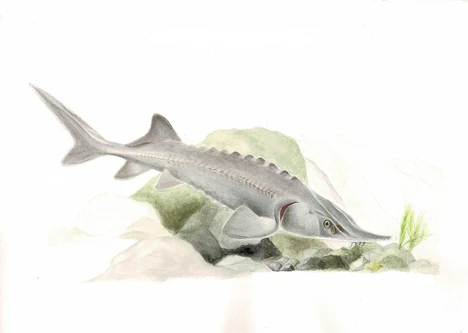
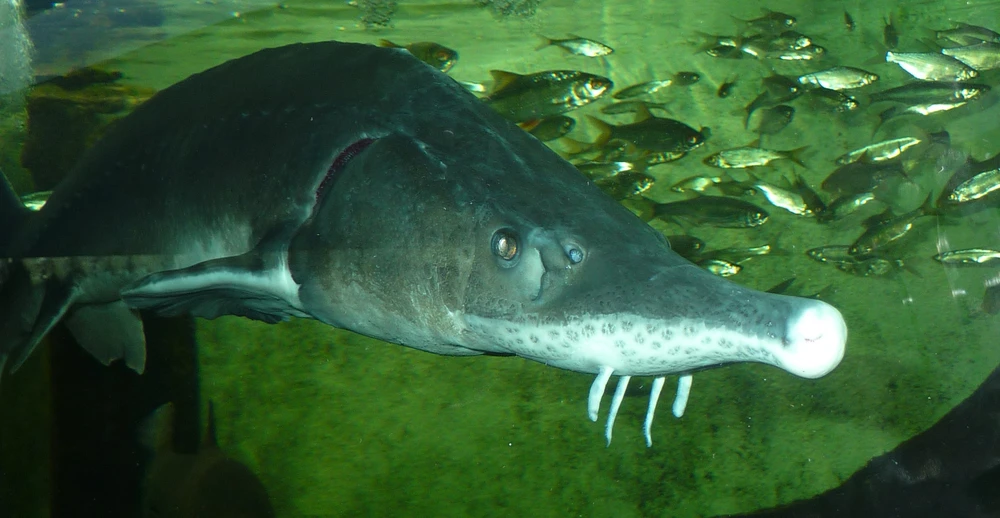
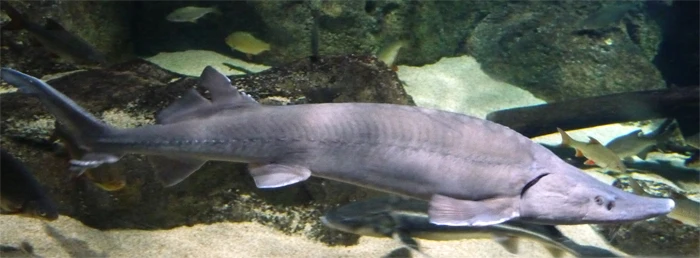
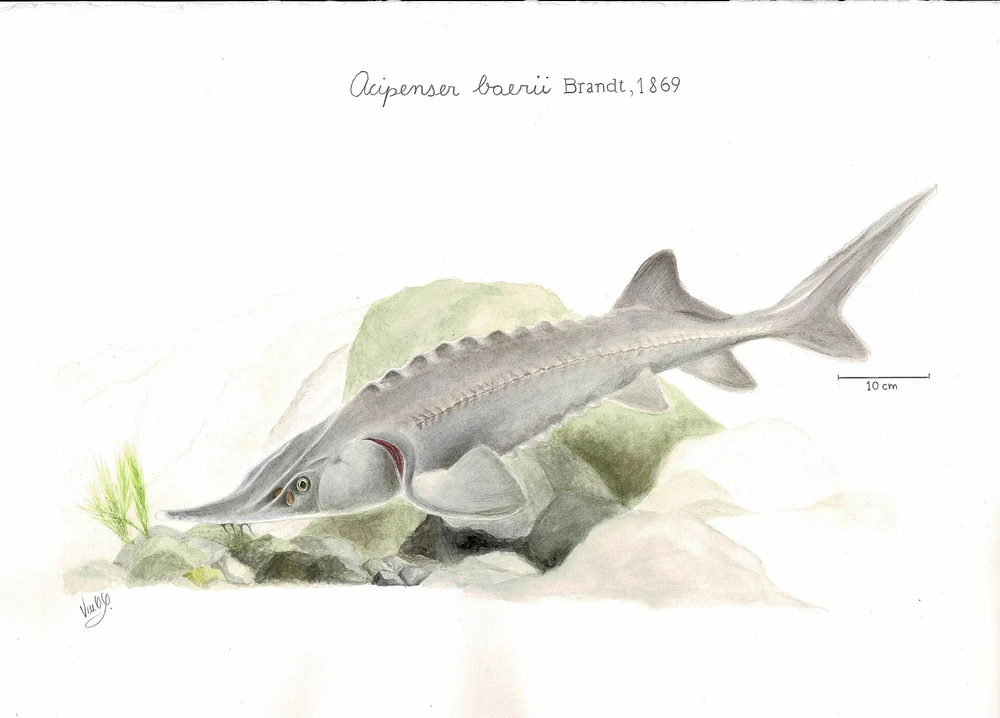
Acipenser baerii (Siberian sturgeon) is a member of the family Acipenseridae. It is a large, long-lived species. Historically, it ranged across major Siberian basins (e.g., Ob–Irtysh, Yenisei, Lena, and others) and lakes (e.g., Baikal), with some populations inhabiting brackish estuaries. Wild populations have declined strongly, mainly due to overfishing for caviar and due to the construction of dams that block the natural spawning migration. There is uncertainty related to wild ecology, as the natural habitat is limited to remote areas, where field studies have not been conducted since the ‘80s.
It is currently farmed around the world, mainly for the eggs (caviar), secondarily for the meat, depending on each country’s internal market. For this reason, its aquaculture focuses on rearing IND for a long period of time (6-7 years) in big tanks, cages, or earthen ponds until sexual maturity is reached and it is possible to collect the eggs by slaughtering the IND. To this end, hormonal implants and invasive monitoring techniques are widespread in order to maximise egg production. IND destined for meat production are slaughtered earlier.
The WelfareScore is low due to the species’ migratory behaviour and the widespread use of artificial reproduction procedures. For JUVENILES, the available rearing substrate may be adequate, and mitigation strategies to reduce stress have been tested. In contrast, procedures and facilities used during the spawning phase often sacrifice welfare in order to optimise egg production. Improving welfare for SPAWNERS and researching natural spawning could deliver the highest welfare payoff. Manuals and studies report little to no inter-individual aggression in farms, but it still needs direct empirical confirmation. Malformation rates are described as low, and good slaughter protocols are available. At the same time, the lack of tagging and field studies in the wild creates high uncertainty about the spatial and social needs of A. baerii in the wild. New research on wild behaviour with modern tracking techniques is critically needed.
1 Home range
Many species traverse in a limited horizontal space (even if just for a certain period of time per year); the home range may be described as a species' understanding of its environment (i.e., its cognitive map) for the most important resources it needs access to.
What is the probability of providing the species' whole home range in captivity?
It is unclear for minimal and high-standard farming conditions, given we exclusively found data from farms. Our conclusion is based on a medium amount of evidence, as further research is needed on home range in the wild.2 Depth range
Given the availability of resources (food, shelter) or the need to avoid predators, species spend their time within a certain depth range.
What is the probability of providing the species' whole depth range in captivity?
It is low for minimal farming conditions, as tanks, raceways, ponds, and cages do not cover the higher end of the depth range in the wild, although we cannot be sure in some age classes. It is unclear for high-standard farming conditions, as these systems do not overlap with the depth range in the wild for ADULTS and SPAWNERS, but we lack details on the lower end of the depth range in the wild for JUVENILES. Our conclusion is based on a medium amount of evidence, as further research is needed on specific depth information in the wild.3 Migration
Some species undergo seasonal changes of environments for different purposes (feeding, spawning, etc.), and to move there, they migrate for more or less extensive distances.
What is the probability of providing farming conditions that are compatible with the migrating or habitat-changing behaviour of the species?
It is low for minimal farming conditions, as the species undertakes more or less extensive migrations, and we cannot be sure that providing each age class with their respective environmental conditions will satisfy their urge to migrate or whether they need to experience the transition. It is low for high-standard farming conditions, as the space range in captivity does not overlap with the migration distance. Our conclusion is based on a high amount of evidence.4 Reproduction
A species reproduces at a certain age, season, and sex ratio and possibly involving courtship rituals.
What is the probability of the species reproducing naturally in captivity without manipulation of these circumstances?
It is low for minimal and high-standard farming conditions, as the species is manipulated (IND kept separately, biopsy/cannulation, hormonal manipulation, stripping, laparotomy), and even if done under anaesthesia, it remains far from natural spawning. Our conclusion is based on a medium amount of evidence, as further research is needed on mating type and courting rituals in the wild as well as number of spawning events in captivity.5 Aggregation
Species differ in the way they co-exist with conspecifics or other species from being solitary to aggregating unstructured, casually roaming in shoals or closely coordinating in schools of varying densities.
What is the probability of providing farming conditions that are compatible with the aggregation behaviour of the species?
It is unclear for minimal and high-standard farming conditions, as the missing wild information on specific densities in aggregations does not allow a comparison with farming conditions. Our conclusion is based on a medium amount of evidence.6 Aggression
There is a range of adverse reactions in species, spanning from being relatively indifferent towards others to defending valuable resources (e.g., food, territory, mates) to actively attacking opponents.
What is the probability of the species being non-aggressive and non-territorial in captivity?
It is low for minimal farming conditions, as FRY can be aggressive – even cannibalistic. It is high for high-standard farming conditions, as a) ways to reduce and in fact avoid aggression in FRY (density, size grading) are verified for the farming context and b) there is no aggression reported from JUVENILES on. Our conclusion is based on a low amount of evidence, as further research is needed specifically addressing aggression (or lack thereof).7 Substrate
Depending on where in the water column the species lives, it differs in interacting with or relying on various substrates for feeding or covering purposes (e.g., plants, rocks and stones, sand and mud, turbidity).
What is the probability of providing the species' substrate and shelter needs in captivity?
It is low for minimal farming conditions, as a) almost all age classes of the species use substrate, but tanks, cages, and some ponds and raceways are devoid of it and b) given stripping, laparotomy, or other ways of artificial spawning. It is medium for high-standard farming conditions given a) earthen ponds (which are not replaced by concrete bottom) or raceways with sand bottom for JUVENILES to ADULTS, but b) no natural reproduction imaginable for SPAWNERS (which would require spawning substrate in earthen ponds) – probably not even substrate in holding ponds. Our conclusion is based on a medium amount of evidence.8 Stress
Farming involves subjecting the species to diverse procedures (e.g., handling, air exposure, short-term confinement, short-term crowding, transport), sudden parameter changes or repeated disturbances (e.g., husbandry, size-grading).
What is the probability of the species not being stressed?
It is low for minimal farming conditions, as the species is stressed (water quality, confinement, crowding, handling). It is medium for high-standard farming conditions, as some ways to reduce (but not avoid) stress are verified for the farming context, others – especially handling for reproduction procedures – do not seem to be avoidable. Our conclusion is based on a medium amount of evidence, as further research is needed.9 Malformations
Deformities that – in contrast to diseases – are commonly irreversible may indicate sub-optimal rearing conditions (e.g., mechanical stress during hatching and rearing, environmental factors unless mentioned in crit. 3, aquatic pollutants, nutritional deficiencies) or a general incompatibility of the species with being farmed.
What is the probability of the species being malformed rarely?
It is low for minimal farming conditions, as malformation rates can exceed 10%. It is high for high-standard farming conditions, as many times, malformation rates stay below 10%, and malformations result from conditions that may be changed (feed supplementation, abrupt events). Our conclusion is based on a medium amount of evidence, as further research is needed on mitigation measures, e.g., how to insulate from loud noises.10 Slaughter
The cornerstone for a humane treatment is that slaughter a) immediately follows stunning (i.e., while the individual is unconscious), b) happens according to a clear and reproducible set of instructions verified under farming conditions, and c) avoids pain, fear, and distress.
What is the probability of the species being slaughtered according to a humane slaughter protocol?
It is low for minimal farming conditions (hypothermia). It is high for high-standard farming conditions, as electronarcosis and percussive stunning by spiking, followed by bleeding, induces unconsciousness fast (if done correctly), kills while still unconscious, and is verified for the farming context. Our conclusion is based on a low amount of evidence, as further research is needed to confirm the findings.Side note: Domestication
Teletchea and Fontaine introduced 5 domestication levels illustrating how far species are from having their life cycle closed in captivity without wild input, how long they have been reared in captivity, and whether breeding programmes are in place.
What is the species’ domestication level?
DOMESTICATION LEVEL 5 40, fully domesticated.
Side note: Forage fish in the feed
450-1,000 milliard wild-caught fishes end up being processed into fish meal and fish oil each year which contributes to overfishing and represents enormous suffering. There is a broad range of feeding types within species reared in captivity.
To what degree may fish meal and fish oil based on forage fish be replaced by non-forage fishery components (e.g., poultry blood meal) or sustainable sources (e.g., soybean cake)?
All age classes:
- WILD: carnivorous 17.
- FARM: fish meal may be mostly* replaced by sustainable sources 7, but further research is needed to investigate effects on welfare beyond 50 days of replacement diet.
- LAB: fish meal may be mostly* 41 42 43 or completely* 44 replaced by sustainable sources, but further research is needed to investigate effects on welfare after >2 months. Fish meal may be mostly* 45 46 replaced by non-forage fishery components, but further research is needed to investigate effects on welfare after more than 2 months.
*partly = <51%, mostly = 51-99%, completely = 100%
Side note: Commercial relevance
How much is this species farmed annually?
513 t/year 1990-2019 amounting to estimated 1,000,000 IND/year 1990-2019 47.
Glossary
BENTHIC = living at the bottom of a body of water, able to rest on the floor
DOMESTICATION LEVEL 5 = selective breeding programmes are used focusing on specific goals 40
DPH = days post hatching
FARM = setting in farming environment or under conditions simulating farming environment in terms of size of facility or number of individuals
FRY = larvae from external feeding on
IND = individuals
JUVENILES = fully developed but immature individuals
LAB = setting in laboratory environment
LARVAE = hatching to mouth opening
PLANKTONIC = horizontal movement limited to hydrodynamic displacement
POTAMODROMOUS = migrating within fresh water
RAS = Recirculating Aquaculture System - almost completely closed system using filters to clean and recirculate water with the aim of reducing water input and with the advantage of enabling close control of environmental parameters to maintain high water quality
SEMI-ANADROMOUS = migrating from downstream or the estuary into fresh water upstream to spawn
SPAWNERS = adults during the spawning season; in farms: adults that are kept as broodstock
WILD = setting in the wild
Bibliography
1 Gisbert, E., P. Williot, and F. Castelló-Orvay. 1999. Behavioural modifications in the early life stages of Siberian sturgeon (Acipenser baerii, Brandt). Journal of Applied Ichthyology 15: 237–242. https://doi.org/10.1111/j.1439-0426.1999.tb00242.x.
2 Gisbert, E. 1999. Early development and allometric growth patterns in Siberian sturgeon and their ecological significance. Journal of Fish Biology 54: 852–862. https://doi.org/10.1111/j.1095-8649.1999.tb02037.x.
3 Gisbert, E, P Williot, and F Castelló-Orvay. 2000. Influence of egg size on growth and survival of early stages of Siberian sturgeon (Acipenser baeri) under small scale hatchery conditions. Aquaculture 183: 83–94. https://doi.org/10.1016/S0044-8486(99)00287-2.
4 Williot, Patrick, Guy Nonnotte, and Mikhail Chebanov, ed. 2018. The Siberian Sturgeon (Acipenser baerii, Brandt, 1869) Volume 2 - Farming. Cham: Springer International Publishing. https://doi.org/10.1007/978-3-319-61676-6.
5 Sîrbu, E, V Nistor, F M Dima, N Patriche, M Tenciu, L B Athanasopoulos, and M D Popa. 2022. Preliminary results regarding the postlarval stage for the species Acipenser baerii (j. f. brandt, 1869) in recirculating aquaculture system.
6 Rodríguez, A., M.A. Gallardo, E. Gisbert, S. Santilari, A. Ibarz, J. Sánchez, and F. Castelló-Orvay. 2002. Osmoregulation in juvenile Siberian sturgeon (Acipenser baerii). Fish Physiology and Biochemistry 26: 345–354. https://doi.org/10.1023/B:FISH.0000009263.83075.68.
7 Mazurkiewicz, Jan, Antoni Przybył, and Janusz Golski. 2009. Usability of some plant protein ingredients in the diets of Siberian sturgeon Acipenser baerii Brandt. Archives of Polish Fisheries 17. https://doi.org/10.2478/v10086-009-0002-3.
8 Eslamloo, Khalil, and Bahram Falahatkar. 2014. Variations of Some Physiological and Immunological Parameters in Siberian Sturgeon (Acipenser baerii, Brandt, 1869) Subjected to an Acute Stressor. Journal of Applied Animal Welfare Science 17: 29–42. https://doi.org/10.1080/10888705.2014.856243.
9 Hj, Hamlin, Edwards Tm, Moore Bc, Main Kl, and Guillette LJ Jr. 2006. Stress and its relation to endocrine function in captive female Siberian sturgeon (Acipenser baeri). Environmental sciences : an international journal of environmental physiology and toxicology 14: 129–139.
10 Hufschmied, P., T. Fankhauser, and D. Pugovkin. 2011. Automatic stress-free sorting of sturgeons inside culture tanks using image processing: Automatic stress-free sorting of sturgeons. Journal of Applied Ichthyology 27: 622–626. https://doi.org/10.1111/j.1439-0426.2011.01704.x.
11 Saraiva, João L. 2018. Personal communication.
12 Köksal, Gülten, Ferit Rad, and Mevlüt Kindir. 2000. Growth performance and feed conversion efficiency of Siberian sturgeon juveniles (Acipenser baeri) reared in concrete raceways. Turkish Journal of Veterinary and Animal Sciences 24: 435–442.
13 Duman, Selçuk. 2020. Effect of concrete pond and net-cage culture systems on growth performance and haematological parameters of Siberian sturgeon (Acipenser baerii). Turkish Journal of Veterinary and Animal Sciences 44: 624–631. https://doi.org/10.3906/vet-1910-41.
14 Piotrowska, Iwona, and Michał Kozłowski. 2024. Preliminary rearing outcomes of Siberian sturgeon, Acipenser baerii Brandt, juveniles in autonomous hatching and rearing modules. Fisheries & Aquatic Life 32: 26–33. https://doi.org/10.2478/aopf-2024-0003.
15 Paschos, I., C. Perdikaris, E. Gouva, and C. Nathanailides. 2008. Sturgeons in Greece: a review. Journal of Applied Ichthyology 24: 131–137. https://doi.org/10.1111/j.1439-0426.2007.01029.x.
16 Votinov, NP. 1963. Biologicheskie osnovy iskusstvennogo vosproizvodstva obskogo osetra (Biological foundations of artificial reproduction of the Ob River sturgeon). Ob-Tazovskogo Otdeleniya Gosudarstvennogo Nauchno-Issledovatelskogo Instituta Ozernogo i Rechnogo Rybnogo Khozyaistva 3. Novaya Seria: 5–102.
17 Williot, Patrick, Guy Nonnotte, Denise Vizziano-Cantonnet, and Mikhail Chebanov, ed. 2018. The Siberian Sturgeon (Acipenser baerii, Brandt, 1869) Volume 1 - Biology. Cham: Springer International Publishing. https://doi.org/10.1007/978-3-319-61664-3.
18 Kirichenko, Olga, Kuanysh Isbekov, Saule Assylbekova, and Alyona Mukhramova. 2023. State overview of the Siberian sturgeon (Acipenser baerii) population in the Irtysh basin 16.
19 Hasanalipour, Alireza, Soheil Eagderi, Hadi Poorbagher, and Mahmoud Bahmani. 2013. Effects of Stocking Density on Blood Cortisol, Glucose and Cholesterol Levels of Immature Siberian Sturgeon. Turkish Journal of Fisheries and Aquatic Sciences 13: 27–32. https://doi.org/10.4194/1303-2712-v13_1_04.
20 Pavlov, D.S., G.I. Ruban, and L.I. Sokolov. 2001. On types of spawning migration in sturgeon fishes (Acipenseriformes) of the world fauna. Journal of Ichthyology 41: 225–236.
21 Birstein, Vadim J., and Georgii I. Ruban. 2004. A comment on the Siberian, Acipenser baerii, and Russian, Acipenser gueldenstaedtii, sturgeons. Environmental Biology of Fishes 70: 91–92.
22 Votinov, N.P., and V.P. Kas’yanov. 1978. K voprosu o vosproizvodstve sibirskogo osetra v basseine r. Obi v usloviyakh zaregulirovannogo stoka (On the problem of of the Siberian sturgeon) Acipenser baeri Brandt reproduction in the Ob River as affected by hydraulic structure. Vopr Ikhtiol 18: 25–35.
23 Dryagyn, P. A. 1949. Biology of the Siberian sturgeon, its reserves and rational utilization. Izvestiya Vsesouznogo Instituta Ozernogo i Rechnogo Rybnogo Khozyaistva: 3–51.
24 Ruban, Georgii I. 1997. Species structure, contemporary distribution and status of the Siberian surgeon Acipenser baerii. Environmental Biology of Fishes 48: 221–230. https://doi.org/10.1023/A:1007372932444.
25 Williot, Patrick, Sylvain Comte, and F. Le Menn. 2011. Stress indicators throughout the reproduction of farmed Siberian sturgeon Acipenser baerii (Brandt) females. Stress 3.
26 Charlon, N, and P Bergot. 1991. Alimentation artificielle des larves de l’esturgeon siberien (Acipenser baeri Brandt). In Proceedings on the First International Symposium on the Sturgeon, 405–415. Bordeaux: CEMAGREF-DICOVA.
27 Gisbert, E., and P. Williot. 2002. Advances in the larval rearing of Siberian sturgeon. Journal of Fish Biology 60: 1071–1092. https://doi.org/10.1111/j.1095-8649.2002.tb01705.x.
28 Aidos, Lucia, Alessandra Cafiso, Annalaura Lopez, Mauro Vasconi, Luisa M. P. Valente, Chiara Bazzocchi, and Alessia Di Giancamillo. 2022. Rearing Environment during the Endogenous Feeding Stage of Acipenser baerii. Animals 12: 2205. https://doi.org/10.3390/ani12172205.
29 Gisbert, Enric, and Patrick Williot. 1997. Larval behaviour and effect of the timing of initial feeding on growth and survival of Siberian sturgeon (Acipenser baeri) larvae under small scale hatchery production. Aquaculture 156: 63–76. https://doi.org/10.1016/S0044-8486(97)00086-0.
30 Allen, P. J., C. C. Barth, S. J. Peake, M. V. Abrahams, and W. G. Anderson. 2009. Cohesive social behaviour shortens the stress response: the effects of conspecifics on the stress response in lake sturgeon Acipenser fulvescens. Journal of Fish Biology 74: 90–104. https://doi.org/10.1111/j.1095-8649.2008.02112.x.
31 Ruban, GI, and LA Konoplya. 1994. Diet of the Siberian Sturgeon, Acipenser baeri, in the Indigirka and Kolyma rivers. Journal of Ichthyology/Voprosy Ikhtiologii: 1.
32 Gisbert, Enric, and Georgii I. Ruban. 2003. Ontogenetic behavior of Siberian sturgeon, Acipenser baerii: A synthesis between laboratory tests and field data. Environmental Biology of Fishes 67: 311–319. https://doi.org/10.1023/A:1025851502232.
33 Mitrofanov, V. P., and G. P. Dukravets. 1986. Fishes of Kazakhstan. In Science of the Kazakh SSR, 110–120.
34 Gisbert, E., and P. Williot. 2002. Duration of synchronous egg cleavage cycles at different temperatures in Siberian sturgeon (Acipenser baerii). Journal of Applied Ichthyology 18: 271–274. https://doi.org/10.1046/j.1439-0426.2002.00374.x.
35 Simide, Rémy, Frédéric Angelier, Sandrine Gaillard, and Antoine Stier. 2016. Age and Heat Stress as Determinants of Telomere Length in a Long-Lived Fish, the Siberian Sturgeon. Physiological and Biochemical Zoology 89: 441–447. https://doi.org/10.1086/687378.
36 Gisbert, Enric, and Patrick Williot. 2002. Influence of Storage Duration of Ovulated Eggs Prior to Fertilisation on the Early Ontogenesis of Sterlet (Acipenser ruthenus) and Siberian Sturgeon (Acipenser baeri). International Review of Hydrobiology 87: 605–612. https://doi.org/10.1002/1522-2632(200211)87:5/6%3C605::AID-IROH605%3E3.0.CO;2-%23.
37 Gisbert, Enric, Adriana Rodriguez, Francesc Castelló-Orvay, and Patrick Williot. 1998. A histological study of the development of the digestive tract of Siberian sturgeon (Acipenser baeri) during early ontogeny. Aquaculture 167: 195–209. https://doi.org/10.1016/S0044-8486(98)00312-3.
38 Fontagné, Stéphanie, Didier Bazin, Jeannine Brèque, Christiane Vachot, Cédric Bernarde, Thierry Rouault, and Pierre Bergot. 2006. Effects of dietary oxidized lipid and vitamin A on the early development and antioxidant status of Siberian sturgeon (Acipenser baeri) larvae. Aquaculture 257: 400–411. https://doi.org/10.1016/j.aquaculture.2006.01.025.
39 Brun, P., P. Nougayrede, P. Chene, and et al. 1991. Bilan sanitaire de 2 ans d’élevage d’Acipenser baeri en piscicultures intensives. In Acipenser, Williot P., 429–437. France: CEMAGREF.
40 Teletchea, Fabrice, and Pascal Fontaine. 2012. Levels of domestication in fish: implications for the sustainable future of aquaculture. Fish and Fisheries 15: 181–195. https://doi.org/10.1111/faf.12006.
41 Ronyai, A., I. Csengeri, and L. Varadi. 2002. Partial substitution of animal protein with full-fat soybean meal and amino acid supplementation in the diet of Siberian sturgeon (Acipenser baerii). Journal of Applied Ichthyology 18: 682–684. https://doi.org/10.1046/j.1439-0426.2002.00372.x.
42 Palmegiano, Giovanni B, Elisabetta Agradi, Gilberto Forneris, Francesco Gai, Laura Gasco, Elisabetta Rigamonti, Benedetto Sicuro, and Ivo Zoccarato. 2005. Spirulina as a nutrient source in diets for growing sturgeon (Acipenser baeri). Aquaculture Research 36: 188–195. https://doi.org/10.1111/j.1365-2109.2005.01209.x.
43 Yun, B., M. Xue, J. Wang, H. Sheng, Y. Zheng, X. Wu, and J. Li. 2014. Fishmeal can be totally replaced by plant protein blend at two protein levels in diets of juvenile Siberian sturgeon, Acipenser baerii Brandt. Aquaculture Nutrition 20: 69–78. https://doi.org/10.1111/anu.12053.
44 Kaushik, S.J., J. Breque, and D. Blanc. 1994. Apparent amino acid availability and plasma free amino acid levels in Siberian sturgeon (Acipenser baeri). Comparative Biochemistry and Physiology Part A: Physiology 107: 433–438. https://doi.org/10.1016/0300-9629(94)90403-0.
45 Xue, M., B. Yun, J. Wang, H. Sheng, Y. Zheng, X. Wu, Y. Qin, and P. Li. 2012. Performance, body compositions, input and output of nitrogen and phosphorus in Siberian sturgeon, Acipenser baerii Brandt, as affected by dietary animal protein blend replacing fishmeal and protein levels. Aquaculture Nutrition 18: 493–501. https://doi.org/10.1111/j.1365-2095.2011.00908.x.
46 Zhu, H., G. Gong, J. Wang, X. Wu, M. Xue, C. Niu, L. Guo, and Y. Yu. 2011. Replacement of fish meal with blend of rendered animal protein in diets for Siberian sturgeon (Acipenser baerii Brandt), results in performance equal to fish meal fed fish: Alternative protein utilization for Siberian sturgeon. Aquaculture Nutrition 17: e389–e395. https://doi.org/10.1111/j.1365-2095.2010.00773.x.
47 Mood, Alison, Elena Lara, Natasha K. Boyland, and Phil Brooke. 2023. Estimating global numbers of farmed fishes killed for food annually from 1990 to 2019. Animal Welfare 32. Cambridge University Press: e12. https://doi.org/10.1017/awf.2023.4.


The legend next to the WelfareScore card gives the definitions of the three dimensions we score the welfare of aquatic species on. You will also find the score options and how we arrive at the overall WelfareScore. If you scroll down to the criteria, you will find the explanations for the scores for each criterion for many species already. We are in the process of inserting these for all WelfareChecks we update. If your species of interest is missing these score justifications or if you are interested to know more details about the scoring procedure, please consult our scoring rationale.
For WelfareChecks we have not managed to update yet, previous scoring rationales may apply:
- before 2022: scoring rationale
- before 2018: scoring rationale
In general, this depends on the available literature on the species – for example, electrical stunning can work for one species but not for another. The prerequisites are that stunning a) induction happens without inducing pain, fear, or distress, b) is verified for the farming context (otherwise, we report under the "LAB" label for laboratory studies), and c) continues until slaughter, so without the individuals regaining consciousness and sensibility. Asphyxiation in air or water as well as hypothermia usually do not cover this. For fair-fish's position on the debate about electrical stunning, including how its effectiveness can be assessed from a welfare perspective, please see our position paper (07/2026).
The criteria cover the main focus of the WelfareChecks – an assessment of the welfare of aquatic species. When selecting the criteria, though, we were aware of the importance of some topics so that we wanted to include them and collect data but not score them. For WelfareChecks | farm, these topics are "domestication level", "feed replacement", and "commercial relevance". The domestication and commercial relevance aspects allow us to analyse the questions whether increasing rate of domestication or relevance in farming worldwide goes hand in hand with better welfare; the feed replacement rather goes in the direction of added suffering for all those species which end up as feed. For a carnivorous species, to gain 1 kg of meat, you do not just kill this one individual but you have to take into account the meat that it was fed during its life in the form of fish meal and fish oil. In other words, carnivorous species (and to a degree also omnivorous ones) have a larger "fish in:fish out" ratio.
Probably, we updated the profile. Check the version number in the head of the page. For more information on the version, see the FAQ about this. Why do we update profiles? Not just do we want to include new research that has come out, but we are continuously developing the database itself. For example, we changed the structure of entries in criteria or we added explanations for scores in the WelfareCheck | farm. And we are always refining our scoring rules.
The centre of the Overview is an array of criteria covering basic features and behaviours of the species. Each of this information comes from our literature search on the species. If we researched a full Dossier on the species, probably all criteria in the Overview will be covered and thus filled. This was our way to go when we first set up the database.
Because Dossiers are time consuming to research, we switched to focusing on WelfareChecks. These are much shorter profiles covering just 10 criteria we deemed important when it comes to behaviour and welfare in aquaculture (and lately fisheries, too). Also, WelfareChecks contain the assessment of the welfare potential of a species which has become the main feature of the fair-fish database over time. Because WelfareChecks do not cover as many criteria as a Dossier, we don't have the information to fill all blanks in the Overview, as this information is "not investigated by us yet".
Our long-term goal is to go back to researching Dossiers for all species covered in the fair-fish database once we set up WelfareChecks for each of them. If you would like to support us financially with this, please get in touch at ffdb@fair-fish.net
See the question "What does "not investigated by us yet" mean?". In short, if we have not had a look in the literature - or in other words, if we have not investigated a criterion - we cannot know the data. If we have already checked the literature on a criterion and could not find anything, it is "no data found yet". You spotted a "no data found yet" where you know data exists? Get in touch with us at ffdb@fair-fish.net!
Once you have clicked on "show details", the entry for a criterion will unfold and display the summarised information we collected from the scientific literature – complete with the reference(s).
As reference style we chose "Springer Humanities (numeric, brackets)" which presents itself in the database as a number in a grey box. Mouse over the box to see the reference; click on it to jump to the bibliography at the bottom of the page. But what does "[x]↶[y]" refer to?
This is the way we mark secondary citations. In this case, we read reference "y", but not reference "x", and cite "x" as mentioned in "y". We try to avoid citing secondary references as best as possible and instead read the original source ourselves. Sometimes we have to resort to citing secondarily, though, when the original source is: a) very old or not (digitally) available for other reasons, b) in a language no one in the team understands. Seldomly, it also happens that we are running out of time on a profile and cannot afford to read the original. As mentioned, though, we try to avoid it, as citing mistakes may always happen (and we don't want to copy the mistake) and as misunderstandings may occur by interpreting the secondarily cited information incorrectly.
If you spot a secondary reference and would like to send us the original work, please contact us at ffdb@fair-fish.net
In general, we aim at giving a good representation of the literature published on the respective species and read as much as we can. We do have a time budget on each profile, though. This is around 80-100 hours for a WelfareCheck and around 300 hours for a Dossier. It might thus be that we simply did not come around to reading the paper.
It is also possible, though, that we did have to make a decision between several papers on the same topic. If there are too many papers on one issue than we manage to read in time, we have to select a sample. On certain topics that currently attract a lot of attention, it might be beneficial to opt for the more recent papers; on other topics, especially in basic research on behaviour in the wild, the older papers might be the go-to source.
And speaking of time: the paper you are missing from the profile might have come out after the profile was published. For the publication date, please check the head of the profile at "cite this profile". We currently update profiles every 6-7 years.
If your paper slipped through the cracks and you would like us to consider it, please get in touch at ffdb@fair-fish.net
This number, for example "C | 2.1 (2022-11-02)", contains 4 parts:
- "C" marks the appearance – the design level – of the profile part. In WelfareChecks | farm, appearance "C" is our most recent one with consistent age class and label (WILD, FARM, LAB) structure across all criteria.
- "2." marks the number of major releases within this appearance. Here, it is major release 2. Major releases include e.g. changes of the WelfareScore. Even if we just add one paper – if it changes the score for one or several criteria, we will mark this as a major update for the profile. With a change to a new appearance, the major release will be re-set to 1.
- ".1" marks the number of minor updates within this appearance. Here, it is minor update 1. With minor updates, we mean changes in formatting, grammar, orthography. It can also mean adding new papers, but if these papers only confirm the score and don't change it, it will be "minor" in our book. With a change to a new appearance, the minor update will be re-set to 0.
- "(2022-11-02)" is the date of the last change – be it the initial release of the part, a minor, or a major update. The nature of the changes you may find out in the changelog next to the version number.
If an Advice, for example, has an initial release date and then just a minor update date due to link corrections, it means that – apart from correcting links – the Advice has not been updated in a major way since its initial release. Please take this into account when consulting any part of the database.
First up, you will find answers to questions for the specific page you are on. Scrolling down in the FAQ window, there are also answers to more general questions. Explore our website and the other sub pages and find there the answers to questions relevant for those pages.
In the fair-fish database, when you have chosen a species (either by searching in the search bar or in the species tree), the landing page is an Overview, introducing the most important information to know about the species that we have come across during our literatures search, including common names, images, distribution, habitat and growth characteristics, swimming aspects, reproduction, social behaviour but also handling details. To dive deeper, visit the Dossier where we collect all available ethological findings (and more) on the most important aspects during the life course, both biologically and concerning the habitat. In contrast to the Overview, we present the findings in more detail citing the scientific references.
Depending on whether the species is farmed or wild caught, you will be interested in different branches of the database.
Farm branch
Founded in 2013, the farm branch of the fair-fish database focuses on farmed aquatic species.
Catch branch
Founded in 2022, the catch branch of the fair-fish database focuses on wild-caught aquatic species.
The heart of the farm branch of the fair-fish database is the welfare assessment – or WelfareCheck | farm – resulting in the WelfareScore | farm for each species. The WelfareCheck | farm is a condensed assessment of the species' likelihood and potential for good welfare in aquaculture, based on welfare-related findings for 10 crucial criteria (home range, depth range, migration, reproduction, aggregation, aggression, substrate, stress, malformations, slaughter).
For those species with a Dossier, we conclude to-be-preferred farming conditions in the Advice | farm. They are not meant to be as detailed as a rearing manual but instead, challenge current farming standards and often take the form of what not to do.
In parallel to farm, the main element of the catch branch of the fair-fish database is the welfare assessment – or WelfareCheck | catch – with the WelfareScore | catch for each species caught with a specific catching method. The WelfareCheck | catch, too, is a condensed assessment of the species' likelihood and potential for good welfare – or better yet avoidance of decrease of good welfare – this time in fisheries. We base this on findings on welfare hazards in 10 steps along the catching process (prospection, setting, catching, emersion, release from gear, bycatch avoidance, sorting, discarding, storing, slaughter).
In contrast to the farm profiles, in the catch branch we assess the welfare separately for each method that the focus species is caught with. In the case of a species exclusively caught with one method, there will be one WelfareCheck, whereas in other species, there will be as many WelfareChecks as there are methods to catch the species with.
Summarising our findings of all WelfareChecks | catch for one species in Advice | catch, we conclude which catching method is the least welfare threatening for this species and which changes to the gear or the catching process will potentially result in improvements of welfare.
Welfare of aquatic species is at the heart of the fair-fish database. In our definition of welfare, we follow Broom (1986): “The welfare of an individual is its state as regards its attempts to cope with its environment.” Thus, welfare may be perceived as a continuum on which an individual rates “good” or “poor” or everything in between.
We pursue what could be called a combination of not only a) valuing the freedom from injuries and stress (function-based approach) but b) supporting attempts to provide rewarding experiences and cognitive challenges (feelings-based approach) as well as c) arguing for enclosures that mimic the wild habitat as best as possible and allow for natural behaviour (nature-based approach).
Try mousing over the element you are interested in - oftentimes you will find explanations this way. If not, there will be FAQ on many of the sub-pages with answers to questions that apply to the respective sub-page. If your question is not among those, contact us at ffdb@fair-fish.net.
It's right here! We decided to re-name it to fair-fish database for several reasons. The database has grown beyond dealing purely with ethology, more towards welfare in general – and so much more. Also, the partners fair-fish and FishEthoGroup decided to re-organise their partnership. While maintaining our friendship, we also desire for greater independence. So, the name "fair-fish database" establishes it as a fair-fish endeavour.