Information
Authors: María J. Cabrera-Álvarez, Jenny Volstorf
Version: A | 1.0Published: 2026-03-03
- minor editorial changes incl. formal and content corrections, clarifications, adjustments in favour of consistency
- pre-release version
WelfareScore | catch
The score card gives our welfare assessments for aquatic species in 10 criteria.
For each criterion, we score the probability to experience good welfare under minimal catching conditions ("Likelihood") and under high-standard catching conditions ("Potential") representing the worst and best case scenario. The third dimension scores how certain we are of our assessments based on the number and quality of sources we found ("Certainty").
The WelfareScore sums just the "High" scores in each dimension. Although good welfare ("High") seems not possible in some criteria, there could be at least a potential improvement from low to medium welfare (indicated by ➚ and the number of criteria).
- Li = Likelihood that the individuals of the species experience good welfare under minimal catching conditions
- Po = Potential of the individuals of the species to experience good welfare under high-standard catching conditions
➚ = potential improvements not reaching "High" - Ce = Certainty of our findings in Likelihood and Potential
WelfareScore = Sum of criteria scoring "High" (max. 10 per dimension)
General remarks
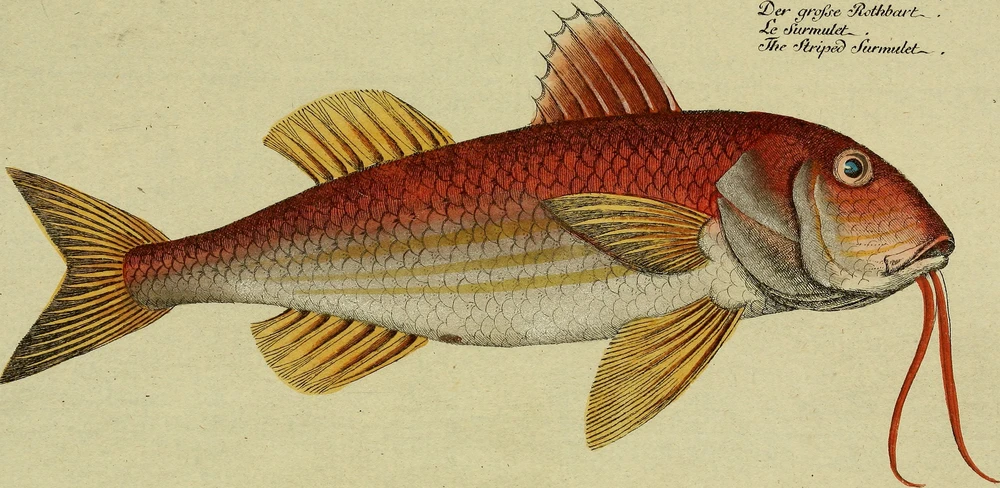
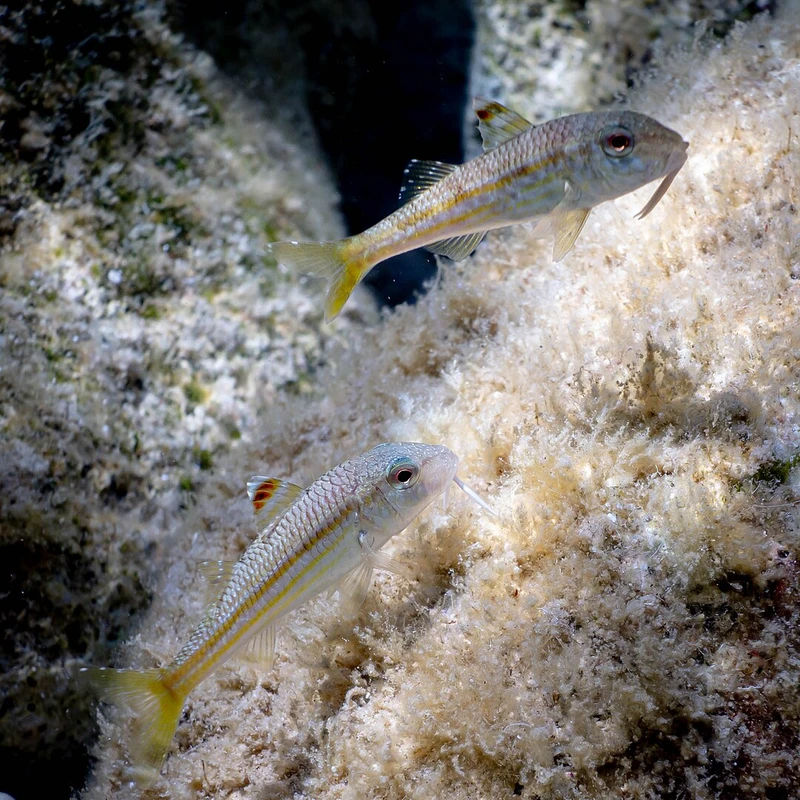
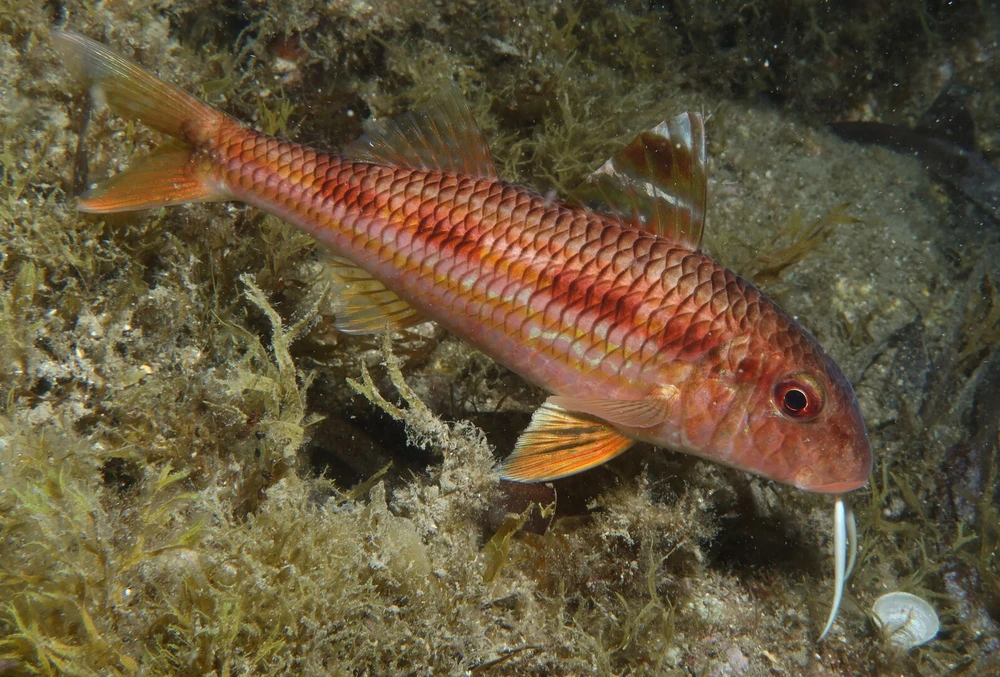
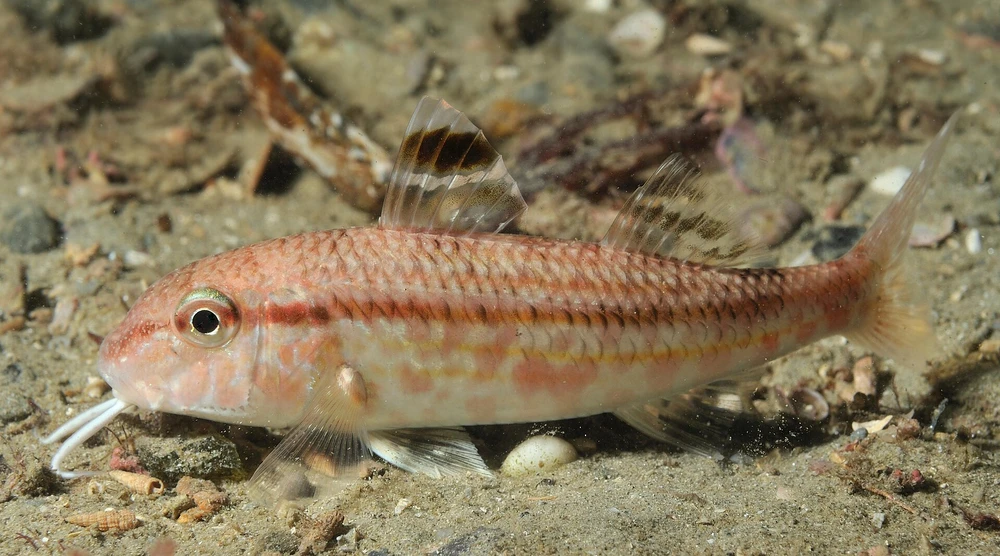
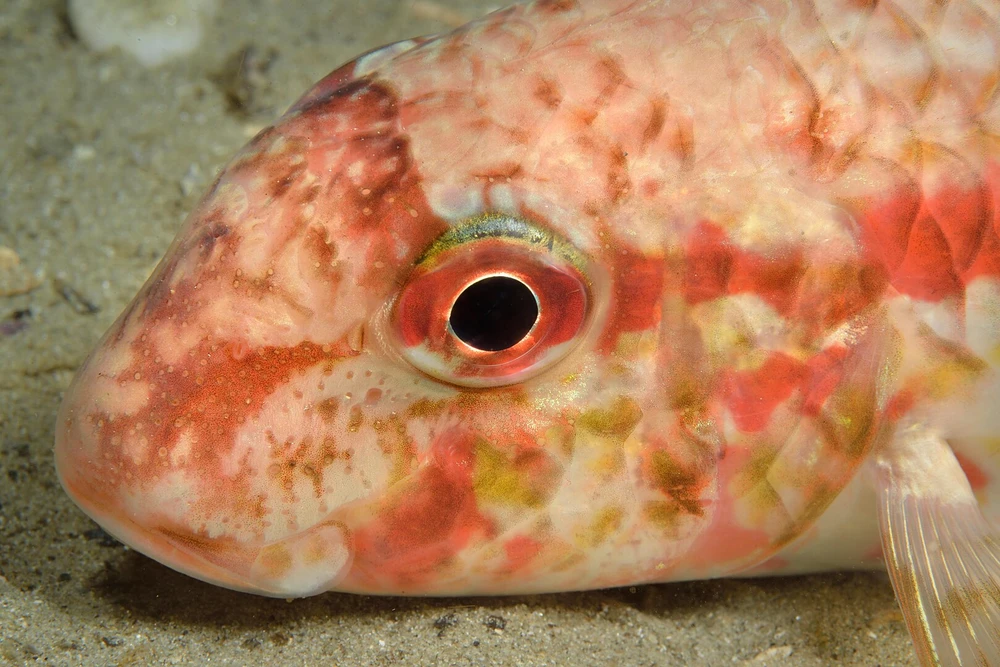
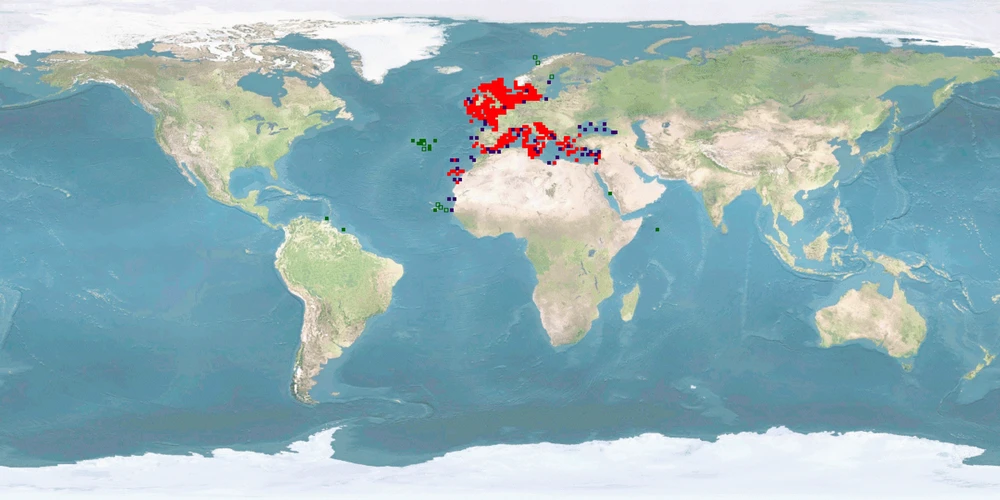
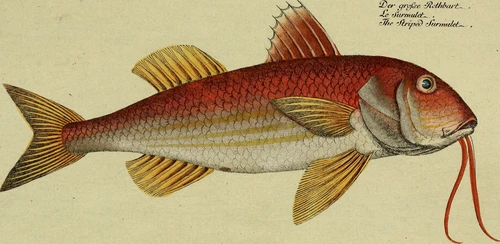
Mullus surmuletus is a popular species from waters off Norway to the Canary islands and in the Mediterranean and Black sea. In some regions, its catch statistic is combined with that of the related M. barbatus (Red mullet), as the market does not differentiate between the two. As a BENTHIC carnivore foraging in depths of 2-80 m, it is caught by DEMERSAL fisheries, predominantly of small scale, among them (bottom-)set nets. The second most frequent capture method is bottom trawl.
After being caught and held in the (gill or trammel) net during soaking and hauling – which can take several hours – the IND can already emerge dead or very weak from exhaustion or depredation by crustaceans or cetaceans. A shorter soak time could decrease suffering. Avoiding bycatch of the target species will only be able through mesh size that reduces catching undersized IND. Once on board, IND then will endure exposure to air, disentangling, experiencing their own weight, and throwing during release from gear, sorting, and storing. This could be avoided through stunning as soon as they arrive on board, followed by slaughter while still unconscious. Such a protocol does not exist, though.
Another possibility to reduce the contact with predating cetaceans could be to close the fishing for certain times or areas which would also benefit the local M. surmuletus populations. To prevent non-target species (usable and non-usable including ETP) being accidentally caught, the mesh size is decisive, but it might also need an adjustment of the minimum conservation reference size. Installing guarding nets for trammel nets is another option. Since non-target bycatch will probably not be completely avoided, a landing obligation and a campaign to encourage consumption of the less popular species could be pursued. Set nets are to be preferred over bottom trawl to catch M. surmuletus, since set nets seem to have a higher size selectivity and since their impact on the benthos is relatively low, as set nets are usually not dragged along the seafloor.
1 Prospection
To find the fishes in their habitat, there are different techniques to localise them (e.g., echosound/sonar, chasing).
What is the probability of avoiding a decrease in welfare during the process of searching for the species?
It is unclear for minimal and high-standard catching conditions. Our conclusion is based on a low amount of evidence.2 Setting
Catching methods differ in the way they are set up and consequently in the time it takes for setting them.
What is the probability of avoiding a decrease in welfare during the process of setting the catching method?
It is unclear for minimal and high-standard catching conditions. Our conclusion is based on a low amount of evidence.3 Catching
Given the principle of the catching method, the gear (with the fishes caught) may be hauled vertically or horizontally in the water for a certain amount of time and distance.
What is the probability of avoiding a decrease in welfare during catching?
It is low for minimal catching conditions, as the principle of set nets is to catch and hold IND for hours and up to great depths most likely resulting in stress and damages including barotrauma and depredation by crustaceans or cetaceans. It is medium for high-standard catching conditions given a) mesh size that reduces (but does not avoid) catching undersized IND (given body ∅ in season and region), b) no risk of decreasing distance to neighbour, c) shorter soak time which also reduces (but does not avoid) depredated IND (which needs to be verified for the catching context), and d) methods to further deter cetaceans: amend or switch gear to avoid recognisable sounds, close fishing for certain times or areas or switch up areas, apply "stealth fishing", attach dolphin deterrent devices or, favourably, dolphin interactive devices to the gear which all need to be verified for the catching context. Our conclusion is based on a medium amount of evidence, as further research is needed on safe catching depths, hauling speed, and soak times.4 Bycatch avoidance
Not all specimens of the target species are equally sought after, e.g., when they are undersized, of wrong sex, wrong age, damaged, over quota, or mixed with a high proportion of undersized or unwanted non-target fishes. Measures to prevent this bycatch still in the water may include slipping in purse seine, window in net, opening in trap, etc.
What is the probability of avoiding a decrease in welfare with the help of bycatch-avoiding measures?
It is low for minimal catching conditions, as avoiding bycatch in the water is impossible in set nets as long as the mesh size overlaps with the body ∅ of undersized IND and given depredated IND. It is medium for high-standard catching methods given a) mesh size that reduces (but does not avoid) catching undersized IND (given body ∅ in season and region), b) shorter soak time that reduces (but does not avoid) depredated IND (which needs to be verified for the catching context), and c) methods to further deter cetaceans: amend or switch gear to avoid recognisable sounds, close fishing for certain times or areas or switch up areas, apply "stealth fishing", attach dolphin deterrent devices or, favourably, dolphin interactive devices to the gear which all need to be verified for the catching context. Our conclusion is based on a medium amount of evidence, as further research is needed on safe soak times.5 Emersion
The process of bringing the fishes out of the water also depends on the catching method and may, thus, differ in duration and impact (e.g., netting, brailing, pumping, lifting).
What is the probability of avoiding a decrease in welfare during emersion?
It is low for minimal catching conditions given exposure to air, contact with the gear (also on deck), and experiencing its own weight. It is medium for high-standard catching conditions given no crowding, low predation pressure, and no risk of decreasing distance to neighbour. Our conclusion is based on a low amount of evidence due to a general lack of information on hazard consequences and on how to avoid or decrease them and as further research is needed on how to achieve more gentle handling.6 Release from gear
There are different ways to remove the fishes from the gear (e.g., unhooking, disentangling, dropping).
What is the probability of avoiding a decrease in welfare during release from the gear?
It is low for minimal catching conditions given exposure to air and rough disentangling that may include dropping and throwing. It is medium for high-standard catching conditions given mesh size that reduces (but does not avoid) catching undersized IND (given body ∅ in season and region). Our conclusion is based on a low amount of evidence due to a general lack of information on hazard consequences and on how to avoid or decrease them and as further research is needed on how to achieve more gentle handling.7 Sorting
Given the species specificity of the method, sorting might be necessary once the catch arrives on deck.
What is the probability of avoiding a decrease in welfare during sorting?
It is low for minimal catching conditions given exposure to air and rough disentangling that may include dropping and throwing. It is medium for high-standard catching conditions given mesh size that reduces (but does not avoid) catching undersized IND (given body ∅ in season and region). Our conclusion is based on a low amount of evidence due to a general lack of information on hazard consequences and on how to avoid or decrease them and as further research is needed on how to achieve more gentle handling.8 Discarding
If bycatch of the target species could not be prevented, the individuals could still be returned from the gear/deck to the water.
What is the probability of avoiding a decrease in welfare during discarding?
It is low for minimal catching conditions given discards of undersized and depredated IND and given exposure to air and rough disentangling (that may include dropping and throwing) before as well as displacement and predation pressure after discarding. It is medium for high-standard catching conditions given a) mesh size that reduces (but does not avoid) catching undersized IND (given body ∅ in season and region), b) shorter soak time that reduces (but does not avoid) depredated IND (which needs to be verified for the catching context) so that fewer IND need to be discarded, and c) deterrents against predatory seabirds: use visual scarybird device, and d) deterrents against cetaceans: amend or switch gear to avoid recognisable sounds, close fishing for certain times or areas or switch up areas, apply "stealth fishing", attach dolphin deterrent devices or, favourably, dolphin interactive devices to the gear which all need to be verified for the catching context. Our conclusion is based on a low amount of evidence due to a general lack of information on hazard consequences and on how to avoid or decrease them and as further research is needed on safe soak times and an how to achieve more gentle handling.9 Storing
Given how long it takes the vessel to return to the harbour, the caught fishes have to be stored for a certain amount of time. This storing happens most frequently with the fishes still being alive, but differing in the type of storage containers and medium (ice, brine, air, etc.).
What is the probability of avoiding a decrease in welfare during storing?
It is low for minimal and high-standard catching conditions given live storage with no or little ice (during which IND are subjected to emersion to air, decreasing distance to neighbour, and contact with the storing container and storing medium) and no indications of avoiding this (by immediate stunning followed by slaughter while still unconscious). Our conclusion is based on a low amount of evidence.10 Slaughter
Ideally, slaughter a) immediately follows stunning (i.e., while the individual is unconscious), b) happens according to a clear and reproducible set of instructions verified under catching conditions, and c) avoids pain, suffering, and distress.
What is the probability of avoiding a decrease in welfare during stunning/slaughter?
It is low for minimal and high-standard catching conditions, as there is no protocol for immediate stunning – followed by slaughter while still unconscious – verified for the catching context. Our conclusion is based on a low amount of evidence.Side note: Uncategorised catching step
Sometimes the literature does not specify the welfare hazards and the catching step that lead to hazard consequences.
What are consequences that decrease welfare during uncategorised steps of the catching process?
No data found yet.Side note: General improvements of the method
The focus of this WelfareCheck | catch is the welfare of the target species. There could be improvements to the catching method that are not covered by the criteria and could include prevention of overexploitation, prevention of bycatch of non-target species, e.g., pingers to deter cetaceans, and avoiding damage to the environment, though.
What are these improvements?
To decrease suffering, the best is to avoid catching IND – that would be discarded – in the first place which could mean for the target species to prefer set nets over bottom trawl and possibly gill nets over trammel nets, limit fishing days, limit fishing depth (<50 m), and possibly closure of fishing areas (further research needed). For non-target species, it could mean to prefer mesh size that avoids catching non-target species, adjust minimum conservation reference size, install guarding net (selvedge) for trammel nets, encourage consumption of non-commercial species, or a landing obligation. Impact on benthos is most likely low, as set nets are usually not dragged along the seafloor.- Target species: measures to manage population besides minimal landing size and minimum mesh size (→ 4.2. Contact with the gear): in another DEMERSAL species caught with set nets in the Northern Atlantic and Mediterranean, Merluccius merluccius, total allowable catch is recommended and closure of areas to prevent catch of JUVENILES because minimum mesh size cannot avoid entangling of small IND by teeth 37 which M. surmuletus loses in the upper jaw only from >9 cm TOTAL LENGTH on 38. Further research needed to determine whether this applies to M. surmuletus as well.
Fishing season: Mar-Aug 18, spring-autumn 14, May-July up to year round 22, July-Dec 21, Sep-Dec 23, Oct-Apr 3 4, year round 16 20 25. In M. merluccius, to avoid overexploitation, recommended to regulate fishing days per year, close areas or seasons, especially during the spawning season 39. Further research needed to determine whether this applies to M. surmuletus as well.
With bottom-set gill nets, mesh size 50-90+ mm, off France, during 2009-2015: <5% bycatch of IND >40 g (ca 18 cm TOTAL LENGTH) minimal commercial landing weight; for trammel nets >15%, probably indicating a risk for overexploitation of the population 20.
Trammel nets off Egypt, Mediterranean, caught IND of 9.1-30 cm TOTAL LENGTH which is partly <15.4 cm age at maturity and thus a risk for overexploitation, since the JUVENILES cannot reproduce before being caught. Possible mitigation measures need to be researched: larger mesh size, closure of fishing areas 40.
Management regulations for trammel nets, off Mallorca: limitation to 6 fishing days per week, forbidden to catch >50 m depth 21.
In Mediterranean, bottom trawl was more detrimental for population of M. surmuletus than gill nets 12 or trammel nets 18 due to worse size selectivity 12 including JUVENILES 18.- How to improve: prefer set nets over bottom trawl and possibly gill nets over trammel nets, limit fishing days, limit fishing depth (<50 m), possibly closure of fishing areas (further research needed)
- Non-target species: given the principle of set nets to be passive gear floating or standing in habitat that other species use or traverse, there is the risk to also catch co-existing, preyed-on, and predating species 0.
Usable bycatch: with gill nets of 300 m length × 1.8 m height, 36 mm mesh size, in northern Aegean Sea, Greece: 20.7% biomass catch of (mostly) JUVENILES of Pagellus acarne, Diplodus annularis, and Pagellus erythrinus threatened these species' populations 14. Given that in northern Aegean Sea, Greece, fishing season (spring-autumn) fell in reproductive season for these species, risk for overexploitation of the population due to extraction of SPAWNERS of Diplodus annularis, Mullus barbatus, Sphyraena sphyraena, and Trachurus trachurus is probable 14. Recommended to specify lengths at maturity and adjust minimum conservation reference size 14.
With gill nets of 1,000 m length × 3 m height and commercial mesh size 53 mm, in Asturias, northwest Spain: M. surmuletus caught together with other species of high economic value representing 33.5% IND of catch (mostly Merluccius merluccius, some Serranus cabrilla, Pagellus acarne, rarely Trisopterus luscus, Pagellus erythrinus, Sepia officinalis, Pagellus bogaraveo, Belone belone, Octopus vulgaris, Trachurus trachurus, Auxis rochei, Chelidonichthys lucerna, Coris julis, Oblada melanura, Pollachius pollachius, Sarda sarda, Scorpaena porcus, Symphodus melops, Zeus faber), another 53.3% IND for use as bait (Trachurus trachurus, Boops boops). Higher number of IND and weight of catch used for bait with 5 m high net instead which is not allowed and cannot be recommended 15. Encouraging consumption of species (so far) used as bait and implementing a landing obligation could reduce the amount of bycatch 15.
With gill nets, in Northern Atlantic, at 68 mm mesh size: pollocks, streaked gurnards, cuckoo wrasses, lesser spotted dogfishes 7 8, scads, poutings, lings, one octopus, horse mackerels 7, one sea cucumber 8.
With shore netting, in Northern Atlantic, at 108 mm mesh size: bycatch of bass, Gilthead seabream (Sparus aurata), mullet 3 4, jellyfish 3.
With trammel nets of 500 m length and mesh sizes in 36-40 mm, out 240 mm, in Izmir Bay, Aegean Sea, Turkey: bycatch of commercial species (mostly Diplodus annularis, some Boops boops, Spicara flexuosa, Diplodus vulgaris, Pagellus erythrinus, rarely Sepia officinalis, Octopus vulgaris, Trachurus trachurus, Trigla lucerna, Pagellus acarne) 16.
Non-usable bycatch: with gill nets with 60-75 mm mesh size, off the southern Portuguese coast (the Algarve): ~0.9% bycatch of Tursiops truncatus 26.
With gill nets of 1,000 m length × 3 m height and commercial mesh size 53 mm, in Asturias, northwest Spain: 13.2% IND discarded due to commercial species being damaged (36.3% IND) or being undersized (21.1% IND) or of too little numbers (12.7% IND) or exceeding total allowable catch (4.6% IND) or due to non-commercial species (25.3% IND) (mostly Polybius henslowi, Sardina pilchardus, Boops boops, Trachurus trachurus, some Trachinus draco, Chelidonichthys cululus, Scorpaena scrofa, Trisopterus luscus, rarely Scomber colias, Scorpaena notata, Callionymus lyra, Serranus cabrilla, Chelidonichthys obscurus, Scomber scombrus, Arnoglossus imperialis, Pagellus acarne, Trisopterus minutus, Chelidonichthys gurnadus, Corystes cassivelaunus, Diplodus vulgaris, Echinaster sepositus, Engraulis encrasicolus, Holothuria forskali, Labrus bergylta, Labrus mixtus, Octopus vulgaris, Pagellus bogaraveo, Sarda sarda, Scyliorhynus canicula, Symphodus bailloni). Higher number of IND damaged and higher number of non-commercial species with 5 m high net instead which is not allowed and cannot be recommended 15. Implementing a landing obligation and encouraging consumption of (so far) non-commercial species could reduce the amount of discards – also because FISHES used as bait (Trachurus trachurus, Boops boops) are not treated carefully during disentangling due to their low appreciation 15.
With trammel nets of 500 m length and mesh sizes in 36-40 mm, out 240 mm, in Izmir Bay, Aegean Sea, Turkey: 77.4-81.4% IND discarded (Anomura spp., Maja squinado, Hexaplex trunculus, Serranus scriba, Symphodus tinca, Arnoglossus materna, Coris julis, Bolinus brandaris, Aporrhais pespelecani, Serranus cabrilla, Eledone moschata, Sardina pilchardus, Symphodus ocellanus, Serranus hepatus, Blennius ocellaris, Gobius niger, Chromis chromis). Highest discards in May-Oct, probably due to more FISHES inhabiting seagrass. Attaching guarding nets (selvedge) decreased discards to 18.6-22.6%, especially of decapod crustaceans Anomoura spp. and Maja squinado and gastropods Hexaplex trunculus, Bolinus brandaris, Aporrhais pespelecani 16.
General bycatch: with bottom-set trammel nets of 500-2,000 m × 1.6 m height, 27 mm mesh size, off Sardinia: the following other non-target species caught of which unclear whether they are used (commercially or at sea) or discarded: mostly Diplodus vulgaris, Scorpaena porcus, Diplodus annularis, Scorpaena scrofa, Serranus cabrilla, Pagellus erythrinus, Sepia officinalis, some Symphodus tinca, Phycis phycis, Sciena umbra, Spodyliosoma cantharus, Spicara maena, Sepia orbignyana, Symphodus roissali, Dentex dentex, rarely Octopus vulgaris, Labrus merula, Diplodus puntazzo, Trigloporus lastoviza, Uranoscopus scaber, Zeus faber, Boops boops, Labrus viridis, Sarpa salpa, Palinurus elephas, Diplodus sargus, Scyliorhinus canicula, Trachinus draco, Trisopterus minutus capelanus, Loligo vulgaris, Pagellus acarne, Conger conger, Symphodus mediterraneus, Dasyatis pastinaca, Labrus micaculatus, Sepia elegans, Sphyraena sphyraena, Seriola dumerili, Trachinus radiatus, Trachinus araneus, Scomberesox saurus, Raja clavata, Raja brachyura, Maja squinado 23.- How to improve: prefer mesh size that avoids catching non-target species, adjust minimum conservation reference size, install guarding net (selvedge) for trammel nets, encourage consumption of non-commercial species, landing obligation
- Non-target species: given that M. surmuletus is a BENTHIC carnivore 41, catching takes place at the bottom 25 12 23 20 26 3 31 24 29 1 4. The net is not dragged along the seafloor 3 4, though, so seabed damage or huge impact on benthos is relatively low 0. Recommended to monitor the benthic habitat before deploying the net 2.
- How to improve: impact on benthos relatively low, recommended to monitor the benthic habitat before deploying the net
- Non-target species: non-usable bycatch: in ghost-net experiments (gill net: 60 mm mesh size, trammel net: in mesh 60 mm and out mesh 100) off the southern Portuguese coast (the Algarve), that catch several FISHES including M. surmuletus, 15-20 weeks effective fishing lifetime of the net. The nets caught 39 species belonging to 4 main groups (crustaceans: Galathea strigosa, Maja squinado, Macropipus puber, Scyllarus arctus; gastropods: Charonia lampas; molluscs: Cybiun olla, Sepia officinalis; FISHES: Alistes carolinensis, Parablennius gattorugine, Callionymus lyra, Caranx rhonchus, Trachurus trachurus, Conger conger, Phycis phycis, Trisopterus luscus, Pomadasys incisus, Labrus merula, Symphodus bailloni, Symphodus spp., Merluccius merluccius, Mugil spp., Mullus surmuletus, Scomber spp., Scomber japonicus, Scorpaena notata, Serranus spp., Serranus cabrilla, Buglossidium luteum, Dentex gibbosus, Diplodus annularis, Diplodus bellottii, Diplodus cervinus, Diplodus puntazzo, Diplodus sargus, Diplodus spp., Diplodus vulgaris). Estimated 344 FISHES/100 m length caught in 120 days. Probable depredation by Conger spp., Muraeinadae, and Coris julis on the ghost netted FISHES, especially soft bodied species like M. surmuletus 42.
Side note: Commercial relevance
How much is this species targeted annually?
12,858 t/year 2000-2019 (across all catching methods) amounting to estimated 49,000,000-160,000,000 IND/year 2000-2019 43.Glossary
DEMERSAL = living and feeding on or near the bottom of a body of water, mostly benthopelagic, some benthic
ETP = endangered, threatened, protected
FAD = fish-aggregating device. Artificial or natural floating or anchored device meant to attract small fishes to take shelter and large fishes to prey on them so that fishers have them conveniently aggregated for fishing
FISHES = using "fishes" instead of "fish" for more than one individual - whether of the same species or not - is inspired by Jonathan Balcombe who proposed this usage in his book "What a fish knows". By referring to a group as "fishes", we acknowledge the individuals with their personalities and needs instead of an anonymous mass of "fish".
FORK LENGTH = from snout to fork of caudal fin as compared to total length (from snout to tip of caudal fin) 19 or standard length (from head to base of tail fin) or body length (from the base of the eye notch to the posterior end of the telson)
IND = individuals
JUVENILES = fully developed but immature individuals
SPAWNERS = adults during the spawning season; in farms: adults that are kept as broodstock
TOTAL LENGTH = from snout to tip of caudal fin as compared to fork length (from snout to fork of caudal fin) 19 or standard length (from head to base of tail fin) or body length (from the base of the eye notch to the posterior end of the telson)
Bibliography
1 Samel, Vighnesh, Rita A. Costa, Ana Marçalo, Magda Frade, Luís Bentes, João L. Saraiva, Jorge M.S. Gonçalves, and Pedro M. Guerreiro. 2025. Assessing fish welfare in small-scale commercial fixed-net fisheries off the Southern Portuguese coast. Edited by Claudio D’Iglio. PLOS One 20: e0330004. https://doi.org/10.1371/journal.pone.0330004.
2 Samel, Vighnesh. 2026. Personal communication.
3 SMASH FISHING! 2024. COMMERCIAL GILL NETTING - Bass , Red mullet , mullet , Bream ! Boat Set Shore Pick Up (YouTube).
4 SMASH FISHING! 2025. Foraging & Gill Nets in a Storm ! Catch & Cook Red Mullet (YouTUbe).
5 Malcolm MacGarvin. 2012. FH214 Lady Hamilton CEFAS science on red mullet net selectivity. Day 1. Pisces-RFR (YouTube).
6 Malcolm MacGarvin. 2012. FH214 Lady Hamilton CEFAS science on red mullet net selectivity. Day 2. Pisces-RFR (YouTube).
7 Malcolm MacGarvin. 2012. FY239 Lucy Marianna. Red mullet & other fish extraction, 68mm mesh gill net off Coverack. Pisces-RFR (YouTube).
8 Malcolm MacGarvin. 2013. FH214 Lady Hamilton Chris Bean demonstrates 68mm red mullet gill nets: Pisces-rfr (YouTube).
9 Hovgård, Holger, and Hans Lassen. 2000. Manual on estimation of selectivity for gillnet and longline gears in abundance surveys. FAO Fisheries Technical Paper 397. Rome, Italy.
10 Barreiro, L., R. Caamaño, S. Cabaleiro, M. V. Ruiz de Ocenda, and F. Villoch. 2017. Ceratomyxosis infection in cultured striped red mullet (Mullus surmuletus Linnaeus 1786) broodstock. Aquaculture International 25: 2027–2034. https://doi.org/10.1007/s10499-017-0166-6.
11 Stergiou, Konstantinos, and Petrakis Georgios. 1993. Description, assessment of the state and management of the demersal and inshore fisheries resources in the Hellenic Seas. Fresenius Environmental Bulletin 2. Aristotle University of Thessaloniki: 312–319.
12 Petrakis, G., and K. I. Stergiou. 1995. Gill net selectivity for Diplodus annularis and Mullus surmuletus in Greek waters. Fisheries Research 21: 455–464. https://doi.org/10.1016/0165-7836(94)00293-6.
13 Lucchetti, A., M. Virgili, A. Petetta, and P. Sartor. 2020. An overview of gill net and trammel net size selectivity in the Mediterranean Sea. Fisheries Research 230: 105677. https://doi.org/10.1016/j.fishres.2020.105677.
14 Mouchlianitis, Foivos A., Maria Garagouni, George Minos, and Kostas Ganias. 2024. Evaluating the Sustainability of an Eastern Mediterranean Gillnet Fishery Based on the Catches of Undersized Individuals and the Reproductive Period of Targeted Species. Fishes 9. Multidisciplinary Digital Publishing Institute: 122. https://doi.org/10.3390/fishes9040122.
15 Fernandez Rueda, M. Pino, Lucía García Flórez, Jorge L. Alcázar, Ruth Herrador, Fernando Jiménez Herrero, and Angel Muñoz. 2019. Catch composition, selectivity and discards associated with an artisanal gillnet métier for the red mullet (mullus surmuletus) in asturias (nw spain). Boletín de Ciencias y Tecnología. Real Instituto de Estudios Asturianos (RIDEA): 7–32.
16 Aydin, I., G. Gokce, and C. Metin. 2013. Using guarding net to reduce regularly discarded invertebrates in trammel net fisheries operating on seagrass meadows (Posidonia oceanica) in Izmir Bay (Eastern Aegean Sea). Mediterranean Marine Science 14: 282. https://doi.org/10.12681/mms.425.
17 Bougis, Paul. 1952. Recherches biométriques sur les rougets, Mullus barbatus L. et Mullus surmuletus L. Thèse, Paris, France: Université de Paris.
18 Martin, P., P. Sartor, and M. Garcia-Rodriguez. 1999. Exploitation patterns of the European hake Merluccius merluccius, red mullet Mullus barbatus and striped red mullet Mullus surmuletus in the western Mediterranean. Journal of Applied Ichthyology 15: 24–28. https://doi.org/10.1046/j.1439-0426.1999.00125.x.
19 Pawson, M.G., and G.D. Pickett. 1996. The Annual Pattern of Condition and Maturity in Bass, Dicentrarchus Labrax, in Waters Around England and Wales. Journal of the Marine Biological Association of the United Kingdom 76: 107. https://doi.org/10.1017/S0025315400029040.
20 Caill-Milly, Nathalie, Muriel Lissardy, Noëlle Bru, Marie-Adèle Dutertre, and Cassandre Saguet. 2019. A methodology based on data filtering to identify reference fleets to account for the abundance of fish species: Application to the Striped red mullet (Mullus surmulletus) in the Bay of Biscay. Continental Shelf Research 183: 51–72. https://doi.org/10.1016/j.csr.2019.06.004.
21 Guijarro, Beatriz. 2014. Stock Assessment Form version 1.0 (January 2014).
22 Urbistondo, José Antonio Alarcón. 2001. Inventario de la Pesca Artesanal en España Mediterránea (2000-2001). FAO-COPEMED- Instituto Español de Oceanografia.
23 Lauriano, G., C. M. Fortuna, G. Moltedo, and G. Notarbartolo Di Sciara. 2004. Interactions between common bottlenose dolphins (Tursiops truncatus) and the artisanal fishery in Asinara Island National Park (Sardinia): assessment of catch damage and economic loss. J. Cetacean Res. Manage. 6: 165–173. https://doi.org/10.47536/jcrm.v6i2.780.
24 Leiva, Ignacio de, Charles Busuttil, Michael Darmanin, and Matthew Camilleri. 2025. Malta Fisheries. FAO - COPEMED. https://www.fao.org/fishery/docs/CDrom/ARTFIMED/ArtFiWeb/mlt/mlt_rpt.pdf. Accessed April 14.
25 Lamboeuf, Michel. Artisanal Fisheries in Libya - Census of Fishing Vessels and Inventory of Artisanal Fishery Metiers.
26 Marçalo, Ana, Vighnesh Samel, Flávia Carvalho, Magda Frade, Karim Erzini, and Jorge MS Gonçalves. 2024. Evaluating dolphin interactions with bottom-set net fisheries off Southern Iberian Atlantic waters. Fisheries Research 278: 107100. https://doi.org/10.1016/j.fishres.2024.107100.
27 Lauriano, Giancarlo, and Stefano Di Muccio. 2002. Check list of fish damage caught in bottom trammel nets in the Asinara Island National Park (North Western Sardinia). In Biologia Marina Mediterranea, 9:679–682.
28 Tregenza, N. 2001. Stealth fishing - an alternative mitigation approach. In . Rome, Italy.
29 Marçalo, Ana, Flávia Carvalho, Magda Frade, Luís Bentes, Pedro Monteiro, João Pontes, Sofia Alexandre, et al. 2025. Reducing Cetacean Interactions With Bottom Set‐Nets and Purse Seining Using Acoustic Deterrent Devices in Southern Iberia. Aquatic Conservation: Marine and Freshwater Ecosystems 35: e70061. https://doi.org/10.1002/aqc.70061.
30 Breen, Mike, Neil Anders, Odd-Børre Humborstad, Jonatan Nilsson, Maria Tenningen, and Aud Vold. 2020. Catch Welfare in Commercial Fisheries. In The Welfare of Fish, ed. Tore S. Kristiansen, Anders Fernö, Michail A. Pavlidis, and Hans van de Vis, 401–437. Animal Welfare. Cham: Springer International Publishing. https://doi.org/10.1007/978-3-030-41675-1_17.
31 Frade, Magda, Flávia Carvalho, Vighnesh Samel, Nuno Oliveira, Ana Almeida, Joana Andrade, Jorge MS. Gonçalves, and Ana Marçalo. 2025. Mitigation measures to reduce seabird’s interactions with bottom-set nets in southern Iberia. Ocean & Coastal Management 268: 107767. https://doi.org/10.1016/j.ocecoaman.2025.107767.
32 Frade, Magda. 2026. Personal communication.
33 Santos, M. N., E. Erzini, A. Diasz, and E. Manzano, ed. 2007. Catálogo de especies de peces de interés comercial de la costa sur atlántica de la Península Ibérica / Catálogo de espécies de peixes de interesse comercial da costa sul atlântica da Península Ibérica. Andalucía, Spain: Junta de Andalucía.
34 Leitão, Francisco. 2023. Environmental Conditions Affect Striped Red Mullet (Mullus surmuletus) Artisanal Fisheries. Oceans 4. Multidisciplinary Digital Publishing Institute: 220–235. https://doi.org/10.3390/oceans4030015.
35 Leitão, Francisco, Vânia Baptista, and Karim Erzini. 2018. Reconstructing discards profiles of unreported catches. Scientia Marina 82: 39–49. https://doi.org/10.3989/scimar.04723.08A.
36 Carefish/catch consortium. 2023. Carefish report - welfare assessment in gillnet and trammel net fisheries.
37 Santos, Miguel Neves Dos, Miguel Gaspar, Carlos Costa Monteiro, and Karim Erzini. 2003. Gill net selectivity for European hake Merluccius merluccius from southern Portugal: implications for fishery management. Fisheries Science 69: 873–882. https://doi.org/10.1046/j.1444-2906.2003.00702.x.
38 Aguirre, H. 1997. Presence of dentition in the premaxilla of juvenile Mullus barbatus and M. surmuletus. Journal of Fish Biology 51: 1186–1191. https://doi.org/10.1111/j.1095-8649.1997.tb01135.x.
39 Sbrana, Mario, Paola Belcari, Stefano de Ranieri, Paolo Sartor, and Claudio Viva. 2007. Comparison of the catches of European hake (Merluccius merluccius, L. 1758) taken with experimental gillnets of different mesh sizes in the northern Tyrrhenian Sea (western Mediterranean). Scientia Marina 71: 47–56. https://doi.org/10.3989/scimar.2007.71n147.
40 Hassanien, Eman M., and Sahar F. Mehanna. 2022. Population structure and fisheries characteristics of the striped red mullet Mullus surmuletus from Matrouh fishing area, Mediterranean Sea, Egypt. Egyptian Journal of Aquatic Biology and Fisheries 26. The Egyptian Society for the Development of Fisheries and Human Health (ESDFHH): 745–755. https://doi.org/10.21608/ejabf.2022.246450.
41 Bautista-Vega, A. A., Y. Letourneur, M. Harmelin-Vivien, and C. Salen-Picard. 2008. Difference in diet and size-related trophic level in two sympatric fish species, the red mullets Mullus barbatus and Mullus surmuletus, in the Gulf of Lions (north-west Mediterranean Sea). Journal of Fish Biology 73: 2402–2420. https://doi.org/10.1111/j.1095-8649.2008.02093.x.
42 Erzini, K., C. C. Monteiro, J. Ribeiro, M.N. Santos, M. Gaspar, P Monteiro, and T C Borges. 1997. An experimental study of gill net and trammel net “ghost fishing” off the Algarve (southern Portugal) 158: 257–265.
43 Mood, Alison, and Phil Brooke. 2024. Estimating global numbers of fishes caught from the wild annually from 2000 to 2019. Animal Welfare 33. Cambridge University Press: e6. https://doi.org/10.1017/awf.2024.7.
Information
Authors: María J. Cabrera-Álvarez, Jenny Volstorf
Version: A | 1.0Published: 2026-03-03
Please note: This view of the WelfareCheck was generated automatically from the default view.
1 Physical damage
As a consequence of welfare hazards, fishes may suffer from physical damage (e.g., barotrauma, abrasions/lacerations/wounds, ecchymosis, desiccation).
Where in the catching process does physical damage occur and how to avoid it?
Physical damage may occur most frequently through contact with the gear, handling/dropping, and predation pressure. To avoid or decrease it during catching/hauling, a) prefer mesh size that reduces catching undersized IND (given body ∅ in season and region), b) prefer shorter soak time which also reduces depredated IND (which needs to be verified for the catching context), and c) to further deter cetaceans: amend or switch gear to avoid recognisable sounds, close fishing for certain times or areas or switch up areas, apply "stealth fishing", attach dolphin deterrent devices or, favourably, dolphin interactive devices to the gear which all need to be verified for the catching context. To avoid it during emersion, further research needed. To avoid it during release from gear, sorting, and storing, prefer immediate stunning followed by slaughter while still unconscious. Decreasing distance to neighbour is probably not an issue in set nets. Further research needed.
1.1 Barotrauma
Extruded eyes/guts: no data found yet.
Ruptured swim bladder: no data found yet.
Bleeding: no data found yet.
Unspecified- Given catching depth of 2-68 m 22, 10-65 m 23, 12-70 m 15, 15-21 m 16, 16-86 m 1, 18-60 m 12, 20-80 m 24, 15-30 fathoms (~27.4-54.9 m) 25 and unknown speed of hauling, barotrauma is possible 0.
1.2 Damages/abrasions/lacerations/wounds
Eye damage: no data found yet.
Skin damage- During soaking, IND may be damaged 6 14, probably by scavenging crustaceans 3 or predating cetaceans 14. Depredation rate by Tursiops truncatus ~21-25%/haul 26. Given that depredated IND are most likely discarded after manual disentangling, depredation should be avoided or at least decreased 0.
During soaking, interactions with 1-12 bottlenose dolphins Tursiops truncatus 12/88 times (13.6%), during hauling 17/88 times (19.3%), spending average 20 min and reducing catch of M. surmuletus. Negative correlation between catch volume and duration of soak time and interactions with dolphins 23 indicates probable reduction of lost catch through lower soak time 0. Of those IND still caught in the net when hauled on board, without interaction with dolphins, mainly bite injuries 23, probably by cuttlefishes Sepia spp., common octopus Octopus vulgaris, European conger Conger conger, Mediterranean moray Murena helena 27↶23; with interaction with dolphins, roughly equal amount of bite injuries, only head remaining, only tail remaining, and fragments remaining 23. As dolphins are probably lured by sounds that the gear make, recommended to amend or switch up gear; dolphins could also hear if vessels leave for the sea at night, so recommended to close fishing for certain times or areas or switch up areas 23 or apply "stealth fishing" 28↶23.
Using dolphin deterrent devices reduced depradation by T. truncatus by 48%, using dolphin interactive devices reduced depradation by 50%, but their efficiency gradually reduces over time 29.- Catching steps:
- How to improve: prefer shorter soak time (further research needed), amend or switch gear to avoid recognisable sounds, close fishing for certain times or areas or switch up areas, apply "stealth fishing", attach dolphin deterrent devices or, favourably, dolphin interactive devices to the gear
Mouth damage: no data found yet.
Opercular/gill damage: no data found yet.
Scale loss: no data found yet.
Broken spine: no data found yet.
Unspecified- Given the principle of set nets to catch IND 5 6 7 8 3 by the head region (called “snagging”) 9, by the gills (called "gilling") 3, by the mid body (called “wedging”) 9, or by wrapping the whole body or attaching protruding body parts like teeth (called “entangling”) 9, hazard consequences are probable 0. During catching, substantial scale loss (26-50% of body surface) in IND, indicating a high risk of external injuries 1.
Catching SPAWNERS with gill nets and transportation caused skin damage resulting in mortality within 2-3 weeks; more IND dead without external injuries 10. - The following mesh sizes assure good size selectivity, i.e., the listed sizes of IND will have contact with the gear:
bottom-set gill nets at 18-60 m depth, after soaking from 2 h prior to 2 h after sunset: decreasing number of IND and increasing catching length with increasing mesh size (17, 19, 21, 23 mm). Of 10-21 cm FORK LENGTH caught, all IND were >10 cm FORK LENGTH minimal landing size 11↶12, indicating good size selectivity of currently used mesh sizes and better size selectivity than bottom trawls 12.
Gill nets at 20 m isobath with mesh size 36 mm, after soaking for 1.5 h, caught IND of 9.4-23.1 cm TOTAL LENGTH, mostly above minimum conservation reference size (11 cm 13↶14) and partly below 50% size at maturity (15.5 cm 13↶14) 14. Recommended mesh size for Mediterranean (38.5 mm 13↶14) might eliminate these issues 0.
Gill nets at 12-70 m, after soaking 3-5 h from before sunrise: decreasing number of IND with increasing mesh size (53, 60, 75, 87 mm); highest weight at 60 mm. Of 18-39 cm TOTAL LENGTH caught, all IND were >15 cm minimal landing size, prompting recommendation to increase allowed mesh size from 50 to 60 mm. No difference in number of IND and weight with 5 m high net instead which is not allowed and cannot be recommended 15.
Trammel nets at 15-21 m depth with 36-40 mm in mesh and 240 mm out mesh, after soaking for 2 h caught IND of 14.1-21.7 cm TOTAL LENGTH, all >11 cm minimal landing size 16.
Trammel nets with 40-52 mm mesh size caught IND of 11-27 cm TOTAL LENGTH, mostly above size at maturity (15-16 cm 17↶18) and with better size selectivity than bottom trawls (5-23 cm TOTAL LENGTH) 18. - The following mesh sizes potentially cause bycatch, i.e., they should be avoided to prevent those IND from having contact with the gear:
With bottom-set gill nets, mesh size 50-90+ mm, during 2009-2015: <5% bycatch of IND >40 g (ca 18 cm TOTAL LENGTH) minimal commercial landing weight, for trammel nets >15%, probably indicating a risk for overexploitation of the population 20.
Trammel nets with minimum mesh size 50 mm, during 2000-2012 caught IND of 9-29 cm TOTAL LENGTH, partly <14 cm size at 50% first maturity, probably indicating a risk for overexploitation of the population 21. - No crowding step before hauling the net on board, but IND remained caught and with the same distance to other con-specifics under and above water when net was continuously hauled 5 6 7 8 or when IND were collected lying on the shore 3 4, probably not resulting in decreasing distance to neighbour 0.
- Given short distance between water surface and aboard vessel and thus hardly any occasion 5 7 8, predation pressure during emersion is probably low 0. More time and more convenient occasion during soak time or hauling → 3.7. Predation pressure.
- Catching step:
- How to improve: low predation pressure during emersion, rather during soaking or hauling (→ 3.7. Predation pressure)
- When the net is hauled onboard, IND may be catapulted on deck, and given how the effect of gravity interacts with the type of catching (snagging, gilling, wedging, entangling) and therefore how the net affects the skin and given contact with several reels along which the net is guided 5 6 7 8 and assuming IND are not already dead, hazard consequences are probable 0. Further research needed on types of hazard consequences and on how to avoid or decrease them.
Catching SPAWNERS with gill nets and transportation caused skin damage resulting in mortality within 2-3 weeks; more IND dead without external injuries 10. - Given that during manual disentangling, IND may fall to the floor 5 7 8 and that after disentangling, IND are thrown into buckets 5 6 7 1 3 4 and assuming IND are not already dead, hazard consequences are probable 1 0. Further research needed on types of hazard consequences and on how to avoid or decrease them.
- Given that manual disentangling happens fast and rough 5 6 7 8 1 and assuming IND are not already dead, hazard consequences are probable 1 0. Further research needed on types of hazard consequences and on how to avoid or decrease them.
- Given that undersized IND are discarded after manual disentangling 8 and assuming IND are not already dead, hazard consequences are probable 0. Further research needed on types of hazard consequences.
- Catching steps:
- How to improve: prefer mesh size that reduces catching undersized IND given body ∅ in season and region (→ 4.2. Contact with the gear)
- Given that surviving discarded IND are probably disoriented, stressed, and weakened after the catching process and release 30, and given that seabirds 5 6 8 and other predators might gather near fishing boats, predation pressure is probable 30. Predation on several FISHES 31, including M. surmuletus 32, by seabirds like Morus bassanus – which was reduced through use of a visual deterrent in the form of a bird of prey ("scarybird") – and by Larus spp. – which was reduced through retaining to-be-discarded IND in buckets until after hauling the net 31. Given the use of small buckets resulting in crowded conditions, hazard consequences are probable 0. Further research needed on types of hazard consequences.
- Discarding probability is assumed to be low due to high commercial value of M. surmuletus 33↶34 35↶34.
Gill nets at 12-70 m, after soaking 3-5 h from before sunrise: at commercial mesh size 53 mm, 1.4% discarded due to damage 15. - Given that IND were thrown into buckets 5 6 7 1 3 4 with water 7, later placed on and under ice 3 4, and assuming IND are not already dead, hazard consequences are probable 0. Further research needed on types of hazard consequences and on how to avoid or decrease them.
1.3 Ecchymosis
Bruising and discoloration of the skin due to squeezing: no data found yet.
1.4 Desiccation (surface issue)
Unspecified: no data found yet.
2 Stress
Stress is a likely consequence of various welfare hazards. It may be measured via physiological parameters (cortisol, glucose, lactate, etc.) or behavioural observations (e.g., opercular movement).
Where in the catching process does stress occur and how to avoid it?
Stress may occur most frequently through contact with the gear, lack of oxygen, handling/dropping, and predation pressure. To avoid or decrease it during catching/hauling, a) prefer mesh size that reduces catching undersized IND (given body ∅ in season and region), b) prefer shorter soak time which also reduces depredated IND (which needs to be verified for the catching context), and c) to further deter cetaceans: amend or switch gear to avoid recognisable sounds, close fishing for certain times or areas or switch up areas, apply "stealth fishing", attach dolphin deterrent devices or, favourably, dolphin interactive devices to the gear which all need to be verified for the catching context. To avoid it during emersion, further research needed. To avoid it during release from gear, sorting, and storing, prefer immediate stunning followed by slaughter while still unconscious. Decreasing distance to neighbour is probably not an issue in set nets. Further research needed.
Cortisol, glucose, lactate, other physiological stress parameters: no data found yet.
Opercular movement: no data found yet.
Unspecified- Fishers use fish finder devices to determine the depth 1, which helps determine the presence of IND 2. Further research needed on types of hazard consequences.
- With shore netting (Oct-Apr), fishers deploy net in dropping tide in bay and trap IND when they want to leave the bay just at a foot of water 3 4. Given that setting does not include active chasing or passive ways to direct IND (noise, light, FADs, etc.), hazard consequences during setting are unlikely 0.
- Given the principle of set nets to catch IND 5 6 7 8 3 by the head region (called “snagging”) 9, by the gills (called "gilling") 3, by the mid body (called “wedging”) 9, or by wrapping the whole body or attaching protruding body parts like teeth (called “entangling”) 9, hazard consequences are probable 0. During catching, substantial scale loss (26-50% of body surface) in IND, indicating a high risk of external injuries 1.
Catching SPAWNERS with gill nets and transportation caused skin damage resulting in mortality within 2-3 weeks; more IND dead without external injuries 10. - The following mesh sizes assure good size selectivity, i.e., the listed sizes of IND will have contact with the gear:
bottom-set gill nets at 18-60 m depth, after soaking from 2 h prior to 2 h after sunset: decreasing number of IND and increasing catching length with increasing mesh size (17, 19, 21, 23 mm). Of 10-21 cm FORK LENGTH caught, all IND were >10 cm FORK LENGTH minimal landing size 11↶12, indicating good size selectivity of currently used mesh sizes and better size selectivity than bottom trawls 12.
Gill nets at 20 m isobath with mesh size 36 mm, after soaking for 1.5 h, caught IND of 9.4-23.1 cm TOTAL LENGTH, mostly above minimum conservation reference size (11 cm 13↶14) and partly below 50% size at maturity (15.5 cm 13↶14) 14. Recommended mesh size for Mediterranean (38.5 mm 13↶14) might eliminate these issues 0.
Gill nets at 12-70 m, after soaking 3-5 h from before sunrise: decreasing number of IND with increasing mesh size (53, 60, 75, 87 mm); highest weight at 60 mm. Of 18-39 cm TOTAL LENGTH caught, all IND were >15 cm minimal landing size, prompting recommendation to increase allowed mesh size from 50 to 60 mm. No difference in number of IND and weight with 5 m high net instead which is not allowed and cannot be recommended 15.
Trammel nets at 15-21 m depth with 36-40 mm in mesh and 240 mm out mesh, after soaking for 2 h caught IND of 14.1-21.7 cm TOTAL LENGTH, all >11 cm minimal landing size 16.
Trammel nets with 40-52 mm mesh size caught IND of 11-27 cm TOTAL LENGTH, mostly above size at maturity (15-16 cm 17↶18) and with better size selectivity than bottom trawls (5-23 cm TOTAL LENGTH) 18. - The following mesh sizes potentially cause bycatch, i.e., they should be avoided to prevent those IND from having contact with the gear:
With bottom-set gill nets, mesh size 50-90+ mm, during 2009-2015: <5% bycatch of IND >40 g (ca 18 cm TOTAL LENGTH) minimal commercial landing weight, for trammel nets >15%, probably indicating a risk for overexploitation of the population 20.
Trammel nets with minimum mesh size 50 mm, during 2000-2012 caught IND of 9-29 cm TOTAL LENGTH, partly <14 cm size at 50% first maturity, probably indicating a risk for overexploitation of the population 21. - Given soak time of 60-75 min and hauling of 150 min 1, soaking ~1.5 h 14, soaking 2 h from just before dusk 16, average 172 min soaking from before dawn, average 42 min hauling at sunrise 23, soaking 3-5 h from before sunrise 15, soaking from 2 h prior to 2 h after sunset 12, soaking from sunset to sunrise 25, average 5.8-9.4 h 26, hazard consequences are probable 0. Further research needed on types of hazard consequences and on how to avoid or decrease them.
With bottom-set gill nets, after soak time of 60-75 min and hauling of 150 min, almost 50% IND arrived on board inactive, another ca 25% were lethargic with maximum duration of activity 4 min 1.
During soaking, interactions with 1-12 bottlenose dolphins Tursiops truncatus 12/88 times (13.6%), during hauling 17/88 times (19.3%), spending average 20 min and reducing catch of M. surmuletus. Negative correlation between catch volume and duration of soak time and interactions with dolphins 23. - No crowding step before hauling the net on board, but IND remained caught and with the same distance to other con-specifics under and above water when net was continuously hauled 5 6 7 8 or when IND were collected lying on the shore 3 4, probably not resulting in decreasing distance to neighbour 0.
- During soaking, IND may be damaged 6 14, probably by scavenging crustaceans 3 or predating cetaceans 14. Depredation rate by Tursiops truncatus ~21-25%/haul 26. Given that depredated IND are most likely discarded after manual disentangling, depredation should be avoided or at least decreased 0.
During soaking, interactions with 1-12 bottlenose dolphins Tursiops truncatus 12/88 times (13.6%), during hauling 17/88 times (19.3%), spending average 20 min and reducing catch of M. surmuletus. Negative correlation between catch volume and duration of soak time and interactions with dolphins 23 indicates probable reduction of lost catch through lower soak time 0. Of those IND still caught in the net when hauled on board, without interaction with dolphins, mainly bite injuries 23, probably by cuttlefishes Sepia spp., common octopus Octopus vulgaris, European conger Conger conger, Mediterranean moray Murena helena 27↶23; with interaction with dolphins, roughly equal amount of bite injuries, only head remaining, only tail remaining, and fragments remaining 23. As dolphins are probably lured by sounds that the gear make, recommended to amend or switch up gear; dolphins could also hear if vessels leave for the sea at night, so recommended to close fishing for certain times or areas or switch up areas 23 or apply "stealth fishing" 28↶23.
Using dolphin deterrent devices reduced depradation by T. truncatus by 48%, using dolphin interactive devices reduced depradation by 50%, but their efficiency gradually reduces over time 29.- Catching steps:
- How to improve: prefer shorter soak time (further research needed), amend or switch gear to avoid recognisable sounds, close fishing for certain times or areas or switch up areas, apply "stealth fishing", attach dolphin deterrent devices or, favourably, dolphin interactive devices to the gear
- Given short distance between water surface and aboard vessel and thus hardly any occasion 5 7 8, predation pressure during emersion is probably low 0. More time and more convenient occasion during soak time or hauling → 3.7. Predation pressure.
- Catching step:
- How to improve: low predation pressure during emersion, rather during soaking or hauling (→ 3.7. Predation pressure)
- Given that when the net is hauled on board 5 6 7 8 or the IND are collected lying on the shore 3 4, IND are exposed to air and assuming IND are not already dead, hazard consequences are probable 0. Further research needed on types of hazard consequences and on how to avoid them.
- When the net is hauled onboard, IND may be catapulted on deck, and given how the effect of gravity interacts with the type of catching (snagging, gilling, wedging, entangling) and therefore how the net affects the skin and given contact with several reels along which the net is guided 5 6 7 8 and assuming IND are not already dead, hazard consequences are probable 0. Further research needed on types of hazard consequences and on how to avoid or decrease them.
Catching SPAWNERS with gill nets and transportation caused skin damage resulting in mortality within 2-3 weeks; more IND dead without external injuries 10. - Given that when the net is hauled on board 5 6 7 8 or the IND are collected lying on the shore 3 4, IND are exposed to gravity and given no evolutionary adaptation to experiencing own weight in air 30, hazard consequences are probable 0. Further research needed on types of hazard consequences and on how to avoid or decrease them.
- Given that during manual disentangling, IND are exposed to air 5 6 7 8 1 3 4 and assuming IND are not already dead, hazard consequences are probable 1 0. Further research needed on types of hazard consequences and on how to avoid or decrease them.
- Given that during manual disentangling, IND may fall to the floor 5 7 8 and that after disentangling, IND are thrown into buckets 5 6 7 1 3 4 and assuming IND are not already dead, hazard consequences are probable 1 0. Further research needed on types of hazard consequences and on how to avoid or decrease them.
- Given that manual disentangling happens fast and rough 5 6 7 8 1 and assuming IND are not already dead, hazard consequences are probable 1 0. Further research needed on types of hazard consequences and on how to avoid or decrease them.
- Given that undersized IND are discarded after manual disentangling 8 and assuming IND are not already dead, hazard consequences are probable 0. Further research needed on types of hazard consequences.
- Catching steps:
- How to improve: prefer mesh size that reduces catching undersized IND given body ∅ in season and region (→ 4.2. Contact with the gear)
- Given that surviving discarded IND will have to return to their natural living depth, vertical displacement is probable 30. Further research needed on types of hazard consequences and on how to avoid or decrease them.
- Given that surviving discarded IND are probably disoriented, stressed, and weakened after the catching process and release 30, and given that seabirds 5 6 8 and other predators might gather near fishing boats, predation pressure is probable 30. Predation on several FISHES 31, including M. surmuletus 32, by seabirds like Morus bassanus – which was reduced through use of a visual deterrent in the form of a bird of prey ("scarybird") – and by Larus spp. – which was reduced through retaining to-be-discarded IND in buckets until after hauling the net 31. Given the use of small buckets resulting in crowded conditions, hazard consequences are probable 0. Further research needed on types of hazard consequences.
- Discarding probability is assumed to be low due to high commercial value of M. surmuletus 33↶34 35↶34.
Gill nets at 12-70 m, after soaking 3-5 h from before sunrise: at commercial mesh size 53 mm, 1.4% discarded due to damage 15. - Given that IND were thrown into buckets 5 6 7 1 3 4 with water 7, later placed on and under ice 3 4, and assuming IND are not already dead, hazard consequences are probable 0. Further research needed on types of hazard consequences and on how to avoid or decrease them.
3 Temperature shock
The difference between temperature in water and air may induce a thermal shock.
Where in the catching process does temperature shock occur and how to avoid it?
Unspecified: no data found yet.
4 Osmoregulatory distress
The quick transition from one salinity level to another may lead to osmoregulatory distress.
Where in the catching process does osmoregulatory distress occur and how to avoid it?
Unspecified: no data found yet.
5 Disorientation
Removing an individual from its home ground and social group and subjecting it to a potentially stressful catching event may result in disorientation.
Where in the catching process does disorientation occur and how to avoid it?
Unspecified: no data found yet.
6 Asphyxia
Lack of oxygen is a likely consequence for aquatic species facing removal from the water.
Where in the catching process does asphyxia occur and how to avoid it?
Asphyxia may occur from emersion on. To avoid it, prefer immediate stunning followed by slaughter while still unconscious. Further research needed.
Behaviour indicating lack of oxygen (gulping, tail beating, etc.): no data found yet.
Intolerance towards lower concentrations of oxygen- Given that when the net is hauled on board 5 6 7 8 or the IND are collected lying on the shore 3 4, IND are exposed to air and assuming IND are not already dead, hazard consequences are probable 0. Further research needed on types of hazard consequences and on how to avoid them.
- Given that during manual disentangling, IND are exposed to air 5 6 7 8 1 3 4 and assuming IND are not already dead, hazard consequences are probable 1 0. Further research needed on types of hazard consequences and on how to avoid or decrease them.
- Given that IND were thrown into buckets 5 6 7 1 3 4 with water 7, later placed on and under ice 3 4, and assuming IND are not already dead, hazard consequences are probable 0. Further research needed on types of hazard consequences and on how to avoid or decrease them.
- Given that IND were thrown into buckets 5 6 7 1 3 4 with water 7, later placed on and under ice 3 4, probably resulting in asphyxia 1 0 or hypothermia 0. Recommended to percussively stun with a fishing priest or captive bolt pistol, followed by cutting gill, immersing in ice water, or storing on ice 36.
Unspecified: no data found yet.
7 Dehydration (internal issue)
Loss of water is another likely consequence of exposing aquatic species to air.
Where in the catching process does dehydration occur and how to avoid it?
Unspecified: no data found yet.
8 Fatigue/exhaustion
In an attempt to escape the situation of being caught, many individuals struggle and resist until they are exhausted.
Where in the catching process does fatigue/exhaustion occur and how to avoid it?
Fatigue/exhaustion may occur during catching (depending on the duration). To avoid or decrease it, prefer shorter soak time. Further research needed.
Inactivity/low vitality: no data found yet.
Oxidative stress: no data found yet.
Unspecified- Given soak time of 60-75 min and hauling of 150 min 1, soaking ~1.5 h 14, soaking 2 h from just before dusk 16, average 172 min soaking from before dawn, average 42 min hauling at sunrise 23, soaking 3-5 h from before sunrise 15, soaking from 2 h prior to 2 h after sunset 12, soaking from sunset to sunrise 25, average 5.8-9.4 h 26, hazard consequences are probable 0. Further research needed on types of hazard consequences and on how to avoid or decrease them.
With bottom-set gill nets, after soak time of 60-75 min and hauling of 150 min, almost 50% IND arrived on board inactive, another ca 25% were lethargic with maximum duration of activity 4 min 1.
During soaking, interactions with 1-12 bottlenose dolphins Tursiops truncatus 12/88 times (13.6%), during hauling 17/88 times (19.3%), spending average 20 min and reducing catch of M. surmuletus. Negative correlation between catch volume and duration of soak time and interactions with dolphins 23.
9 Emotion-like states
The process of being caught probably induces states not unlike emotions.
Where in the catching process do emotion-like states occur and how to avoid them?
9.1 Fear (continuum up to panic)
Freeze: no data found yet.
Avoidance behaviour: no data found yet.
Escape manoeuvres: no data found yet.
Startling behaviour: no data found yet.
Unspecified: no data found yet.
9.2 Other
Unspecified: no data found yet.
10 Mortality
Although killing is the ultimate goal of fisheries, many mortalities happen unwanted - even resulting in discards - and unregulated, without avoiding prolonged suffering.
Where in the catching process does mortality occur and how to avoid it?
Mortality may occur most frequently through contact with the gear, lack of oxygen, handling/dropping, and predation pressure. To avoid it during catching/hauling, a) prefer mesh size that reduces catching undersized IND (given body ∅ in season and region), b) prefer shorter soak time which also reduces depredated IND (which needs to be verified for the catching context), and c) to further deter cetaceans: amend or switch gear to avoid recognisable sounds, close fishing for certain times or areas or switch up areas, apply "stealth fishing", attach dolphin deterrent devices or, favourably, dolphin interactive devices to the gear which all need to be verified for the catching context. To avoid it during emersion, further research needed. To avoid it during release from gear, sorting, and storing, prefer immediate stunning followed by slaughter while still unconscious. Further research needed.
Unspecified- Given the principle of set nets to catch IND 5 6 7 8 3 by the head region (called “snagging”) 9, by the gills (called "gilling") 3, by the mid body (called “wedging”) 9, or by wrapping the whole body or attaching protruding body parts like teeth (called “entangling”) 9, hazard consequences are probable 0. During catching, substantial scale loss (26-50% of body surface) in IND, indicating a high risk of external injuries 1.
Catching SPAWNERS with gill nets and transportation caused skin damage resulting in mortality within 2-3 weeks; more IND dead without external injuries 10. - The following mesh sizes assure good size selectivity, i.e., the listed sizes of IND will have contact with the gear:
bottom-set gill nets at 18-60 m depth, after soaking from 2 h prior to 2 h after sunset: decreasing number of IND and increasing catching length with increasing mesh size (17, 19, 21, 23 mm). Of 10-21 cm FORK LENGTH caught, all IND were >10 cm FORK LENGTH minimal landing size 11↶12, indicating good size selectivity of currently used mesh sizes and better size selectivity than bottom trawls 12.
Gill nets at 20 m isobath with mesh size 36 mm, after soaking for 1.5 h, caught IND of 9.4-23.1 cm TOTAL LENGTH, mostly above minimum conservation reference size (11 cm 13↶14) and partly below 50% size at maturity (15.5 cm 13↶14) 14. Recommended mesh size for Mediterranean (38.5 mm 13↶14) might eliminate these issues 0.
Gill nets at 12-70 m, after soaking 3-5 h from before sunrise: decreasing number of IND with increasing mesh size (53, 60, 75, 87 mm); highest weight at 60 mm. Of 18-39 cm TOTAL LENGTH caught, all IND were >15 cm minimal landing size, prompting recommendation to increase allowed mesh size from 50 to 60 mm. No difference in number of IND and weight with 5 m high net instead which is not allowed and cannot be recommended 15.
Trammel nets at 15-21 m depth with 36-40 mm in mesh and 240 mm out mesh, after soaking for 2 h caught IND of 14.1-21.7 cm TOTAL LENGTH, all >11 cm minimal landing size 16.
Trammel nets with 40-52 mm mesh size caught IND of 11-27 cm TOTAL LENGTH, mostly above size at maturity (15-16 cm 17↶18) and with better size selectivity than bottom trawls (5-23 cm TOTAL LENGTH) 18. - The following mesh sizes potentially cause bycatch, i.e., they should be avoided to prevent those IND from having contact with the gear:
With bottom-set gill nets, mesh size 50-90+ mm, during 2009-2015: <5% bycatch of IND >40 g (ca 18 cm TOTAL LENGTH) minimal commercial landing weight, for trammel nets >15%, probably indicating a risk for overexploitation of the population 20.
Trammel nets with minimum mesh size 50 mm, during 2000-2012 caught IND of 9-29 cm TOTAL LENGTH, partly <14 cm size at 50% first maturity, probably indicating a risk for overexploitation of the population 21. - Given soak time of 60-75 min and hauling of 150 min 1, soaking ~1.5 h 14, soaking 2 h from just before dusk 16, average 172 min soaking from before dawn, average 42 min hauling at sunrise 23, soaking 3-5 h from before sunrise 15, soaking from 2 h prior to 2 h after sunset 12, soaking from sunset to sunrise 25, average 5.8-9.4 h 26, hazard consequences are probable 0. Further research needed on types of hazard consequences and on how to avoid or decrease them.
With bottom-set gill nets, after soak time of 60-75 min and hauling of 150 min, almost 50% IND arrived on board inactive, another ca 25% were lethargic with maximum duration of activity 4 min 1.
During soaking, interactions with 1-12 bottlenose dolphins Tursiops truncatus 12/88 times (13.6%), during hauling 17/88 times (19.3%), spending average 20 min and reducing catch of M. surmuletus. Negative correlation between catch volume and duration of soak time and interactions with dolphins 23. - During soaking, IND may be damaged 6 14, probably by scavenging crustaceans 3 or predating cetaceans 14. Depredation rate by Tursiops truncatus ~21-25%/haul 26. Given that depredated IND are most likely discarded after manual disentangling, depredation should be avoided or at least decreased 0.
During soaking, interactions with 1-12 bottlenose dolphins Tursiops truncatus 12/88 times (13.6%), during hauling 17/88 times (19.3%), spending average 20 min and reducing catch of M. surmuletus. Negative correlation between catch volume and duration of soak time and interactions with dolphins 23 indicates probable reduction of lost catch through lower soak time 0. Of those IND still caught in the net when hauled on board, without interaction with dolphins, mainly bite injuries 23, probably by cuttlefishes Sepia spp., common octopus Octopus vulgaris, European conger Conger conger, Mediterranean moray Murena helena 27↶23; with interaction with dolphins, roughly equal amount of bite injuries, only head remaining, only tail remaining, and fragments remaining 23. As dolphins are probably lured by sounds that the gear make, recommended to amend or switch up gear; dolphins could also hear if vessels leave for the sea at night, so recommended to close fishing for certain times or areas or switch up areas 23 or apply "stealth fishing" 28↶23.
Using dolphin deterrent devices reduced depradation by T. truncatus by 48%, using dolphin interactive devices reduced depradation by 50%, but their efficiency gradually reduces over time 29.- Catching steps:
- How to improve: prefer shorter soak time (further research needed), amend or switch gear to avoid recognisable sounds, close fishing for certain times or areas or switch up areas, apply "stealth fishing", attach dolphin deterrent devices or, favourably, dolphin interactive devices to the gear
- Given short distance between water surface and aboard vessel and thus hardly any occasion 5 7 8, predation pressure during emersion is probably low 0. More time and more convenient occasion during soak time or hauling → 3.7. Predation pressure.
- Catching step:
- How to improve: low predation pressure during emersion, rather during soaking or hauling (→ 3.7. Predation pressure)
- When the net is hauled onboard, IND may be catapulted on deck, and given how the effect of gravity interacts with the type of catching (snagging, gilling, wedging, entangling) and therefore how the net affects the skin and given contact with several reels along which the net is guided 5 6 7 8 and assuming IND are not already dead, hazard consequences are probable 0. Further research needed on types of hazard consequences and on how to avoid or decrease them.
Catching SPAWNERS with gill nets and transportation caused skin damage resulting in mortality within 2-3 weeks; more IND dead without external injuries 10. - Given that undersized IND are discarded after manual disentangling 8 and assuming IND are not already dead, hazard consequences are probable 0. Further research needed on types of hazard consequences.
- Catching steps:
- How to improve: prefer mesh size that reduces catching undersized IND given body ∅ in season and region (→ 4.2. Contact with the gear)
- Given that surviving discarded IND are probably disoriented, stressed, and weakened after the catching process and release 30, and given that seabirds 5 6 8 and other predators might gather near fishing boats, predation pressure is probable 30. Predation on several FISHES 31, including M. surmuletus 32, by seabirds like Morus bassanus – which was reduced through use of a visual deterrent in the form of a bird of prey ("scarybird") – and by Larus spp. – which was reduced through retaining to-be-discarded IND in buckets until after hauling the net 31. Given the use of small buckets resulting in crowded conditions, hazard consequences are probable 0. Further research needed on types of hazard consequences.
- Discarding probability is assumed to be low due to high commercial value of M. surmuletus 33↶34 35↶34.
Gill nets at 12-70 m, after soaking 3-5 h from before sunrise: at commercial mesh size 53 mm, 1.4% discarded due to damage 15. - Given that IND were thrown into buckets 5 6 7 1 3 4 with water 7, later placed on and under ice 3 4, and assuming IND are not already dead, hazard consequences are probable 0. Further research needed on types of hazard consequences and on how to avoid or decrease them.
11 Uncategorised behavioural changes
When it is difficult to assign an observed behaviour to one of the above categories, we report it here.
Where in the catching process do uncategorised behavioural changes occur and how to avoid them?
Unspecified: no data found yet.
Glossary
DEMERSAL = living and feeding on or near the bottom of a body of water, mostly benthopelagic, some benthic
ETP = endangered, threatened, protected
FAD = fish-aggregating device. Artificial or natural floating or anchored device meant to attract small fishes to take shelter and large fishes to prey on them so that fishers have them conveniently aggregated for fishing
FISHES = using "fishes" instead of "fish" for more than one individual - whether of the same species or not - is inspired by Jonathan Balcombe who proposed this usage in his book "What a fish knows". By referring to a group as "fishes", we acknowledge the individuals with their personalities and needs instead of an anonymous mass of "fish".
FORK LENGTH = from snout to fork of caudal fin as compared to total length (from snout to tip of caudal fin) 19 or standard length (from head to base of tail fin) or body length (from the base of the eye notch to the posterior end of the telson)
IND = individuals
JUVENILES = fully developed but immature individuals
SPAWNERS = adults during the spawning season; in farms: adults that are kept as broodstock
TOTAL LENGTH = from snout to tip of caudal fin as compared to fork length (from snout to fork of caudal fin) 19 or standard length (from head to base of tail fin) or body length (from the base of the eye notch to the posterior end of the telson)
Bibliography
1 Samel, Vighnesh, Rita A. Costa, Ana Marçalo, Magda Frade, Luís Bentes, João L. Saraiva, Jorge M.S. Gonçalves, and Pedro M. Guerreiro. 2025. Assessing fish welfare in small-scale commercial fixed-net fisheries off the Southern Portuguese coast. Edited by Claudio D’Iglio. PLOS One 20: e0330004. https://doi.org/10.1371/journal.pone.0330004.
2 Samel, Vighnesh. 2026. Personal communication.
3 SMASH FISHING! 2024. COMMERCIAL GILL NETTING - Bass , Red mullet , mullet , Bream ! Boat Set Shore Pick Up (YouTube).
4 SMASH FISHING! 2025. Foraging & Gill Nets in a Storm ! Catch & Cook Red Mullet (YouTUbe).
5 Malcolm MacGarvin. 2012. FH214 Lady Hamilton CEFAS science on red mullet net selectivity. Day 1. Pisces-RFR (YouTube).
6 Malcolm MacGarvin. 2012. FH214 Lady Hamilton CEFAS science on red mullet net selectivity. Day 2. Pisces-RFR (YouTube).
7 Malcolm MacGarvin. 2012. FY239 Lucy Marianna. Red mullet & other fish extraction, 68mm mesh gill net off Coverack. Pisces-RFR (YouTube).
8 Malcolm MacGarvin. 2013. FH214 Lady Hamilton Chris Bean demonstrates 68mm red mullet gill nets: Pisces-rfr (YouTube).
9 Hovgård, Holger, and Hans Lassen. 2000. Manual on estimation of selectivity for gillnet and longline gears in abundance surveys. FAO Fisheries Technical Paper 397. Rome, Italy.
10 Barreiro, L., R. Caamaño, S. Cabaleiro, M. V. Ruiz de Ocenda, and F. Villoch. 2017. Ceratomyxosis infection in cultured striped red mullet (Mullus surmuletus Linnaeus 1786) broodstock. Aquaculture International 25: 2027–2034. https://doi.org/10.1007/s10499-017-0166-6.
11 Stergiou, Konstantinos, and Petrakis Georgios. 1993. Description, assessment of the state and management of the demersal and inshore fisheries resources in the Hellenic Seas. Fresenius Environmental Bulletin 2. Aristotle University of Thessaloniki: 312–319.
12 Petrakis, G., and K. I. Stergiou. 1995. Gill net selectivity for Diplodus annularis and Mullus surmuletus in Greek waters. Fisheries Research 21: 455–464. https://doi.org/10.1016/0165-7836(94)00293-6.
13 Lucchetti, A., M. Virgili, A. Petetta, and P. Sartor. 2020. An overview of gill net and trammel net size selectivity in the Mediterranean Sea. Fisheries Research 230: 105677. https://doi.org/10.1016/j.fishres.2020.105677.
14 Mouchlianitis, Foivos A., Maria Garagouni, George Minos, and Kostas Ganias. 2024. Evaluating the Sustainability of an Eastern Mediterranean Gillnet Fishery Based on the Catches of Undersized Individuals and the Reproductive Period of Targeted Species. Fishes 9. Multidisciplinary Digital Publishing Institute: 122. https://doi.org/10.3390/fishes9040122.
15 Fernandez Rueda, M. Pino, Lucía García Flórez, Jorge L. Alcázar, Ruth Herrador, Fernando Jiménez Herrero, and Angel Muñoz. 2019. Catch composition, selectivity and discards associated with an artisanal gillnet métier for the red mullet (mullus surmuletus) in asturias (nw spain). Boletín de Ciencias y Tecnología. Real Instituto de Estudios Asturianos (RIDEA): 7–32.
16 Aydin, I., G. Gokce, and C. Metin. 2013. Using guarding net to reduce regularly discarded invertebrates in trammel net fisheries operating on seagrass meadows (Posidonia oceanica) in Izmir Bay (Eastern Aegean Sea). Mediterranean Marine Science 14: 282. https://doi.org/10.12681/mms.425.
17 Bougis, Paul. 1952. Recherches biométriques sur les rougets, Mullus barbatus L. et Mullus surmuletus L. Thèse, Paris, France: Université de Paris.
18 Martin, P., P. Sartor, and M. Garcia-Rodriguez. 1999. Exploitation patterns of the European hake Merluccius merluccius, red mullet Mullus barbatus and striped red mullet Mullus surmuletus in the western Mediterranean. Journal of Applied Ichthyology 15: 24–28. https://doi.org/10.1046/j.1439-0426.1999.00125.x.
19 Pawson, M.G., and G.D. Pickett. 1996. The Annual Pattern of Condition and Maturity in Bass, Dicentrarchus Labrax, in Waters Around England and Wales. Journal of the Marine Biological Association of the United Kingdom 76: 107. https://doi.org/10.1017/S0025315400029040.
20 Caill-Milly, Nathalie, Muriel Lissardy, Noëlle Bru, Marie-Adèle Dutertre, and Cassandre Saguet. 2019. A methodology based on data filtering to identify reference fleets to account for the abundance of fish species: Application to the Striped red mullet (Mullus surmulletus) in the Bay of Biscay. Continental Shelf Research 183: 51–72. https://doi.org/10.1016/j.csr.2019.06.004.
21 Guijarro, Beatriz. 2014. Stock Assessment Form version 1.0 (January 2014).
22 Urbistondo, José Antonio Alarcón. 2001. Inventario de la Pesca Artesanal en España Mediterránea (2000-2001). FAO-COPEMED- Instituto Español de Oceanografia.
23 Lauriano, G., C. M. Fortuna, G. Moltedo, and G. Notarbartolo Di Sciara. 2004. Interactions between common bottlenose dolphins (Tursiops truncatus) and the artisanal fishery in Asinara Island National Park (Sardinia): assessment of catch damage and economic loss. J. Cetacean Res. Manage. 6: 165–173. https://doi.org/10.47536/jcrm.v6i2.780.
24 Leiva, Ignacio de, Charles Busuttil, Michael Darmanin, and Matthew Camilleri. 2025. Malta Fisheries. FAO - COPEMED. https://www.fao.org/fishery/docs/CDrom/ARTFIMED/ArtFiWeb/mlt/mlt_rpt.pdf. Accessed April 14.
25 Lamboeuf, Michel. Artisanal Fisheries in Libya - Census of Fishing Vessels and Inventory of Artisanal Fishery Metiers.
26 Marçalo, Ana, Vighnesh Samel, Flávia Carvalho, Magda Frade, Karim Erzini, and Jorge MS Gonçalves. 2024. Evaluating dolphin interactions with bottom-set net fisheries off Southern Iberian Atlantic waters. Fisheries Research 278: 107100. https://doi.org/10.1016/j.fishres.2024.107100.
27 Lauriano, Giancarlo, and Stefano Di Muccio. 2002. Check list of fish damage caught in bottom trammel nets in the Asinara Island National Park (North Western Sardinia). In Biologia Marina Mediterranea, 9:679–682.
28 Tregenza, N. 2001. Stealth fishing - an alternative mitigation approach. In . Rome, Italy.
29 Marçalo, Ana, Flávia Carvalho, Magda Frade, Luís Bentes, Pedro Monteiro, João Pontes, Sofia Alexandre, et al. 2025. Reducing Cetacean Interactions With Bottom Set‐Nets and Purse Seining Using Acoustic Deterrent Devices in Southern Iberia. Aquatic Conservation: Marine and Freshwater Ecosystems 35: e70061. https://doi.org/10.1002/aqc.70061.
30 Breen, Mike, Neil Anders, Odd-Børre Humborstad, Jonatan Nilsson, Maria Tenningen, and Aud Vold. 2020. Catch Welfare in Commercial Fisheries. In The Welfare of Fish, ed. Tore S. Kristiansen, Anders Fernö, Michail A. Pavlidis, and Hans van de Vis, 401–437. Animal Welfare. Cham: Springer International Publishing. https://doi.org/10.1007/978-3-030-41675-1_17.
31 Frade, Magda, Flávia Carvalho, Vighnesh Samel, Nuno Oliveira, Ana Almeida, Joana Andrade, Jorge MS. Gonçalves, and Ana Marçalo. 2025. Mitigation measures to reduce seabird’s interactions with bottom-set nets in southern Iberia. Ocean & Coastal Management 268: 107767. https://doi.org/10.1016/j.ocecoaman.2025.107767.
32 Frade, Magda. 2026. Personal communication.
33 Santos, M. N., E. Erzini, A. Diasz, and E. Manzano, ed. 2007. Catálogo de especies de peces de interés comercial de la costa sur atlántica de la Península Ibérica / Catálogo de espécies de peixes de interesse comercial da costa sul atlântica da Península Ibérica. Andalucía, Spain: Junta de Andalucía.
34 Leitão, Francisco. 2023. Environmental Conditions Affect Striped Red Mullet (Mullus surmuletus) Artisanal Fisheries. Oceans 4. Multidisciplinary Digital Publishing Institute: 220–235. https://doi.org/10.3390/oceans4030015.
35 Leitão, Francisco, Vânia Baptista, and Karim Erzini. 2018. Reconstructing discards profiles of unreported catches. Scientia Marina 82: 39–49. https://doi.org/10.3989/scimar.04723.08A.
36 Carefish/catch consortium. 2023. Carefish report - welfare assessment in gillnet and trammel net fisheries.
37 Santos, Miguel Neves Dos, Miguel Gaspar, Carlos Costa Monteiro, and Karim Erzini. 2003. Gill net selectivity for European hake Merluccius merluccius from southern Portugal: implications for fishery management. Fisheries Science 69: 873–882. https://doi.org/10.1046/j.1444-2906.2003.00702.x.
38 Aguirre, H. 1997. Presence of dentition in the premaxilla of juvenile Mullus barbatus and M. surmuletus. Journal of Fish Biology 51: 1186–1191. https://doi.org/10.1111/j.1095-8649.1997.tb01135.x.
39 Sbrana, Mario, Paola Belcari, Stefano de Ranieri, Paolo Sartor, and Claudio Viva. 2007. Comparison of the catches of European hake (Merluccius merluccius, L. 1758) taken with experimental gillnets of different mesh sizes in the northern Tyrrhenian Sea (western Mediterranean). Scientia Marina 71: 47–56. https://doi.org/10.3989/scimar.2007.71n147.
40 Hassanien, Eman M., and Sahar F. Mehanna. 2022. Population structure and fisheries characteristics of the striped red mullet Mullus surmuletus from Matrouh fishing area, Mediterranean Sea, Egypt. Egyptian Journal of Aquatic Biology and Fisheries 26. The Egyptian Society for the Development of Fisheries and Human Health (ESDFHH): 745–755. https://doi.org/10.21608/ejabf.2022.246450.
41 Bautista-Vega, A. A., Y. Letourneur, M. Harmelin-Vivien, and C. Salen-Picard. 2008. Difference in diet and size-related trophic level in two sympatric fish species, the red mullets Mullus barbatus and Mullus surmuletus, in the Gulf of Lions (north-west Mediterranean Sea). Journal of Fish Biology 73: 2402–2420. https://doi.org/10.1111/j.1095-8649.2008.02093.x.
42 Erzini, K., C. C. Monteiro, J. Ribeiro, M.N. Santos, M. Gaspar, P Monteiro, and T C Borges. 1997. An experimental study of gill net and trammel net “ghost fishing” off the Algarve (southern Portugal) 158: 257–265.
43 Mood, Alison, and Phil Brooke. 2024. Estimating global numbers of fishes caught from the wild annually from 2000 to 2019. Animal Welfare 33. Cambridge University Press: e6. https://doi.org/10.1017/awf.2024.7.
The legend next to the WelfareScore card gives the definitions of the three dimensions we score the welfare of aquatic species on. You will also find the score options and how we arrive at the overall WelfareScore. If you scroll down to the criteria, you will find the explanations for the scores for each criterion for many species already. We are in the process of inserting these for all WelfareChecks we update. If your species of interest is missing these score justifications or if you are interested to know more details about the scoring procedure, please consult our scoring rationale.
For WelfareChecks we have not managed to update yet, previous scoring rationales may apply:
- before 2022: scoring rationale
- before 2018: scoring rationale
The criteria cover the main focus of the WelfareChecks – an assessment of the welfare of aquatic species. When selecting the criteria, though, we were aware of the importance of some topics so that we wanted to include them and collect data but not score them. For WelfareChecks | farm, these topics are "domestication level", "feed replacement", and "commercial relevance". The domestication and commercial relevance aspects allow us to analyse the questions whether increasing rate of domestication or relevance in farming worldwide goes hand in hand with better welfare; the feed replacement rather goes in the direction of added suffering for all those species which end up as feed. For a carnivorous species, to gain 1 kg of meat, you do not just kill this one individual but you have to take into account the meat that it was fed during its life in the form of fish meal and fish oil. In other words, carnivorous species (and to a degree also omnivorous ones) have a larger "fish in:fish out" ratio.
Probably, we updated the profile. Check the version number in the head of the page. For more information on the version, see the FAQ about this. Why do we update profiles? Not just do we want to include new research that has come out, but we are continuously developing the database itself. For example, we changed the structure of entries in criteria or we added explanations for scores in the WelfareCheck | farm. And we are always refining our scoring rules.
The centre of the Overview is an array of criteria covering basic features and behaviours of the species. Each of this information comes from our literature search on the species. If we researched a full Dossier on the species, probably all criteria in the Overview will be covered and thus filled. This was our way to go when we first set up the database.
Because Dossiers are time consuming to research, we switched to focusing on WelfareChecks. These are much shorter profiles covering just 10 criteria we deemed important when it comes to behaviour and welfare in aquaculture (and lately fisheries, too). Also, WelfareChecks contain the assessment of the welfare potential of a species which has become the main feature of the fair-fish database over time. Because WelfareChecks do not cover as many criteria as a Dossier, we don't have the information to fill all blanks in the Overview, as this information is "not investigated by us yet".
Our long-term goal is to go back to researching Dossiers for all species covered in the fair-fish database once we set up WelfareChecks for each of them. If you would like to support us financially with this, please get in touch at ffdb@fair-fish.net
See the question "What does "not investigated by us yet" mean?". In short, if we have not had a look in the literature - or in other words, if we have not investigated a criterion - we cannot know the data. If we have already checked the literature on a criterion and could not find anything, it is "no data found yet". You spotted a "no data found yet" where you know data exists? Get in touch with us at ffdb@fair-fish.net!
Once you have clicked on "show details", the entry for a criterion will unfold and display the summarised information we collected from the scientific literature – complete with the reference(s).
As reference style we chose "Springer Humanities (numeric, brackets)" which presents itself in the database as a number in a grey box. Mouse over the box to see the reference; click on it to jump to the bibliography at the bottom of the page. But what does "[x]↶[y]" refer to?
This is the way we mark secondary citations. In this case, we read reference "y", but not reference "x", and cite "x" as mentioned in "y". We try to avoid citing secondary references as best as possible and instead read the original source ourselves. Sometimes we have to resort to citing secondarily, though, when the original source is: a) very old or not (digitally) available for other reasons, b) in a language no one in the team understands. Seldomly, it also happens that we are running out of time on a profile and cannot afford to read the original. As mentioned, though, we try to avoid it, as citing mistakes may always happen (and we don't want to copy the mistake) and as misunderstandings may occur by interpreting the secondarily cited information incorrectly.
If you spot a secondary reference and would like to send us the original work, please contact us at ffdb@fair-fish.net
In general, we aim at giving a good representation of the literature published on the respective species and read as much as we can. We do have a time budget on each profile, though. This is around 80-100 hours for a WelfareCheck and around 300 hours for a Dossier. It might thus be that we simply did not come around to reading the paper.
It is also possible, though, that we did have to make a decision between several papers on the same topic. If there are too many papers on one issue than we manage to read in time, we have to select a sample. On certain topics that currently attract a lot of attention, it might be beneficial to opt for the more recent papers; on other topics, especially in basic research on behaviour in the wild, the older papers might be the go-to source.
And speaking of time: the paper you are missing from the profile might have come out after the profile was published. For the publication date, please check the head of the profile at "cite this profile". We currently update profiles every 6-7 years.
If your paper slipped through the cracks and you would like us to consider it, please get in touch at ffdb@fair-fish.net
This number, for example "C | 2.1 (2022-11-02)", contains 4 parts:
- "C" marks the appearance – the design level – of the profile part. In WelfareChecks | farm, appearance "C" is our most recent one with consistent age class and label (WILD, FARM, LAB) structure across all criteria.
- "2." marks the number of major releases within this appearance. Here, it is major release 2. Major releases include e.g. changes of the WelfareScore. Even if we just add one paper – if it changes the score for one or several criteria, we will mark this as a major update for the profile. With a change to a new appearance, the major release will be re-set to 1.
- ".1" marks the number of minor updates within this appearance. Here, it is minor update 1. With minor updates, we mean changes in formatting, grammar, orthography. It can also mean adding new papers, but if these papers only confirm the score and don't change it, it will be "minor" in our book. With a change to a new appearance, the minor update will be re-set to 0.
- "(2022-11-02)" is the date of the last change – be it the initial release of the part, a minor, or a major update. The nature of the changes you may find out in the changelog next to the version number.
If an Advice, for example, has an initial release date and then just a minor update date due to link corrections, it means that – apart from correcting links – the Advice has not been updated in a major way since its initial release. Please take this into account when consulting any part of the database.
First up, you will find answers to questions for the specific page you are on. Scrolling down in the FAQ window, there are also answers to more general questions. Explore our website and the other sub pages and find there the answers to questions relevant for those pages.
In the fair-fish database, when you have chosen a species (either by searching in the search bar or in the species tree), the landing page is an Overview, introducing the most important information to know about the species that we have come across during our literatures search, including common names, images, distribution, habitat and growth characteristics, swimming aspects, reproduction, social behaviour but also handling details. To dive deeper, visit the Dossier where we collect all available ethological findings (and more) on the most important aspects during the life course, both biologically and concerning the habitat. In contrast to the Overview, we present the findings in more detail citing the scientific references.
Depending on whether the species is farmed or wild caught, you will be interested in different branches of the database.
Farm branch
Founded in 2013, the farm branch of the fair-fish database focuses on farmed aquatic species.
Catch branch
Founded in 2022, the catch branch of the fair-fish database focuses on wild-caught aquatic species.
The heart of the farm branch of the fair-fish database is the welfare assessment – or WelfareCheck | farm – resulting in the WelfareScore | farm for each species. The WelfareCheck | farm is a condensed assessment of the species' likelihood and potential for good welfare in aquaculture, based on welfare-related findings for 10 crucial criteria (home range, depth range, migration, reproduction, aggregation, aggression, substrate, stress, malformations, slaughter).
For those species with a Dossier, we conclude to-be-preferred farming conditions in the Advice | farm. They are not meant to be as detailed as a rearing manual but instead, challenge current farming standards and often take the form of what not to do.
In parallel to farm, the main element of the catch branch of the fair-fish database is the welfare assessment – or WelfareCheck | catch – with the WelfareScore | catch for each species caught with a specific catching method. The WelfareCheck | catch, too, is a condensed assessment of the species' likelihood and potential for good welfare – or better yet avoidance of decrease of good welfare – this time in fisheries. We base this on findings on welfare hazards in 10 steps along the catching process (prospection, setting, catching, emersion, release from gear, bycatch avoidance, sorting, discarding, storing, slaughter).
In contrast to the farm profiles, in the catch branch we assess the welfare separately for each method that the focus species is caught with. In the case of a species exclusively caught with one method, there will be one WelfareCheck, whereas in other species, there will be as many WelfareChecks as there are methods to catch the species with.
Summarising our findings of all WelfareChecks | catch for one species in Advice | catch, we conclude which catching method is the least welfare threatening for this species and which changes to the gear or the catching process will potentially result in improvements of welfare.
Welfare of aquatic species is at the heart of the fair-fish database. In our definition of welfare, we follow Broom (1986): “The welfare of an individual is its state as regards its attempts to cope with its environment.” Thus, welfare may be perceived as a continuum on which an individual rates “good” or “poor” or everything in between.
We pursue what could be called a combination of not only a) valuing the freedom from injuries and stress (function-based approach) but b) supporting attempts to provide rewarding experiences and cognitive challenges (feelings-based approach) as well as c) arguing for enclosures that mimic the wild habitat as best as possible and allow for natural behaviour (nature-based approach).
Try mousing over the element you are interested in - oftentimes you will find explanations this way. If not, there will be FAQ on many of the sub-pages with answers to questions that apply to the respective sub-page. If your question is not among those, contact us at ffdb@fair-fish.net.
It's right here! We decided to re-name it to fair-fish database for several reasons. The database has grown beyond dealing purely with ethology, more towards welfare in general – and so much more. Also, the partners fair-fish and FishEthoGroup decided to re-organise their partnership. While maintaining our friendship, we also desire for greater independence. So, the name "fair-fish database" establishes it as a fair-fish endeavour.